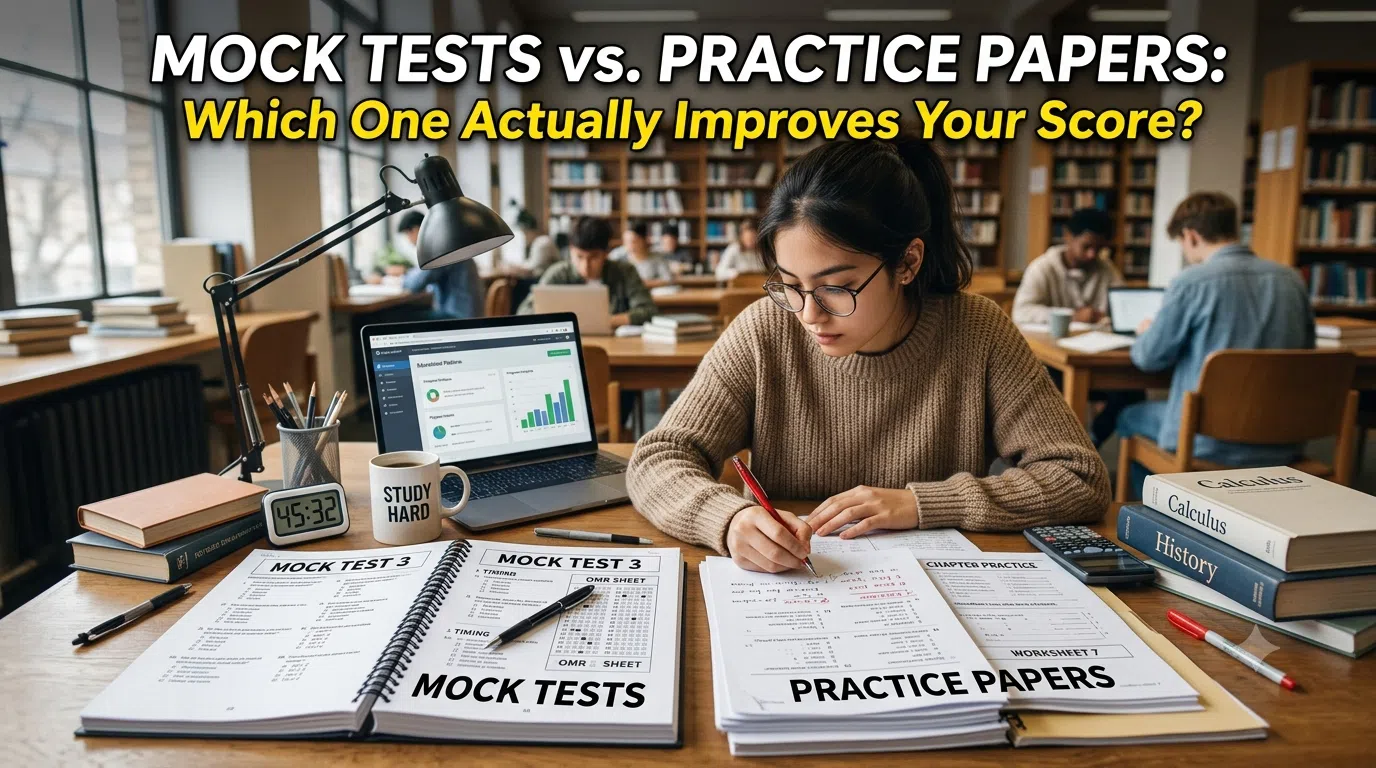
Ask any group of JEE or NEET aspirants how they're preparing, and you'll hear the same two words on repeat: mock tests and practice papers. Both are everywhere — in every study plan, every coaching brochure, every senior's advice. But here's the question students rarely stop to ask: are they actually doing the same job, or is one quietly doing more heavy lifting than the other?
Let's break it down.
What Practice Papers Are Really For
Practice papers are your repetition tool. They're built to reinforce a concept right after you've learned it. Solved a chapter on electrostatics? A practice paper on the same topic tells you, almost immediately, whether the concept has actually sunk in or just looked familiar while you were reading it.
Their biggest strength is focus. There's no clock pressure, no mixed-subject chaos — just you and one topic, working through problems until the logic clicks. That's exactly why practice papers are so heavily used in the early and middle stages of preparation, when the goal is building a solid foundation rather than testing speed.
Their limitation, though, is that they don't prepare you for the real exam environment. Real exams don't hand you one topic at a time.
What Mock Tests Actually Simulate
Mock tests are a different animal altogether. They compress the entire syllabus into one sitting, under the same time limit, same marking scheme, and same unpredictability you'll face on exam day. This is where students discover things practice papers never reveal — like running out of time on organic chemistry because they spent too long second-guessing a physics numerical.
Mock tests build three things practice papers simply can't: exam temperament, time management, and the instinct to skip a tough question instead of getting stuck on it. Students preparing at a serious IIT coaching in Bhopal will tell you the same thing — it's usually the weekly mock test, not the practice paper, that exposes where the real gaps are hiding.
So, Which One Actually Moves the Needle?
Honestly, it isn't a competition — it's a sequence. Practice papers build the raw material. Mock tests test whether that material holds up under pressure. Skip practice papers, and your fundamentals stay shaky. Skip mock tests, and you'll walk into the exam hall with strong concepts but no idea how to manage 180 minutes of relentless pressure.
This is precisely why structured programs matter. At a good NEET coaching classes in Bhopal, you'll notice the timetable isn't random — practice papers dominate the early months, and mock tests take over as the exam gets closer. That shift isn't accidental; it mirrors exactly how a student's brain needs to transition from "understanding" to "performing."
The Real Answer
If you're weeks away from your exam, mock tests deserve more of your time. If you're still building concepts, practice papers should come first. Most toppers don't pick a side — they use both, at the right stage, for the right reason.
Your score doesn't improve because you picked the "better" tool. It improves because you used each one exactly when it was supposed to matter.