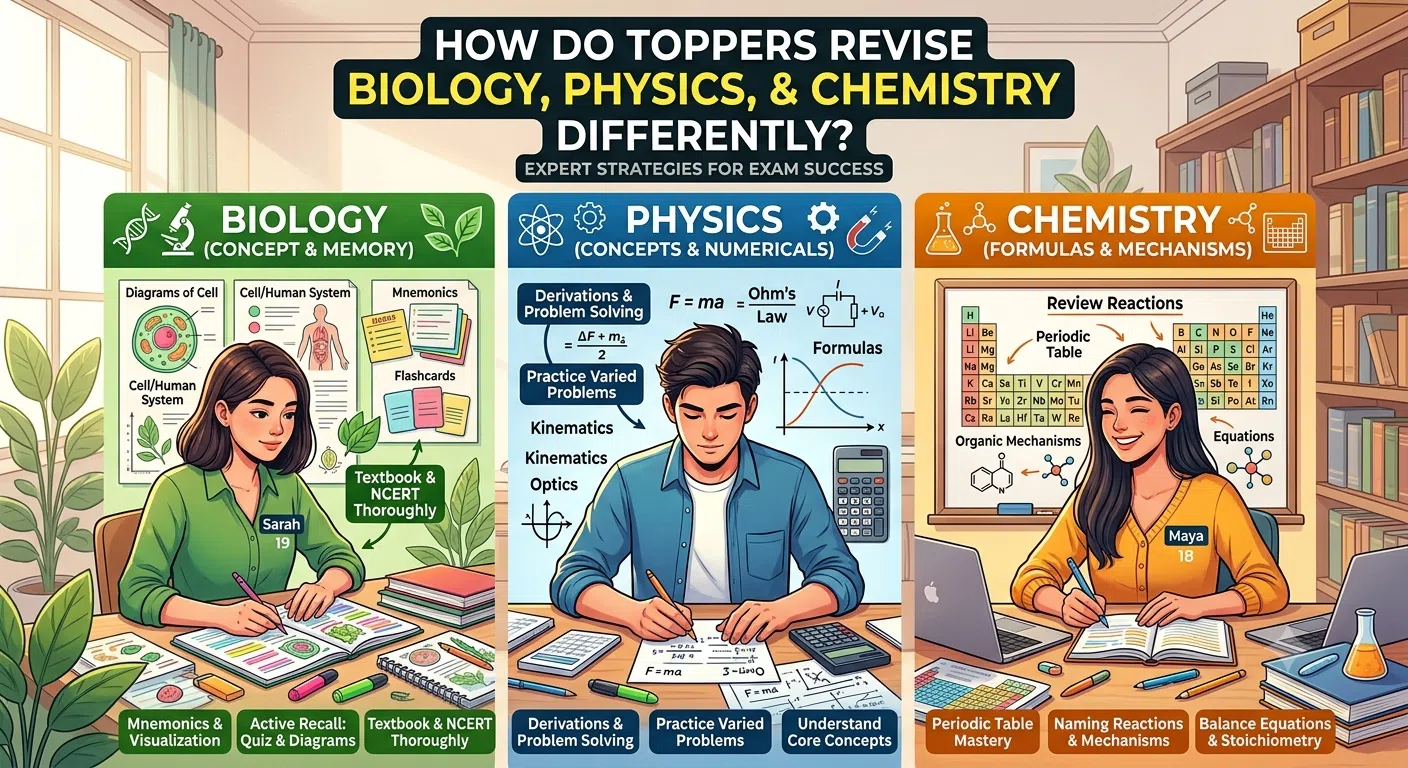
Walk into any NEET topper's study room a month before the exam, and you won't find one giant revision pile — you'll find three completely different systems running side by side. Ask any mentor at the top NEET classes in Bhopal, and they'll tell you the same thing: students who crack NEET with flying colours never treat Biology, Physics, and Chemistry as one subject wearing three different hats. Each one demands its own rhythm, and toppers figure that out early.
Biology: Repetition Over Reasoning
Biology is the scoring subject, and toppers know it. Their revision looks almost boringly repetitive — flashcards, diagrams redrawn from memory, NCERT lines read for the fifth or sixth time. They're not trying to "understand" Biology anymore by this stage; they're trying to make sure nothing slips through the cracks. Toppers often keep a running list of terms they keep forgetting — things like enzyme names, hormone functions, or obscure plant classifications — and revisit that list daily instead of rereading entire chapters. The goal isn't depth, it's recall speed. In an exam where every second counts, hesitating on a Biology question is often costlier than getting it wrong.
Physics: Problem Banks, Not Notes
Physics revision looks nothing like this. Toppers rarely reread Physics notes passively — instead, they solve. A lot. They maintain error logs, noting which type of problem tripped them up and why, then revisit that exact category a few days later to see if the mistake still happens. Formula sheets exist, but they're used as a last resort, not a primary tool. The real revision happens through repeated problem-solving under time pressure, because Physics rewards pattern recognition more than memorization. A topper preparing for Physics two weeks before NEET is usually knee-deep in previous years' papers, not rereading a chapter summary.
Chemistry: A Split Personality
Chemistry is where things get interesting, because it's really three subjects stitched together. Organic Chemistry gets treated almost like Biology — lots of reaction mechanisms flagged and revisited, named reactions drilled until they're automatic. Inorganic Chemistry gets treated like rote memory work, often condensed into short, ugly-looking personal notes that make sense to nobody but the student who wrote them. Physical Chemistry, meanwhile, gets the Physics treatment entirely — numerical practice, formula application, and timed problem sets. Toppers rarely revise Chemistry as one block; they split their day and give each branch its own dedicated slot.
The Common Thread
What ties all three together isn't the method — it's the honesty. Toppers are ruthless about tracking what they don't know, rather than comfortably revising what they've already mastered. They revise to expose weaknesses, not to feel good about their preparation.
If there's one lesson to take from this, it's that generic revision plans rarely work for NEET. Biology needs memory drilling, Physics needs problem-solving stamina, and Chemistry needs a split strategy altogether. Students enrolled in the top NEET classes in Bhopal often get this structured guidance built directly into their study plans — because knowing what to revise matters just as much as knowing how.