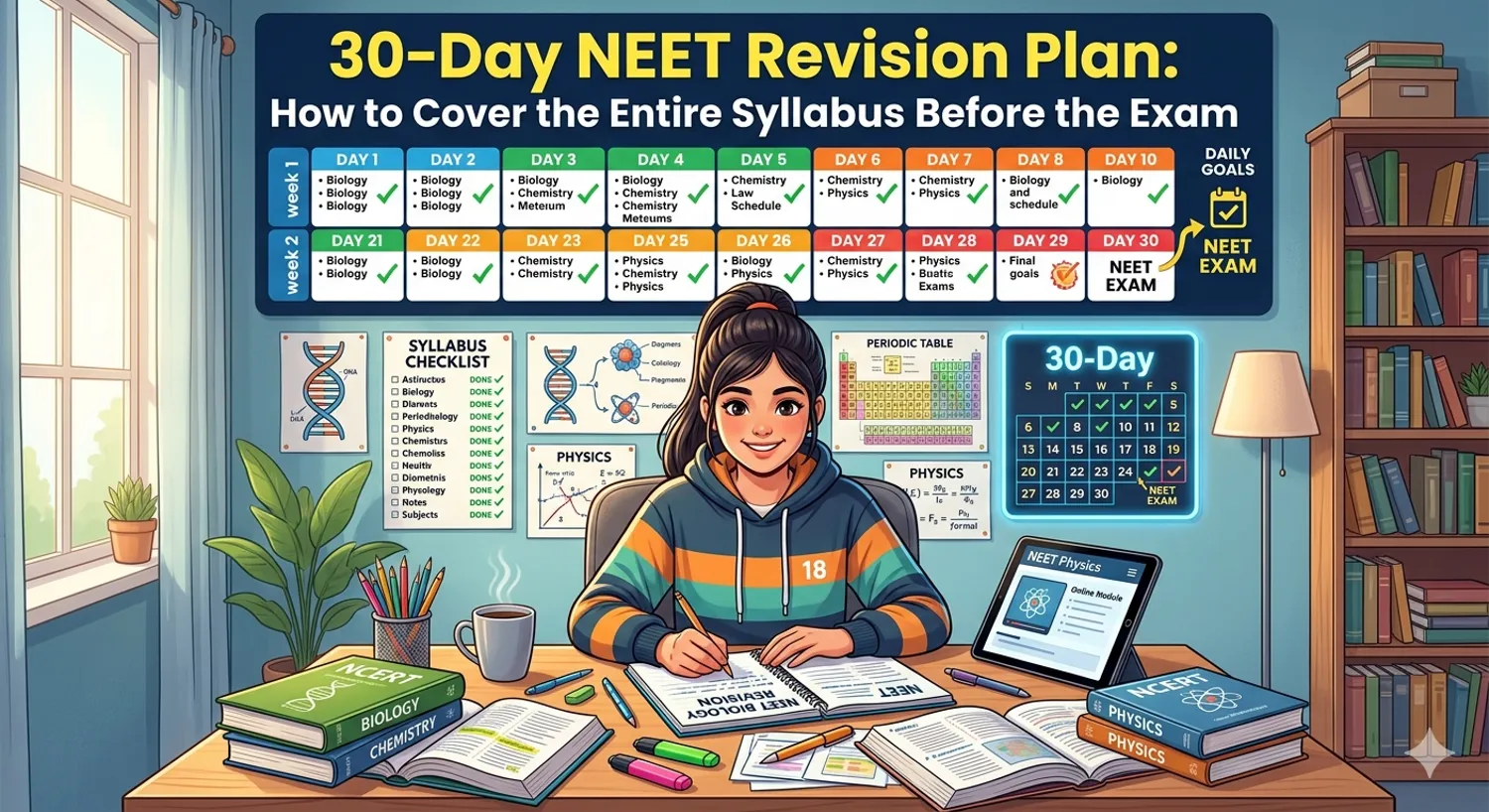
Picture this — it's exactly one month before NEET, and you're sitting at your desk surrounded by six months' worth of notes, textbooks with broken spines, and sticky tabs on practically every other page. You know you've studied. But somehow, the closer the exam gets, the less confident you feel.
Sound familiar?
That last-month panic is something almost every NEET aspirant goes through — even the toppers. The difference isn't who studied more. It's who revised smarter.
Here's how to do exactly that.
Days 1 to 7 — Stop and Look Back Before You Rush Forward
Most students make the mistake of diving straight into revision without figuring out what actually needs revisiting. Don't do that.
Spend the first two days just going through your old mock tests. Not to feel bad about your scores — but to spot the patterns. Which topics keep showing up in your wrong answers? Is it genuinely not knowing the concept, or is it reading the question too fast and making careless errors? Those are two very different problems with two very different fixes.
Once you have that clarity, build a rough priority list. High-weightage topics you're shaky on go right at the top. Topics you're already confident about? A quick skim will do.
Days 8 to 16 — Revise Like You Mean It, Not Like You're Re-Learning
Here's something nobody tells you enough: re-reading is not the same as revising.
Going through an entire chapter from scratch wastes time you simply don't have right now. Instead, work from your own notes, marked NCERT pages, and formula sheets. If you haven't made condensed notes yet, this week is your last real chance to build them.
Biology needs the most attention here — NCERT is practically the answer key for half the questions. Genetics, Human Physiology, Ecology — read those lines carefully. In Chemistry, don't just memorize organic reactions; understand why they happen. And for Physics, a formula without knowing when to apply it is useless. Practice application, not just recall.
Students at many NEET coaching in Bhopal centres follow a subject-rotation method during this phase — roughly 2 to 3 hours per subject daily — to avoid the burnout that comes from staring at one subject all day. It genuinely works.
Days 17 to 23 — Let Mock Tests Do the Heavy Lifting
By now, your brain has absorbed a lot. The job this week is to stress-test it.
Sit for a full-length mock every alternate day — phone away, timer running, no interruptions. Treat it like the real thing, because in many ways, it is. You're training your mind to think clearly under pressure, manage time instinctively, and recover quickly when a question stumps you.
What most people skip — and shouldn't — is the post-test review. Sit with your answers for at least 90 minutes after each test. Every wrong answer deserves a why. Every question you guessed on deserves a note. That review session is where the actual learning happens.
Days 24 to 30 — Slow Down on Purpose
This is the week to consolidate, not cram.
Light quizzes, diagram revision, quick formula runs — that's your zone now. The night before the exam is not the time to discover a new chapter. Your job in these final days is to make sure everything you already know stays accessible and fresh.
Sleep properly. Eat properly. These aren't soft suggestions — your memory consolidates during sleep. Skimping on rest in the final week is one of the most counterproductive things you can do.
The Bigger Picture
Thirty days is genuinely enough time to turn your preparation around — if you're intentional about it. Whether you've been studying independently or through NEET coaching in Bhopal, the fundamentals of good revision stay the same: know your gaps, be consistent, test yourself often, and don't let anxiety drive your schedule.
You've already done the hard part. This last month is just about showing up for it.