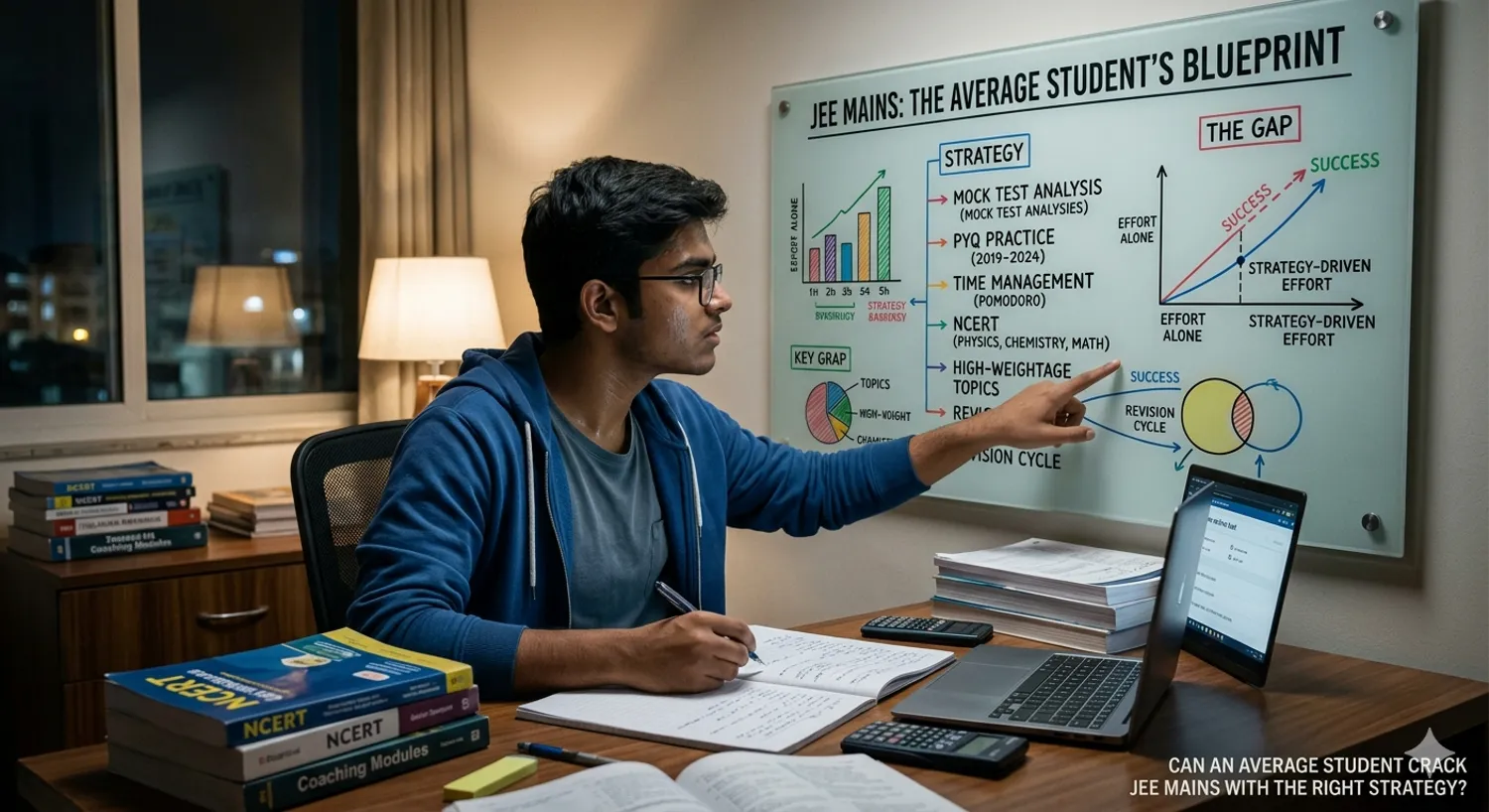
Let's be honest — most students preparing for JEE Mains are not prodigies. They're not the kid who solved calculus problems in Class 8 or the one who "just gets" thermodynamics without being taught. Most are regular students — decent at studies, maybe a little better at one subject than another, trying to figure out how to turn a dream into a result.
And here's the thing nobody says loudly enough: a lot of those regular students crack JEE Mains every single year.
So What's Actually Going On?
The idea that JEE Mains is only for the naturally brilliant is one of the most damaging myths in Indian competitive exam culture. It stops students from even trying properly. They half-prepare, half-believe, and then point to the result as proof they "weren't good enough."
But look at the actual numbers. Over a million students appear for JEE Mains annually. The ones who clear it aren't all from IIT-lineage families or elite schools. Many come from small towns, average coaching setups, and genuinely ordinary academic backgrounds. What they did differently wasn't smarter genes — it was smarter preparation.
The Part Where Strategy Actually Matters
Here's a thought experiment. Take two students. One studies 10 hours a day, covers every chapter, reads three reference books per subject, but never takes a single mock test and never goes back to revise what was studied three months ago. The other studies 5–6 hours, focuses hard on high-weightage topics, takes a mock test every week, and spends Sunday doing nothing but fixing mistakes from that test.
Who clears JEE Mains? Almost certainly the second student.
JEE Mains doesn't care how long you sat at your desk. It cares whether you can apply concepts correctly in 3 hours with a timer running and 90 questions staring at you. That's a specific skill. It needs to be trained specifically.
Also Read: Best NEET Coaching in Bhopal
What "Right Strategy" Actually Looks Like in Practice
Start with what's actually being tested.The JEE Mains syllabus is large but not infinite. Within it, some topics show up almost every year — Modern Physics, Organic Chemistry mechanisms, Coordinate Geometry, Integral Calculus. A student who genuinely masters these areas is already covering a massive chunk of the paper. Spending equal time on every chapter sounds disciplined but it's actually a mistake.
Understand before you memorise. Rote learning in JEE Mains is a trap. The questions are designed to test application, not recall. A student who understands why a formula works will handle twisted questions far better than someone who just plugged it in twenty times without understanding where it came from.
Mock tests are training, not just assessment.This is where most average students fall short — they treat mock tests as a way to check where they stand, take a look at the score, feel bad or good, and move on. That's the wrong approach entirely. The test itself isn't the point. The debrief is. Going through every mistake, understanding why it happened, and not repeating it — that's where improvement actually lives.
Revision beats new material every single time.At some point, adding new topics stops being useful. The brain needs repetition to retain things. A topic studied once in August and never seen again until January is as good as not studied. Simple, consistent revision — even 45 minutes a day dedicated to going back over older material — makes a difference that students rarely appreciate until it's exam season.
Why Coaching Matters — But Not in the Way People Think
There's a lot of pressure in families across Madhya Pradesh around the question of where to send kids for JEE prep. The conversation usually defaults to Kota. And look — Kota has produced results, no argument there. But it's not the only option, and for many students, it's not even the right one.
Good JEE Mains coaching in Bhopalhas improved dramatically over the years. The faculty quality, the test series, the structured doubt-clearing sessions — these are real, and students who use them well see real results. More importantly, staying in Bhopal means staying in a familiar environment. That's not a small thing. Stress management during JEE prep is underrated, and students who are comfortable, supported at home, and not dealing with adjustment issues in a new city often outperform their peers who relocated — purely because their mental bandwidth isn't being eaten up by everything else.
Coaching, whether in Bhopal or elsewhere, works best when a student comes to it with intention. The institute provides structure, accountability, and access to good teachers. The student has to bring consistency and the willingness to be corrected.
The Mindset Problem Nobody Talks About
Average students often carry a quiet, nagging self-doubt into their preparation. They see toppers on YouTube talking about their 700+ NTA scores and wonder if they're just built differently. They compare their mock test performance to classmates and spiral.
This is genuinely the hardest part of JEE prep — not the Physics, not the Organic Chemistry — but the sustained belief that the effort is worth it when results aren't immediately visible.
Progress in JEE prep is not linear. There will be weeks where mock scores don't improve. There will be chapters that just don't click for a while. Pushing through that without abandoning the strategy is what separates students who reach exam day in good shape from those who've already given up mentally even before writing the paper.
A Realistic Picture
Can an average student crack JEE Mains? Yes — with a serious caveat. It requires actual work. 5–6 focused hours a day, a well-prioritised study plan, weekly mock tests, regular revision, and timely help when something isn't making sense. That's not a light ask. But it's also not some impossible standard.
Students in Bhopal who are serious about JEE Mains have real resources available — quality JEE Mains coaching in Bhopal, strong peer groups, and teachers who have seen enough students to know what works. Using those resources intelligently, without letting comparison or anxiety run the show, is the actual game.
Being average at the start of Class 11 means almost nothing about where things end up in April of Class 12.