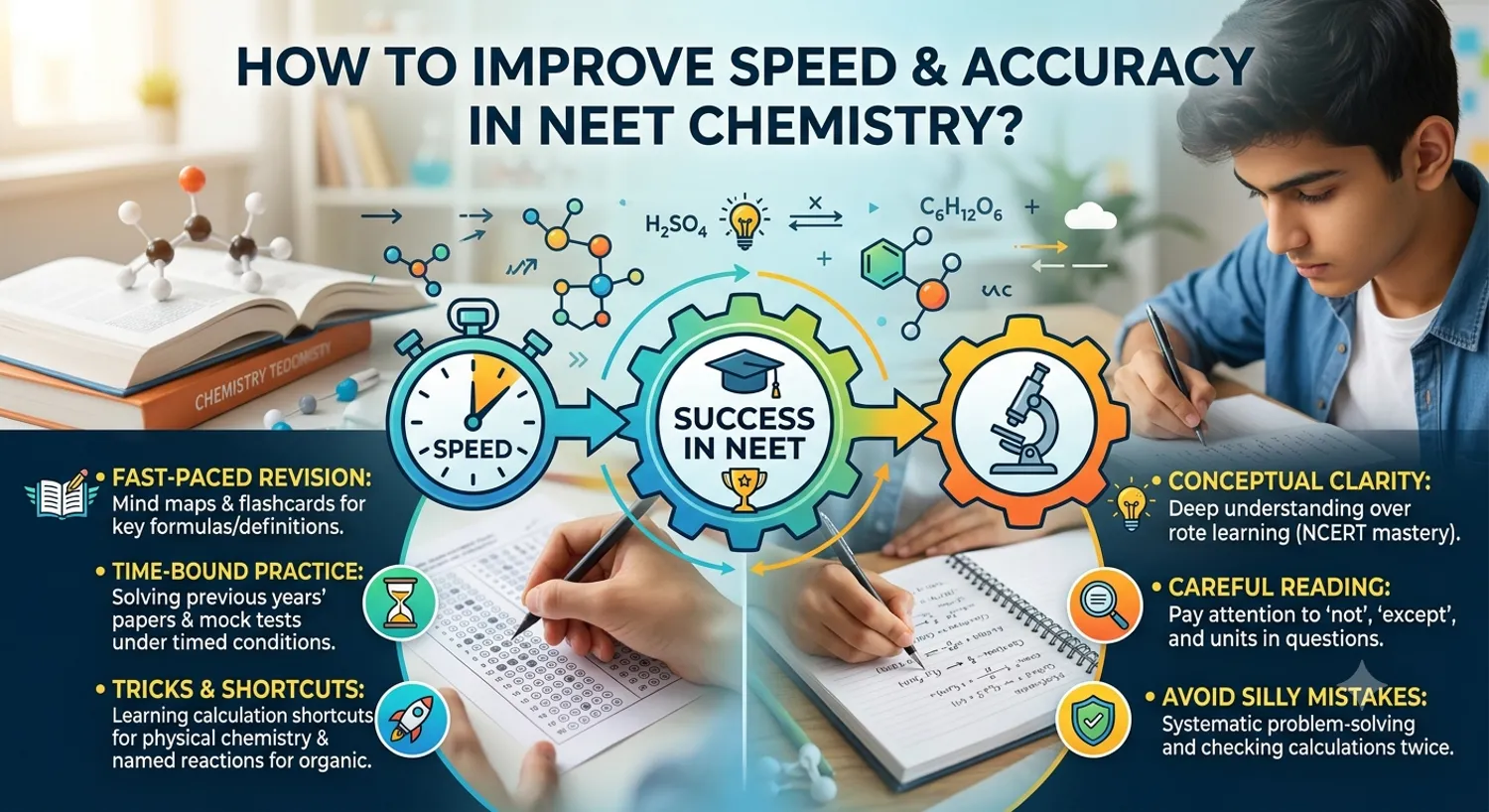
If you've ever walked out of a NEET mock test wondering how you ran out of time despite knowing the answers, you're not alone. Chemistry is often called the "scoring subject" of NEET, but only if you can answer fast and get it right. Students preparing through a good NEET coaching in Bhopal often say the same thing: it's not about knowing more, it's about retrieving what you know, faster and cleaner.
So how do you actually get there? Let's break it down.
Stop Treating All Three Sections the Same Way
NEET Chemistry has three distinct personalities — Physical, Organic, and Inorganic — and each demands a different kind of speed.
Physical Chemistry rewards formula fluency. If you're still pausing to recall the ideal gas equation mid-exam, that's a red flag. Drill formulas until they're reflexive, not remembered.
Organic Chemistry rewards pattern recognition. Reaction mechanisms aren't meant to be memorized line by line; once you understand whya reaction happens, predicting the product becomes almost automatic.
Inorganic Chemistry rewards pure recall. This is where NCERT becomes your best friend. No shortcuts here — just repetition and revision.
Trying to study all three the same way is probably one reason your speed feels inconsistent.
Accuracy Comes Before Speed, Not After
A common mistake students make is chasing speed first, assuming accuracy will follow. It rarely does. Instead, get accurate first through untimed practice, then gradually introduce a clock. Once your fundamentals are solid, speed becomes a natural byproduct — not something you force.
Build a Formula and Reaction Sheet — And Actually Use It
Most students make one, then forget it exists. Instead, keep it visible — stick it near your study desk, glance at it every day, and quiz yourself randomly. Spaced repetition beats last-minute cramming every single time.
Practice With a Timer, But Analyze Without One
Timed mock tests are essential, but the real growth happens afterward. When reviewing, don't just check right or wrong — ask why a question took longer than it should have. Was it a formula you hesitated on? A concept you half-remembered? That's the gap to close before your next test.
Don't Ignore NCERT Line-by-Line Reading
A large chunk of NEET Chemistry questions, especially Inorganic and parts of Organic, are directly picked from NCERT textbooks. Students who skip this in favor of reference books often lose easy marks simply because they overlooked a subtle NCERT line.
Get Structured Feedback, Not Just More Practice
Solving endless questions without expert feedback can plateau your progress. This is where structured mentorship helps — identifying blind spots you can't see on your own. Many aspirants enrolled in NEET coaching in Bhopal find that regular mock analysis and doubt-clearing sessions shave off precious seconds per question, which adds up significantly over a 180-question paper.
Speed and accuracy in Chemistry aren't separate skills — they grow together when your concepts are clear and your practice is consistent. Small, steady improvements every week matter far more than one intense study session before the exam.