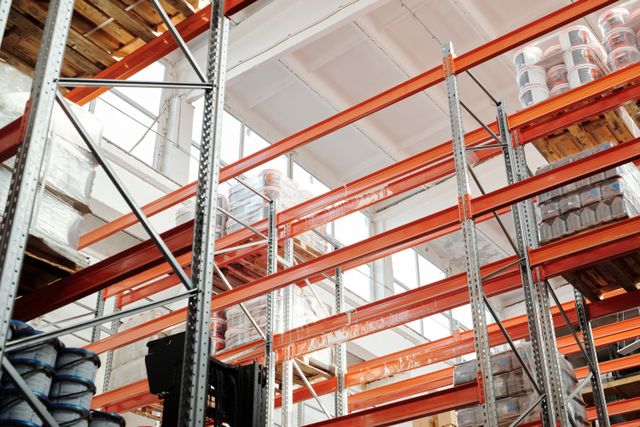
Warehouse operations have changed dramatically over the past decade. Growing customer expectations, faster shipping requirements, labor shortages, and rising operating costs have pushed businesses to rethink how inventory is stored and retrieved. Traditional storage methods that once worked well are often no longer sufficient for today's high-volume distribution environments.
This is where ASRS systems have become an increasingly valuable investment. Automated Storage and Retrieval Systems help warehouses improve efficiency, maximize storage space, increase inventory accuracy, and reduce manual labor by automating the movement of products throughout the facility.
Whether serving manufacturing plants, e-commerce fulfillment centers, pharmaceutical companies, or cold storage operations, ASRS technology is helping businesses operate faster while making better use of available warehouse space.
What Is an ASRS System?
An Automated Storage and Retrieval System (ASRS) is a warehouse automation solution that stores, organizes, and retrieves inventory using computer-controlled equipment rather than relying primarily on manual labor.
Instead of warehouse employees traveling through long aisles searching for products, automated equipment performs much of the movement. Inventory is stored in predefined locations, and when an item is requested, the system automatically retrieves it and delivers it to the appropriate workstation or shipping area.
These systems combine specialized storage structures, automated machinery, sensors, robotics, and warehouse software into one coordinated solution. Every inventory movement is tracked electronically, giving businesses real-time visibility into inventory locations and stock levels.
The result is a warehouse that operates more efficiently with greater consistency and fewer opportunities for human error.
Why Warehouse Automation Continues to Grow
Modern warehouses face challenges that were far less common just a few years ago. Online shopping has dramatically increased order volumes while customers expect faster deliveries than ever before. At the same time, many businesses struggle to recruit and retain warehouse workers.
Adding more employees or expanding warehouse buildings is often expensive and difficult. ASRS systems provide another option by allowing businesses to increase storage capacity and throughput without proportionally increasing labor requirements.
Automation also creates more predictable operations. Unlike manual processes, automated equipment performs repetitive tasks consistently throughout the day, reducing delays while improving order accuracy.
For many companies, warehouse automation has shifted from being a competitive advantage to becoming an operational necessity.
How ASRS Systems Work
Although different ASRS technologies vary in design, they all follow the same general principle.
Products are assigned specific storage locations within the warehouse. When inventory arrives, the automated system places each item into its designated position using cranes, robotic shuttles, lifts, conveyors, or autonomous robots.
When inventory is needed for production, replenishment, or shipping, warehouse software identifies the storage location and directs the automated equipment to retrieve the product. The item is then transported directly to an operator, conveyor system, packing station, or outbound shipping area.
Because every movement is digitally tracked, inventory records remain highly accurate while reducing the need for manual counting and searching.
Different Types of ASRS Systems
Warehouse automation comes in many forms, with each system designed to solve different storage challenges.
Pallet shuttle systems are commonly used for high-density pallet storage. Battery-powered shuttles move pallets through deep storage lanes, eliminating the need for forklifts to enter the rack system. These solutions work particularly well for warehouses storing large quantities of similar products.
Unit load ASRS systems use automated stacker cranes to retrieve full pallets stored in tall warehouse racks. These systems maximize vertical storage while efficiently handling heavy loads throughout large distribution centers and manufacturing facilities.
Mini-load systems focus on lightweight products stored in totes, cartons, or small containers. Rather than retrieving entire pallets, they deliver individual storage bins directly to operators, making them popular in e-commerce, pharmaceutical, and electronics industries.
Vertical Lift Modules (VLMs) utilize enclosed cabinets with automated trays that bring inventory to ergonomic access openings. By making full use of vertical storage, VLMs significantly reduce floor space requirements while improving inventory organization.
Horizontal and vertical carousels rotate stored inventory directly to workers, minimizing walking distances while increasing picking speed. These systems are particularly effective for small parts storage and maintenance departments.
Robotic cube storage systems represent one of the newest developments in warehouse automation. Autonomous robots retrieve storage bins from dense cube-like grids, eliminating traditional warehouse aisles while creating exceptional storage density and scalability.
Benefits of ASRS Systems
One of the biggest reasons companies invest in ASRS technology is improved space utilization.
Traditional pallet racking requires wide aisles to accommodate forklifts and operators. Automated systems reduce or eliminate many of these aisles, allowing significantly more inventory to be stored within the same building footprint. Many warehouses also take advantage of greater vertical storage heights that would be impractical using conventional equipment.
Labor efficiency also improves considerably. Warehouse employees spend much less time walking between storage locations because inventory is automatically delivered where it is needed. This allows workers to process more orders while reducing physical strain.
Inventory accuracy increases because every storage location is monitored electronically. Automated systems know exactly where products are located, reducing misplaced inventory and minimizing costly picking errors.
Order fulfillment becomes faster as well. Goods-to-person systems eliminate unnecessary travel, allowing operators to focus entirely on picking, packing, and shipping customer orders.
Warehouse safety also improves. Fewer forklifts operating throughout storage aisles reduce the likelihood of collisions, product damage, and workplace accidents. Automated equipment performs many repetitive movements that traditionally exposed workers to greater physical risk.
Industries That Benefit from ASRS
ASRS systems are used across numerous industries because storage challenges vary widely depending on the products being handled.
E-commerce fulfillment centers rely heavily on automation to process thousands of customer orders quickly while maintaining high accuracy rates.
Manufacturing facilities use ASRS systems to store raw materials, work-in-progress inventory, and finished products while ensuring production lines receive materials when needed.
Cold storage warehouses benefit from automation because it minimizes employee exposure to freezing temperatures while maximizing expensive refrigerated storage space.
Healthcare organizations and pharmaceutical companies depend on accurate inventory management for medications and medical supplies, making automated retrieval systems especially valuable.
Automotive manufacturers, electronics companies, food distributors, retail distribution centers, and third-party logistics providers also use ASRS technology to improve operational efficiency.
Factors to Consider Before Investing
Although ASRS offers significant advantages, selecting the right system requires careful planning.
Warehouse size, ceiling height, product dimensions, SKU count, inventory turnover, throughput requirements, and available floor space all influence which automation solution will provide the greatest value.
Software integration is another important consideration. Most ASRS systems communicate directly with Warehouse Management Systems (WMS) or Enterprise Resource Planning (ERP) platforms, allowing inventory data to remain synchronized across the business.
Companies should also evaluate future growth plans before making an investment. Choosing scalable automation allows additional storage capacity or retrieval equipment to be added as operations expand.
Finally, organizations should consider total cost of ownership rather than focusing solely on initial purchase price. Labor savings, increased storage capacity, improved accuracy, lower product damage, and higher productivity often generate substantial long-term returns.
The Future of ASRS Technology
Warehouse automation continues to evolve rapidly as robotics, artificial intelligence, machine learning, and advanced warehouse software become increasingly sophisticated.
Future ASRS systems will likely include smarter inventory optimization, predictive maintenance, autonomous decision-making, and greater integration with broader supply chain technologies. As businesses continue pursuing faster fulfillment and greater operational efficiency, automated storage systems will play an even larger role in warehouse design.
Companies investing in automation today are not simply purchasing new equipment—they are building warehouses capable of adapting to changing customer expectations, labor markets, and supply chain demands.
Conclusion
ASRS systems have transformed the way modern warehouses manage inventory by combining intelligent software with automated storage and retrieval equipment. These solutions improve storage density, increase inventory accuracy, reduce labor requirements, and accelerate order fulfillment while making better use of available warehouse space.
As distribution networks continue to grow and operational demands become more complex, warehouse automation provides businesses with a practical path toward higher productivity and long-term scalability. Whether storing pallets, cartons, small parts, or individual products, the right ASRS solution can help create a safer, faster, and more efficient warehouse that is prepared for future growth.