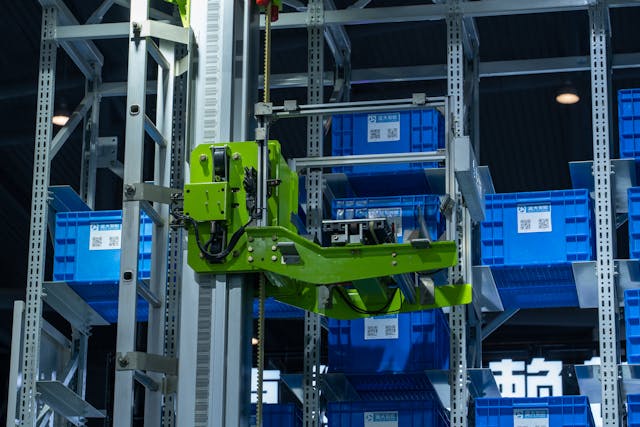
Warehouses are no longer simply large buildings filled with rows of racks and forklifts moving inventory from one location to another. The demands of modern logistics have changed the way facilities operate. Faster shipping expectations, labor shortages, rising operational costs, and growing inventory complexity have pushed businesses toward automation at a pace that would have seemed unrealistic only a decade ago.
At the center of this transformation is the automated storage and retrieval system, more commonly known as ASRS. These systems combine software, robotics, storage structures, and automated handling equipment to move products through a warehouse with minimal manual intervention. Instead of workers traveling long distances to retrieve products, ASRS technology brings inventory directly to operators or automatically transfers it through the facility.
The result is a warehouse operation that is faster, more accurate, and significantly more space efficient than traditional storage methods.
What an ASRS System Actually Does
An ASRS system is designed to automatically place inventory into defined storage locations and retrieve it when needed. While the exact equipment varies depending on the application, every system relies on three core elements working together.
The first is the storage structure itself, which may include high-bay racking, shelving, tray systems, bins, or dense grid layouts. The second component is the retrieval mechanism. This can take the form of cranes, robotic shuttles, carousels, vertical lifts, or autonomous robots depending on the type of inventory being handled. The third component is the software layer, which coordinates movement, tracks inventory, and communicates with warehouse management systems and ERP platforms.
Together, these technologies create an integrated system capable of handling repetitive storage and retrieval tasks with remarkable speed and consistency.
Why ASRS Systems Have Become So Important
The rapid growth of e-commerce and high-volume distribution has changed expectations around warehouse performance. Businesses are now expected to process more orders in less time while maintaining extremely high levels of inventory accuracy.
Traditional warehouse models struggle to keep up with these demands because so much time is lost through manual travel. Operators spend a large portion of their shift walking, driving forklifts, locating products, and navigating crowded aisles.
ASRS systems eliminate much of that wasted movement. Inventory is stored and retrieved automatically, reducing travel time and allowing operators to focus on verification, packing, and order processing.
At the same time, automated systems make far better use of available space. Many ASRS installations use vertical storage that extends well above the height practical for conventional forklift operations. By reducing aisle requirements and maximizing building height, facilities can dramatically increase storage density without expanding their footprint.
Automated Pallet Shuttle Systems
One of the most widely used forms of ASRS technology is the automated pallet shuttle system. These systems use battery-powered shuttles that move pallets along rails within deep storage lanes.
Unlike drive-in racking, forklifts do not enter the storage lanes themselves. Instead, operators place pallets at the lane entrance, and the shuttle carries the load to its designated position. Retrieval works in reverse, with the shuttle bringing pallets back to the front access point.
Automated pallet shuttles are especially effective in high-density environments such as cold storage facilities, where minimizing aisle space reduces refrigeration costs. They are also common in operations handling large quantities of similar products with relatively low SKU counts.
Because the system prioritizes density over selectivity, it is generally less suitable for warehouses requiring constant access to a wide variety of SKUs.
Pallet and Unit Load ASRS
Pallet and unit load ASRS systems are among the largest and most visually impressive warehouse automation solutions. These systems use rail-guided stacker cranes that move vertically and horizontally through high-bay storage structures.
Some facilities using this technology exceed 100 feet in height, allowing companies to maximize cubic storage capacity rather than relying solely on floor space. The cranes automatically retrieve and place palletized loads, often weighing several thousand pounds.
Configurations may range from single-deep to triple-deep storage depending on the balance required between density and accessibility.
These systems are particularly effective in manufacturing operations, bulk storage facilities, and large distribution centers where inventory volume is extremely high. However, buildings with low ceiling heights or rapidly changing SKU profiles may not benefit as much from this approach.
Mini-Load ASRS and Goods-to-Person Fulfillment
As order fulfillment has shifted toward smaller and more frequent orders, mini-load ASRS systems have become increasingly popular. These systems are designed for lightweight inventory such as cartons, totes, pharmaceutical products, and small components.
Mini-load systems use cranes, robotic arms, or shuttle systems to retrieve inventory and deliver it directly to operator workstations. This goods-to-person model eliminates the need for employees to travel through aisles searching for products.
The impact on efficiency can be dramatic. Picking accuracy improves because the system delivers the correct item directly to the workstation, and throughput increases because operators remain stationary while inventory moves automatically.
Industries such as e-commerce, healthcare, and parts distribution rely heavily on mini-load systems because of their ability to process high SKU counts quickly and accurately.
ASRS Carousels and Vertical Lift Modules
Not every automated system requires massive cranes or high-rise structures. ASRS carousels and vertical lift modules focus on compact, high-density storage for smaller inventory items.
Horizontal and vertical carousels rotate stored inventory to an operator station, reducing travel time and increasing picking speed. These systems are particularly useful in environments handling small parts, kitting operations, or maintenance inventory.
Vertical lift modules, often called VLMs, take this concept further by storing trays vertically within an enclosed structure. An inserter and extractor mechanism retrieves trays and delivers them to an ergonomic access opening.
One of the key advantages of VLMs is their ability to dynamically adjust tray spacing based on inventory height. This allows businesses to store variable-sized products more efficiently than fixed shelving systems.
The tall, narrow design also creates impressive storage density while occupying a relatively small footprint.
Robotic Cube and Pod Storage Systems
Some of the newest ASRS technologies are robotic cube and pod storage systems. These systems use fleets of autonomous robots operating on top of dense storage grids filled with bins or totes.
Rather than traveling through traditional aisles, robots retrieve inventory directly from the storage grid and deliver it to workstations. The modular design allows throughput to scale simply by adding more robots.
This flexibility makes robotic storage especially attractive for e-commerce and third-party logistics operations with highly variable order volumes.
Because the system eliminates fixed aisle structures, storage density can be exceptionally high while maintaining fast retrieval speeds.
Where ASRS Systems Deliver the Strongest Return
ASRS systems provide the greatest value in operations with repetitive, high-volume activity and strong accuracy requirements. Warehouses operating across multiple shifts often see significant benefits because automation allows throughput to increase without proportional labor growth.
Cold storage facilities frequently achieve strong returns because dense automated systems reduce refrigerated space requirements and minimize employee exposure to freezing environments.
Pharmaceutical operations benefit from the inventory control and traceability that automated systems provide. Automotive parts distribution, manufacturing buffer storage, and large-scale retail fulfillment are also common applications.
However, ASRS is not always the right solution. Facilities with low throughput, constantly changing layouts, or short-term occupancy plans may struggle to justify the investment. Automated systems require significant planning, infrastructure, and long-term operational commitment.
The Importance of Software and Integration
The physical automation equipment often receives the most attention, but the software layer is equally important. Warehouse control systems coordinate movement between cranes, shuttles, conveyors, and robotic systems while maintaining communication with warehouse management software.
Successful integration ensures inventory data remains accurate in real time. It also allows facilities to monitor system performance, manage replenishment, and optimize workflow across the operation.
Without strong software integration, even the most advanced automation equipment cannot perform efficiently.
Planning for Long-Term Scalability
One of the biggest mistakes companies make when investing in automation is designing only for current demand. Warehouses evolve, order profiles change, and customer expectations continue to increase.
Modern ASRS systems are increasingly designed with scalability in mind. Modular shuttle systems, robotic grids, and expandable storage layouts allow operations to grow without requiring complete redesigns.
Planning for future growth from the beginning often prevents expensive retrofits later.
The Future of Warehouse Automation
ASRS systems are no longer considered niche technology reserved for massive distribution centers. Advancements in robotics, software, and automation have made these systems more accessible across a wide range of industries.
As labor challenges continue and customer expectations rise, automation will play an even larger role in warehouse operations. Facilities that once relied entirely on forklifts and manual picking are steadily transitioning toward intelligent, connected systems capable of operating around the clock with greater speed and accuracy.
The future warehouse will not simply store inventory. It will function as a coordinated automation ecosystem where software, robotics, and storage infrastructure work together seamlessly to support modern supply chain demands.