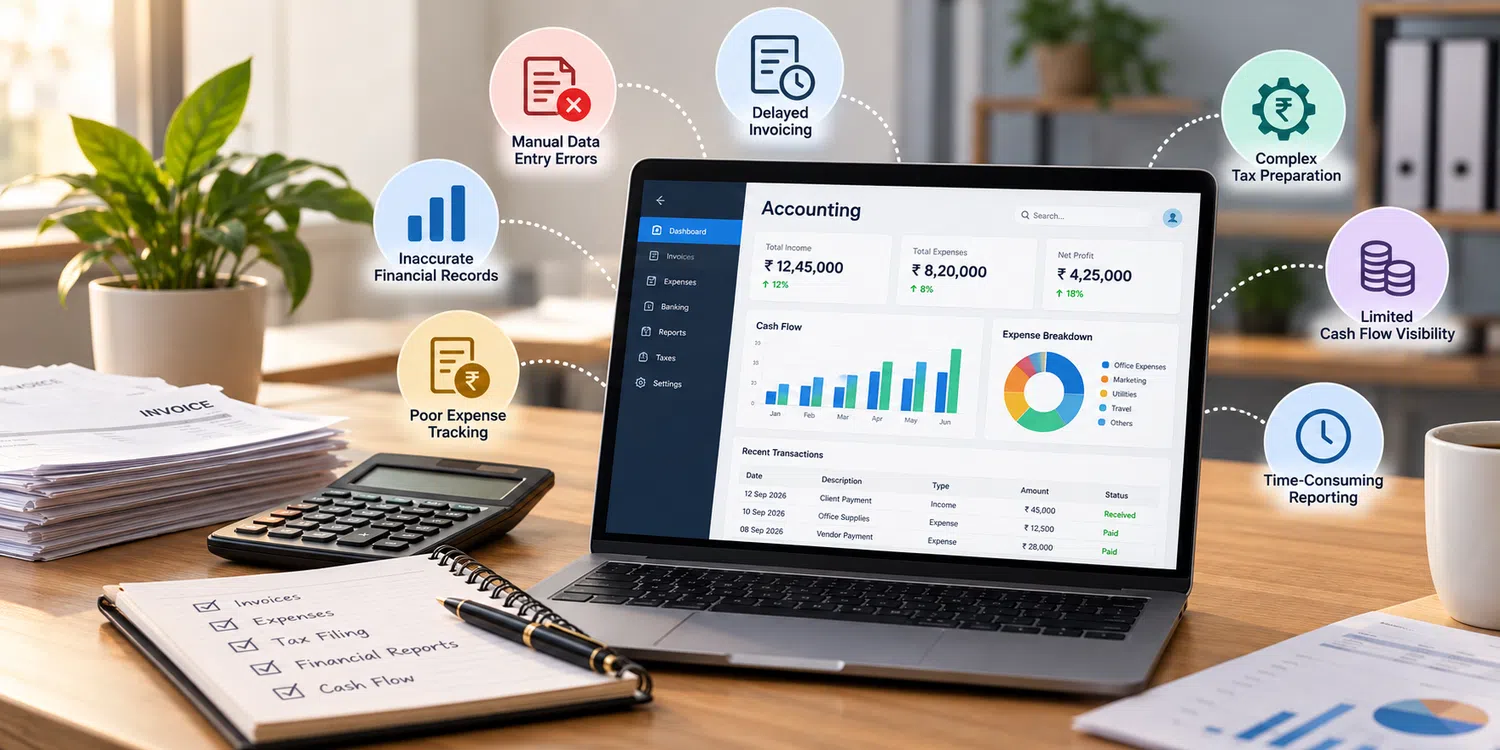
Managing business finances accurately is essential for every organisation, regardless of its size or industry. Accounting involves much more than recording sales and expenses. Businesses need to manage invoices, payments, taxes, payroll-related records, cash flow, financial reports, and many other financial activities. When these tasks are handled manually, accounting teams can spend a significant amount of time entering data, checking records, correcting errors, and preparing reports.
As a business grows, these challenges can become more difficult to manage. Spreadsheets and manual bookkeeping may work for a small number of transactions, but they can become complicated when transaction volumes increase. This is where accounting software can help. By automating routine financial processes and keeping important information organised in one place, accounting software can reduce several common accounting problems.
1. Manual Data Entry and Repetitive Work
One of the most common accounting problems businesses face is excessive manual data entry. Employees may need to enter information from invoices, receipts, sales records, purchase orders, and bank transactions into spreadsheets or accounting records.
Repeatedly entering the same information increases the workload for accounting teams and creates opportunities for mistakes. A simple typing error can result in an incorrect amount, duplicate entry, or inaccurate financial record.
Accounting software can reduce repetitive work by allowing businesses to record and organise financial transactions digitally. Depending on the software and its integrations, information can also be imported from other business systems, reducing the need to enter everything manually.
This gives accounting teams more time to focus on reviewing financial information and supporting business decisions rather than spending most of their time on repetitive administrative tasks.
2. Inaccurate Financial Records
Accuracy is one of the most important requirements in accounting. Incorrect figures can affect financial reports, cash flow analysis, tax calculations, budgeting, and business planning.
Manual accounting processes can lead to common errors such as incorrect calculations, duplicate entries, missing transactions, and misplaced records. Identifying these mistakes can also take considerable time, especially when a business has a large number of transactions.
Accounting software can perform calculations automatically and maintain structured financial records. It can also make it easier to review transaction histories and identify inconsistencies.
Although software does not eliminate the need for human review, it can reduce many errors associated with manual calculations and repetitive data entry.
3. Difficulty Tracking Invoices and Payments
Businesses need to know which invoices have been issued, which customers have paid, and which payments are still outstanding. Managing this information manually can become difficult when a company deals with many customers.
Without an organised system, invoices may be overlooked or payment follow-ups may be delayed. This can affect the company's cash flow and make it harder to understand how much money is expected from customers.
Accounting software can help businesses create, organise, and track invoices in a centralised system. Finance teams can monitor outstanding invoices and review payment information without searching through multiple spreadsheets or files.
Better invoice tracking can also help businesses maintain a more organised accounts receivable process.
4. Poor Expense Management
Tracking business expenses is another area where companies often face difficulties. Expenses can come from office supplies, travel, utilities, software subscriptions, equipment, marketing, transportation, and many other activities.
When expenses are recorded manually, some transactions may be missed or categorised incorrectly. Employees may also have difficulty locating receipts when they need to verify a transaction.
Accounting software can provide a structured way to record and categorise expenses. Businesses can maintain digital records of financial transactions and review spending by category.
This makes it easier for managers to understand where money is being spent and identify areas where expenses may need closer attention.
5. Limited Visibility into Cash Flow
Cash flow is important because a profitable business can still face financial pressure if it does not have enough available cash to meet its short-term obligations.
When financial information is stored across spreadsheets, invoices, bank records, and separate documents, getting a clear view of cash flow can be difficult. Business owners may have to collect information from several sources before understanding their current financial position.
Accounting software can bring important financial information together in one system. Businesses can use available reports to review income, expenses, receivables, payables, and other financial information.
Having more organised financial data can help business owners make better-informed decisions about spending, payments, and future financial requirements.
6. Time-Consuming Financial Reporting
Financial reports help businesses understand their performance. Common reports include profit and loss statements, balance sheets, cash flow reports, sales summaries, and expense reports.
Preparing these reports manually can require significant effort. Accounting teams may need to collect information from different files, check calculations, format the data, and update reports regularly.
Accounting software can simplify this process by organising financial transactions and generating reports based on recorded data. Instead of preparing every report from scratch, finance teams can use available reporting features to access relevant information more efficiently.
This can be particularly useful for businesses that need regular financial updates for management meetings and planning.
7. Difficulty Preparing for Tax Compliance
Tax-related accounting requires accurate and organised financial records. Businesses need to maintain appropriate transaction information and ensure that financial data is available when preparing tax-related documents.
Poor record-keeping can make tax preparation more stressful and increase the time required to review financial information. Missing invoices, incorrectly categorised expenses, or incomplete records can create additional work.
Accounting software can help businesses maintain organised records throughout the year. By keeping financial transactions and supporting information in one system, businesses can make it easier for their accounting teams or professional advisors to review the required data.
Software should support the applicable tax requirements for the business, and businesses should still rely on qualified professionals when specific tax advice or compliance interpretation is required.
8. Difficulty Managing Accounts Payable
Accounts payable refers to money a business owes to suppliers and other parties. Businesses need to keep track of bills, payment due dates, supplier information, and payment status.
When these records are maintained manually, it can be difficult to know which bills are due and when payments need to be made. Delayed payments can create unnecessary administrative problems and affect relationships with suppliers.
Accounting software can help organise supplier bills and payment records. Finance teams can review outstanding obligations and maintain a clearer view of upcoming payments.
A structured accounts payable process can help businesses manage their financial responsibilities more systematically.
9. Scattered Financial Information
Another common problem is having financial information stored in different locations. One employee may maintain an expense spreadsheet, another may manage invoices, while bank information and receipts may be stored separately.
This fragmented approach makes it harder to get a complete view of the company's finances. It can also create challenges when employees need to find historical information.
Accounting software provides a central system for managing many accounting activities. Depending on the solution, businesses can manage transactions, invoices, expenses, reports, and other financial records from the same platform.
Centralised information can improve organisation and make financial data easier to access.
10. Lack of Timely Financial Information
Business decisions often need to be made quickly. Owners and managers may need to know current sales, expenses, outstanding payments, or available cash before making operational decisions.
If financial information is updated manually at the end of each week or month, decision-makers may be working with outdated information.
Accounting software can help businesses maintain financial records more consistently. Many systems provide dashboards and reports that make important financial information easier to review.
Timely access to financial data can support better budgeting, planning, and financial management.
11. Challenges as the Business Grows
A manual accounting process that works for a small business may become difficult to maintain as transaction volumes increase. More customers, suppliers, employees, products, and sales transactions naturally create more financial records.
Without a scalable accounting process, finance teams may spend increasingly more time maintaining spreadsheets and checking data.
Accounting software can provide a more structured foundation for financial management. Businesses can select solutions with features that match their current requirements while considering future growth.
The goal is not simply to automate accounting but to create a process that can continue to support the organisation as its financial activities become more complex.
12. Difficulty Maintaining Consistent Records
Consistency is important when multiple people are involved in accounting. Different employees may use different spreadsheet formats, naming conventions, or methods for categorising transactions.
This can make financial information harder to analyse and review.
Accounting software provides predefined structures for recording financial information. Standardised processes can make it easier for accounting teams to maintain consistent records and follow the same workflow.
Businesses can also establish user permissions and approval processes where supported by their chosen software, helping create greater control over financial activities.
Conclusion
Accounting challenges can affect businesses at every stage of growth. Manual data entry, inaccurate records, invoice tracking, expense management, cash flow visibility, financial reporting, tax preparation, accounts payable, and scattered information are some of the problems that can become increasingly difficult to manage as transaction volumes grow.
Accounting software can address many of these challenges by organising financial information, automating repetitive activities, reducing manual calculations, improving reporting, and making important financial data easier to access.
However, software should be viewed as a tool that supports good accounting practices rather than a complete replacement for financial oversight. Businesses still need accurate data, appropriate processes, regular reviews, and professional advice where required.
Choosing accounting software that matches the company's size, industry, transaction volume, reporting requirements, integrations, and future plans can help create a more organised financial management system. With the right approach, businesses can spend less time dealing with repetitive accounting tasks and more time using financial information to support responsible business planning and growth.