Market Overview
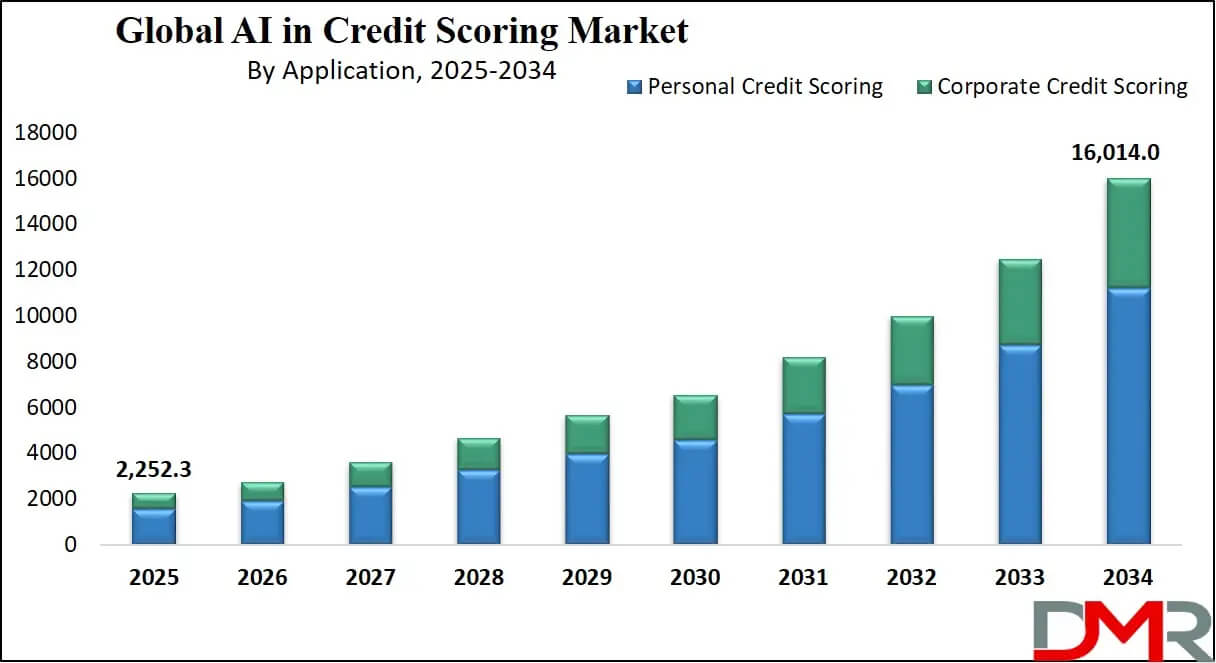
The global Artificial Intelligence In Credit Scoring Market is expected to reach a value of USD 2,252.3 Mn in 2025 and is further anticipated to reach a market value of USD 16,014.0 Mn by 2034, growing at a CAGR of 24.4% during the forecast period.
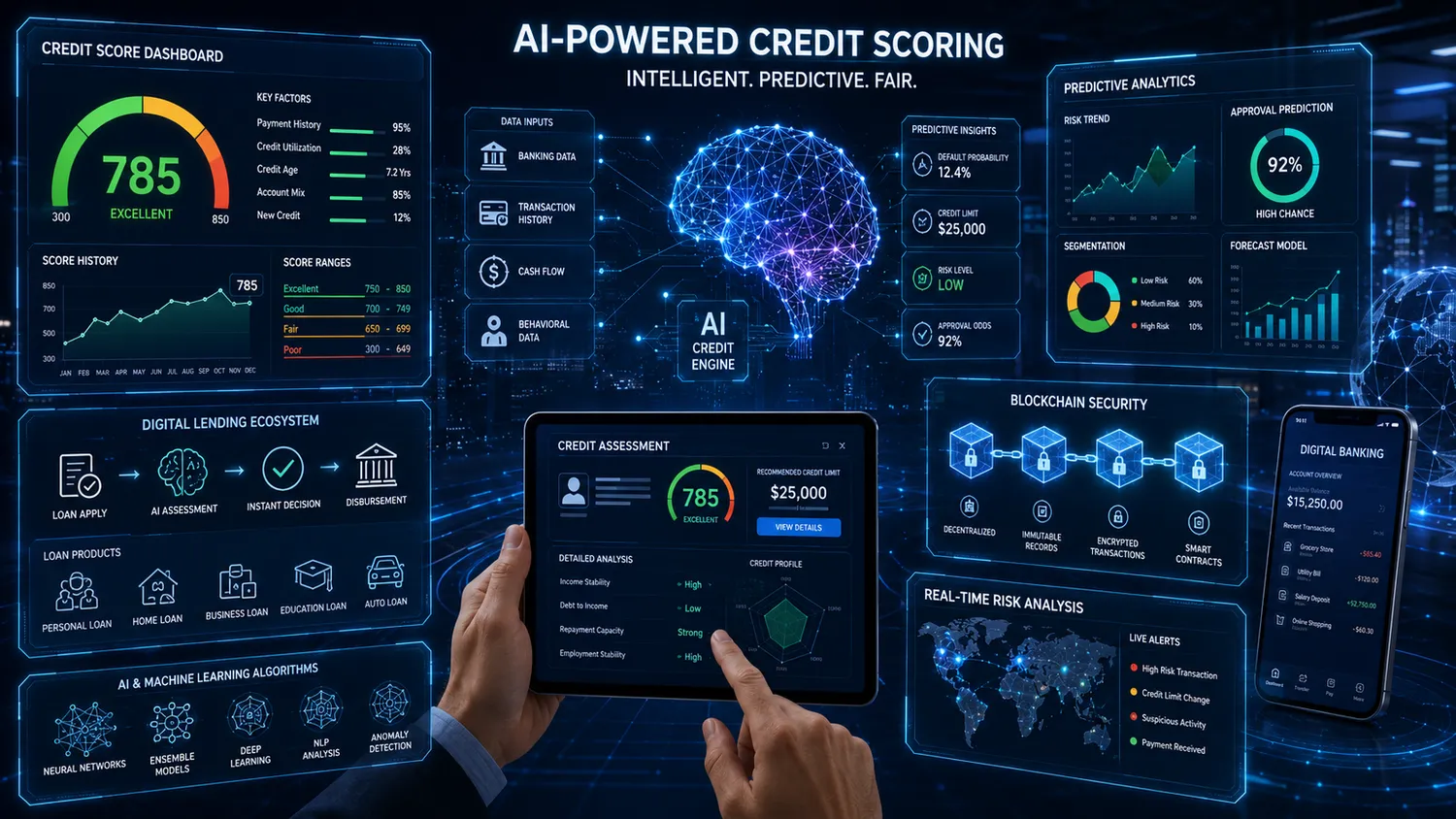
Artificial Intelligence (AI) in credit scoring refers to the integration of advanced AI technologies such as machine learning, predictive analytics, natural language processing, and data intelligence into credit evaluation systems to determine the creditworthiness of individuals and businesses. Unlike traditional scoring methods that rely heavily on historical financial records and fixed algorithms, AI-driven credit scoring systems utilize broader datasets and real-time analytics to deliver more accurate, adaptive, and inclusive credit assessments.
The rapid digital transformation of the banking, financial services, and insurance (BFSI) sector is significantly accelerating the adoption of AI-based credit scoring solutions worldwide. Financial institutions are increasingly leveraging AI-powered platforms to improve loan approval accuracy, minimize default risks, automate underwriting workflows, and enhance operational efficiency. The increasing penetration of digital banking platforms, fintech applications, and alternative lending ecosystems is also contributing to market growth.
Growing demand for financial inclusion is another major factor supporting market expansion. AI-powered credit scoring systems can evaluate alternative datasets such as utility payments, mobile wallet transactions, social media activity, and behavioral data, enabling lenders to assess underbanked and unbanked populations more effectively. This capability is transforming lending operations in emerging economies where traditional credit infrastructure remains limited.
Additionally, advancements in cloud computing, big data analytics, blockchain integration, and explainable AI (XAI) technologies are creating significant opportunities for the market. However, challenges related to data privacy, algorithm transparency, regulatory compliance, and cybersecurity continue to influence market dynamics globally.
Definition and Market Significance
Artificial Intelligence in credit scoring refers to AI-powered systems designed to evaluate and predict borrower creditworthiness using machine learning models, alternative data analysis, and predictive risk assessment tools. These systems enhance traditional credit scoring methods by incorporating structured and unstructured data sources for more accurate and real-time credit evaluations.
The significance of this market lies in its ability to improve financial inclusion, automate credit decision-making, reduce operational costs, and minimize credit risks for financial institutions. AI-driven credit scoring also enables lenders to provide faster and more personalized lending services while expanding access to credit for individuals and businesses lacking conventional credit histories.
Market Drivers
One of the primary drivers of the Artificial Intelligence in Credit Scoring market is the increasing demand for financial inclusion across emerging economies. Millions of individuals worldwide remain underserved by traditional banking systems due to limited or non-existent credit histories. AI technologies enable lenders to analyze alternative data sources, making it easier to extend financial services to underbanked populations.
The rapid digital transformation of banking and lending operations is also driving market growth. Financial institutions are increasingly adopting AI-powered solutions to automate underwriting processes, improve customer experiences, and reduce loan processing times. AI-based platforms provide real-time credit assessments, helping lenders make faster and more accurate lending decisions.
Additionally, the growing adoption of fintech platforms, digital payment systems, open banking initiatives, and API-driven financial ecosystems is increasing the availability of customer data for AI-driven risk analysis. Advancements in machine learning algorithms, cloud infrastructure, and predictive analytics are further accelerating market expansion.
Market Trends
One of the major trends in the market is the increasing adoption of Explainable AI (XAI) in credit scoring systems. Financial institutions and regulators are emphasizing transparency in AI-generated lending decisions, encouraging the development of models capable of providing clear and interpretable credit assessment explanations.
Another key trend is the growing integration of alternative data sources with traditional credit scoring frameworks. AI-powered hybrid scoring models are combining conventional credit bureau data with behavioral analytics, transaction histories, mobile wallet usage, and utility payment records to create more comprehensive borrower profiles.
The integration of blockchain technology with AI-driven credit scoring platforms is also emerging as a notable trend. Blockchain-based systems improve data integrity, transparency, and security while supporting automated lending workflows through smart contracts and decentralized finance ecosystems.
Furthermore, AI-powered fraud detection and risk mitigation tools are becoming increasingly important as financial institutions seek to strengthen cybersecurity and prevent identity fraud within digital lending environments.
Market Restraints
Despite strong growth opportunities, the market faces several challenges related to data privacy and regulatory compliance. AI-driven credit scoring systems require access to vast amounts of personal and behavioral data, raising concerns regarding data ownership, consent, and misuse of sensitive consumer information.
Lack of transparency in AI algorithms also remains a significant restraint for market growth. Many AI models operate as “black box” systems, making it difficult for lenders and regulators to understand how credit decisions are generated. Regulatory frameworks in multiple regions require financial institutions to provide explainable lending decisions, limiting adoption of opaque AI systems.
Additionally, cybersecurity risks, implementation complexity, and high integration costs associated with AI infrastructure can restrict adoption among smaller financial institutions and regional lenders.
Market Opportunities
The growing expansion of AI-driven credit scoring solutions into new industry verticals presents significant growth opportunities for the market. Industries such as retail, telecommunications, healthcare, and utilities are increasingly adopting AI-powered credit assessment tools for buy-now-pay-later (BNPL) services, customer financing, and subscription-based business models.
The integration of blockchain and decentralized finance technologies with AI credit scoring systems is also creating new growth opportunities. Blockchain enhances security and transparency in credit data management while enabling secure peer-to-peer lending ecosystems.
Furthermore, rising adoption of embedded finance platforms and digital-first lending solutions is expected to increase demand for real-time AI-based credit evaluation systems. Emerging economies across Asia-Pacific, Latin America, and Africa are anticipated to offer strong growth potential due to rising smartphone penetration, digital banking adoption, and fintech ecosystem expansion.
Segmentation
The Artificial Intelligence in Credit Scoring market is segmented based on component, application, and industry vertical.
By component, software is expected to dominate the market with approximately 60.0% share in 2025 due to increasing deployment of AI-powered credit scoring platforms, predictive analytics systems, and automated underwriting tools. Services also represent an important segment, supporting AI implementation, consulting, maintenance, and regulatory compliance integration.
By application, personal credit scoring is projected to maintain the dominant market position with 70.0% share in 2025. Growing demand for digital lending, personal loans, credit cards, and BNPL services is driving adoption of AI-powered consumer credit assessment tools. Corporate credit scoring is also gaining traction as businesses increasingly utilize AI for SME financing and commercial lending risk analysis.
By industry vertical, BFSI is anticipated to hold the leading market position with 30.0% market share in 2025. Banks, insurance companies, fintech firms, and digital lenders are rapidly adopting AI technologies to improve risk management, automate credit evaluations, and enhance customer engagement. Retail, healthcare, telecommunications, utilities, and real estate sectors are also increasingly integrating AI-based credit scoring capabilities.
Regional Analysis
North America
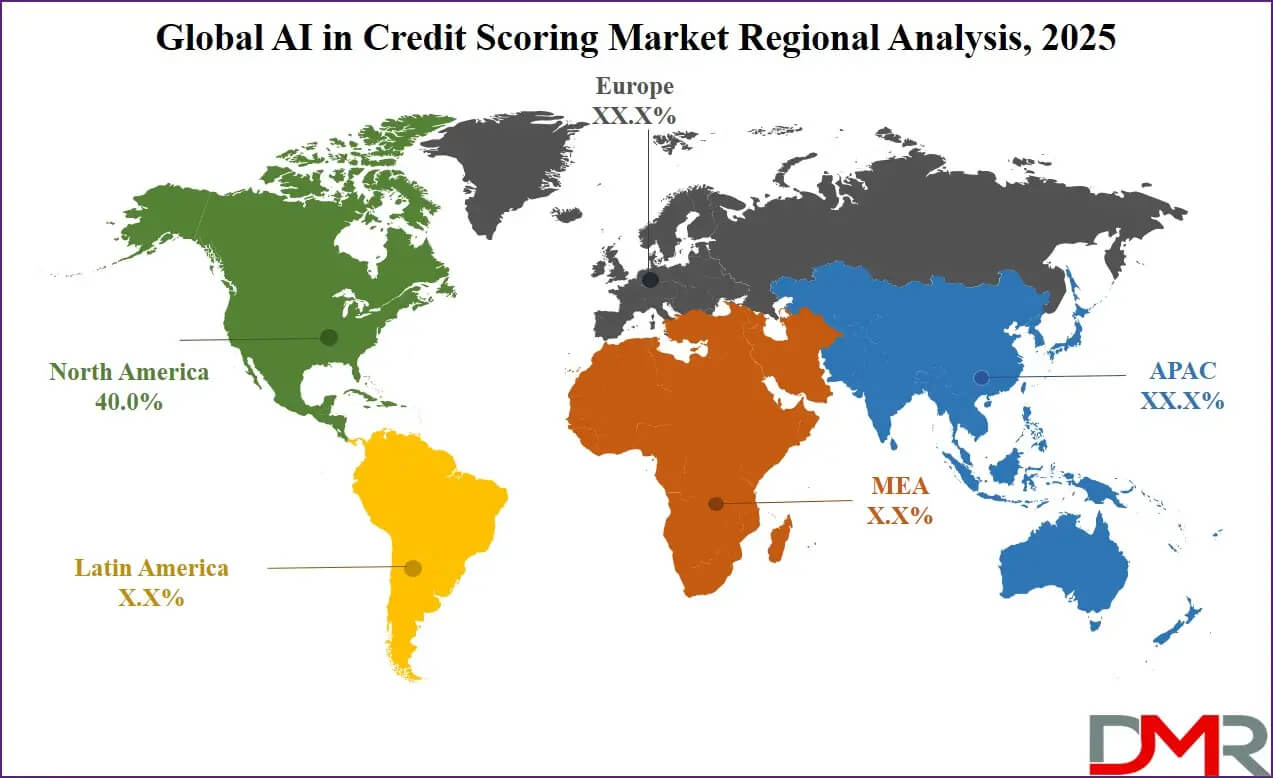
North America is expected to dominate the Artificial Intelligence in Credit Scoring market with a 40.0% share in 2025. The region benefits from advanced digital infrastructure, strong AI adoption, mature financial ecosystems, and the presence of major market players such as FICO, Experian, Equifax, and Upstart. Increasing demand for automated lending systems and advanced fraud detection technologies continues to strengthen market growth in the region.
Europe
Europe is witnessing steady growth in AI-powered credit scoring adoption due to increasing regulatory focus on responsible AI development and financial transparency. Financial institutions across the region are investing in explainable AI models, digital lending platforms, and AI-based compliance management systems to improve credit risk assessment processes.
Asia-Pacific
Asia-Pacific is projected to register the highest CAGR during the forecast period, driven by rapid digital transformation, expanding fintech ecosystems, and growing financial inclusion initiatives across countries such as China, India, Indonesia, and Vietnam. Rising smartphone penetration, digital payments adoption, and mobile banking expansion are significantly supporting regional market growth.
Latin America
Latin America is gradually emerging as a promising market for AI-driven credit scoring solutions due to increasing fintech investments, digital banking adoption, and growing demand for alternative lending platforms. AI technologies are helping lenders expand financial services to underserved populations across the region.
Middle East & Africa
The Middle East & Africa region is experiencing growing adoption of AI-powered credit scoring platforms supported by digital transformation initiatives, financial inclusion programs, and increasing investment in fintech infrastructure. The rise of mobile banking and alternative financing solutions is contributing to regional market expansion.
Download a Complimentary PDF Sample Report
https://dimensionmarketresearch.com/request-sample/artificial-intelligence-in-credit-scoring-market/
Competitive Landscape
The Artificial Intelligence in Credit Scoring market is highly competitive and consists of established credit bureaus, fintech companies, AI startups, and financial software providers. Companies are focusing on improving predictive accuracy, enhancing algorithm transparency, integrating alternative data analysis, and strengthening fraud detection capabilities.
Major market participants are investing heavily in explainable AI technologies, cloud-based lending infrastructure, and advanced risk analytics solutions to maintain competitive advantages. Strategic partnerships, acquisitions, and product innovations are also shaping the competitive landscape.
Key players operating in the market include FICO, Experian, Equifax, TransUnion, Zest AI, Upstart, LenddoEFL, Scienaptic AI, Pagaya, Nova Credit, OakNorth, RiskSpan, CreditVidya, and other major industry participants.
Technological Advancements
Rapid advancements in machine learning, predictive analytics, and big data processing technologies are significantly improving the efficiency and accuracy of AI-powered credit scoring systems.
Explainable AI (XAI) technologies are enhancing transparency and regulatory compliance in automated credit decision-making processes. Cloud-based AI infrastructure and API-driven financial ecosystems are also improving scalability and accessibility for lenders worldwide.
The integration of blockchain technology, smart contracts, and decentralized finance frameworks is further transforming AI-driven credit scoring by enhancing data security, transparency, and automation capabilities.
Consumer Adoption Patterns
Financial institutions and fintech lenders represent the largest adopters of AI-based credit scoring technologies due to increasing demand for automated underwriting and real-time lending decisions.
Consumers are increasingly utilizing digital lending platforms, mobile banking applications, and embedded finance services, encouraging broader adoption of AI-powered credit evaluation systems.
Businesses are also adopting AI-based corporate credit scoring tools to streamline SME financing, commercial lending, and risk management operations.
Regulatory Environment
Governments and financial regulators worldwide are introducing frameworks focused on ethical AI deployment, data privacy protection, and algorithm transparency within financial services.
Regulations such as GDPR in Europe and consumer protection laws in North America are influencing the development of explainable and compliant AI credit scoring systems.
Regulatory authorities are also emphasizing fairness, bias reduction, and accountability in automated lending decisions to ensure responsible use of AI technologies in financial ecosystems.
Market Challenges
The market faces several challenges including data privacy concerns, algorithmic bias, cybersecurity risks, and regulatory complexities.
High implementation costs and technical integration challenges may limit adoption among smaller financial institutions.
Ensuring transparency, fairness, and consumer trust in AI-generated credit decisions remains a significant challenge for industry participants globally.
Future Outlook
The Artificial Intelligence in Credit Scoring market is expected to witness substantial growth through 2034 driven by increasing adoption of AI-powered lending technologies, rapid fintech expansion, and growing demand for financial inclusion.
Advancements in explainable AI, predictive analytics, blockchain integration, and digital banking infrastructure will continue transforming credit assessment processes globally.
The growing use of alternative data, embedded finance platforms, and real-time lending systems is expected to create new growth opportunities for market participants in the coming years.
FAQs
What is the Artificial Intelligence in Credit Scoring Market?
It refers to the market focused on AI-powered technologies used to evaluate borrower creditworthiness through machine learning, predictive analytics, and alternative data analysis.
What is the market size in 2025 and 2034?
The market is projected to reach USD 2,252.3 Mn in 2025 and USD 16,014.0 Mn by 2034.
What is the CAGR of the market?
The market is growing at a CAGR of 24.4% during the forecast period.
Which region dominates the market?
North America dominates the market with a 40.0% share in 2025.
What are the key growth drivers?
Major growth drivers include financial inclusion initiatives, digital banking transformation, fintech expansion, AI adoption in lending, and increasing demand for automated credit assessment systems.
Summary of Key Insights
The Artificial Intelligence in Credit Scoring Market is experiencing strong growth due to rapid adoption of AI technologies across banking, fintech, and lending ecosystems. The market is projected to grow from USD 2,252.3 Mn in 2025 to USD 16,014.0 Mn by 2034 at a CAGR of 24.4%. North America leads the market with 40.0% share, while Asia-Pacific is emerging as the fastest-growing region. Increasing demand for financial inclusion, real-time lending solutions, explainable AI, and alternative data analysis is significantly driving market expansion globally.
Purchase the report for comprehensive details
https://dimensionmarketresearch.com/checkout/artificial-intelligence-in-credit-scoring-market/