You've spent ₹8,000–₹15,000 on a nanoplastia session. Your hair looks incredible when you walk out of the salon — silky, smooth, and manageable. Then July arrives in Mumbai. Or August hits Delhi. And suddenly your hair is fighting back.
This is the real question Indian consumers and stylists need answered honestly: does nanoplastia hair treatment actually hold up against Indian humidity?
Most blog posts skip this question entirely. They talk about benefits, pricing, and procedures — but almost no one addresses whether nanoplastia survives a 90% humidity day in Chennai or a monsoon commute in Kolkata. This guide answers that directly, with city-wise context, the science behind why nanoplastia behaves the way it does in heat-and-humidity conditions, and what you can do to maximise your results year-round.
What Is Nanoplastia and Why Does It React to Humidity?
Nanoplastia is a semi-permanent, formaldehyde-free hair smoothing and repair treatment. Unlike traditional keratin treatments, it works by using nanotechnology to deliver amino acids, collagen, and botanical actives directly into the hair cortex — the inner structural layer of each strand.
The key difference from a humidity-resistance standpoint is the mechanism of action. Standard keratin treatments coat the outer cuticle with a film. When humidity breaks down that film, frizz returns rapidly. Nanoplastia, by contrast, restructures the hair from within, reinforcing the cortex so the strand itself becomes more resistant to moisture-driven swelling — the primary cause of frizz.
This is why nanoplastia is increasingly preferred over keratin treatments for Indian climates — not just because it is formaldehyde-free, but because its repair mechanism is fundamentally more robust against external moisture.
India's Humidity Problem: Why Standard Treatments Fail
India has some of the most extreme humidity conditions in the world — and they vary dramatically by city, season, and even time of day.
City-Wise Frizz Threat Index (2026)
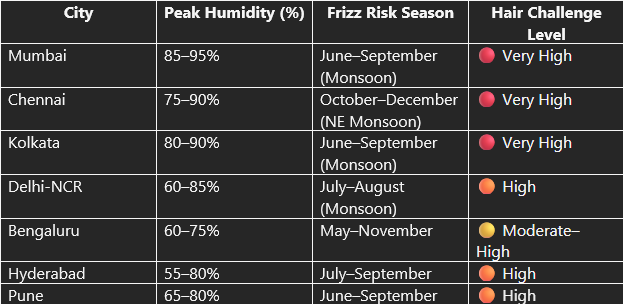
For anyone in a red or orange category — which covers the majority of India's urban population — hair treatment longevity is directly tied to humidity resistance. This is not a cosmetic concern; it is a functional one.
When humidity levels rise above 70%, unprotected or weakly treated hair absorbs ambient moisture through the cuticle, causing hydrogen bonds in the hair shaft to shift. The result is swelling, separation of the cuticle scales, and visible frizz. Treatments that only coat the outside of the hair — rather than repairing the inside — fail quickly under these conditions.
How Dorofey's Nanoplastia Formula Is Built for Indian Hair
Dorofey Professional's Nanoplastia treatment is formulated specifically with the challenges of Indian hair and Indian climate in mind. The core of its performance in humid conditions comes down to two proprietary elements:
The 16 Amino Acid Complex (Sweet Corn-Derived)
Amino acids are the building blocks of keratin — the structural protein that makes up 95% of each hair strand. When hair is repeatedly exposed to humidity, heat, or chemical processing, keratin bonds break down and the hair becomes porous. Porous hair absorbs moisture unevenly, which is why frizz worsens over time for untreated or chemically-processed hair.
Dorofey's 16 amino acid complex, sourced from sweet corn, works intracellularly — meaning it penetrates through the cuticle into the cortex to rebuild broken keratin bonds from within. This is not a surface coating. It is internal reinforcement. The result is a hair strand that is physically less porous and less reactive to ambient humidity.
You can learn more about how this repair process works in Dorofey's detailed guide on nanoplastia hair treatment benefits and science.
Murumuru Butter as a Humidity Sealant
After the amino acid complex reinforces the cortex, Murumuru Butter — a cold-pressed Amazonian palm fruit butter — acts as a natural cuticle sealant. Its molecular structure is compatible with the hair's lipid layer, creating a flexible, breathable barrier that slows moisture uptake without the stiff, coated feeling associated with silicone-based products.
The combination of internal reinforcement (amino acids) + external sealing (Murumuru Butter) is what gives Dorofey's nanoplastia a structural advantage in India's monsoon months. It doesn't just fight frizz on the surface — it reduces the hair's capacity to absorb humidity in the first place.
This is also why Dorofey's formulation is a strong choice for seasonal hair care management throughout the year — not just post-treatment maintenance.
Does Nanoplastia Last Through the Monsoon? Real Expectations
Here is the honest answer: yes, with proper aftercare — and with important nuances by hair type.
Hair types that tend to maintain results well through Indian monsoon:
- Medium-density, previously healthy hair with mild frizz concerns
- Colour-treated hair with moderate porosity
- Wavy hair with frizz as the primary concern
Hair types where results may need more maintenance support:
- Highly porous or extremely damaged hair (may absorb humidity more quickly even after treatment)
- Very coarse, high-density hair common in South India (may need a second application for full cortex saturation)
- Hair with heavy prior bleaching or multiple chemical overlaps
For chemically treated hair specifically, it is worth reading Dorofey's detailed guide on nanoplastia side effects for chemically treated hair before booking your appointment, as pre-treatment conditioning can significantly improve how long your results hold.
5 Aftercare Steps That Protect Nanoplastia Results in High Humidity
Good nanoplastia aftercare can extend results by 6–8 additional weeks even in peak monsoon conditions. These are the steps that matter most:
- Use sulphate-free shampoo exclusively — sulphates strip the amino acid complex and accelerate fading. This is non-negotiable for treated hair in India's humid months.
- Deep condition weekly with a protein-rich mask — replenishes amino acid bonds that humidity depletes over time. Dorofey's Refix Spa Mask is formulated to complement post-nanoplastia maintenance.
- Avoid washing hair daily — daily washing weakens the cortex reinforcement. 2–3 washes per week is the recommended frequency for treated hair.
- Apply a finishing serum before stepping out in humidity — a lightweight serum provides a secondary moisture barrier on days when ambient humidity is above 70%.
- Sleep on a satin or silk pillowcase — cotton pillowcases create friction that roughens the cuticle over time, accelerating moisture uptake and dulling results.
For a full product routine, Dorofey's salon professional home-care range — including sulphate-free shampoos, conditioners, and serums — is specifically designed to extend professional treatment results between salon visits.
Conclusion
For anyone living in India's humidity belt — which spans coastal cities, monsoon zones, and much of the Gangetic plain — the effectiveness of any hair treatment depends not just on what it does in a salon, but how it holds up when real Indian weather hits.
Nanoplastia, particularly a professionally applied amino acid-based formulation like Dorofey's, is genuinely better equipped for Indian humidity than surface-coating alternatives like keratin or smoothening. Its advantage comes from repairing the hair's internal structure rather than just wrapping its exterior — and that makes a measurable difference when humidity climbs above 80% for weeks at a time.
The treatment is not maintenance-free. Sulphate-free aftercare, weekly conditioning, and minimal heat styling are all part of protecting your investment. But for Indian consumers who want results that last through monsoon, and for salon professionals looking for a product system that delivers consistent outcomes for clients across different hair types and cities, nanoplastia backed by the right formula and the right aftercare routine is a well-founded choice.
For salon professionals interested in your Hair Repair Expert, Dorofey professional’s kit options, or consumers looking for the right home-care system to pair with in-salon treatment, explore the full range at Dorofey Professional