In this guide, you will learn why to start email marketing for an agency, how to build a high-quality email list, create engaging content, and manage your email deliverability like an expert.
Want to skip the theory and jump straight to the step-by-step email marketing guide? Click here!
Benefits of email marketing for agencies
Email marketing helps agencies to communicate consistently, share insights, and show expertise — all at a reasonable cost.
But that sounds too hypothetical, right?
Let’s explore the real benefits of email marketing in more detail.
1. Offers great return on investment (ROI)
Email marketing delivers one of the highest returns on investment among digital channels. In fact, a recent study by Litmus shows that each dollar spent on email marketing likely returns an average of $36.
This high ROI is mainly due to its ability to reach a highly targeted audience at a low cost while nurturing relationships over time.
Unlike other marketing channels that require constant investment, email campaigns reach a targeted audience with minimal extra expenses — provided that the sender reputation and email infrastructure are properly maintained.
For example, you could use a personalized email drip campaign to guide a lead through the sales process. When a potential client downloads a free eBook, an automated email sequence triggers.
The client starts by receiving a warm welcome email. After that, they get messages tailored to their needs, with relevant case studies, and, eventually, an offer for a personalized consultation.
This campaign engages prospects over time without manual follow-up. It increases conversions while keeping costs low.
However, keep in mind that achieving this ROI isn’t easy and can vary considerably. The success of your email marketing campaigns will depend on various factors, including:
- Quality of your contact list
- Content quality and value
- Email deliverability and sender reputation
For instance, only a well-timed promotion that aligns with your clients’ needs and preferences could encourage immediate responses and drive conversions.
2. Support advanced personalization and dynamic segmentation
Unlike other marketing tools and approaches, only emails let you use all the collected data on your users, and hyper-personalize messages automatically (if you use the right tools).
For instance, Maichimp marketing platform allows you to segment your email list using demographic data, purchase behavior, engagement history, and custom attributes of your choice. Then, when creating a targeted email campaign, you can layer these criteria and target them separately with curated content.
GetResponse, another email marketing platform, offers dynamic segmentation, meaning contacts are automatically transferred from one segment (e.g. new users) to another (e.g. loyal customers).
And the email marketing platform ActiveCampaign offers a dynamic content feature that automatically personalizes sections of an email based on each user’s preferences, actions, or other data.
3. Allows scalability through automation
Email marketing automation allows you to handle repetitive tasks without manual intervention. Instead of manually sending each campaign, you can create automated workflows that trigger messages based on client actions.
Here are some of many examples of email automations that companies use:
- Welcome emails
- Onboarding sequences
- Birthday or anniversary messages
- Post-purchase follow-ups
- Re-engagement campaigns
- Upsell or cross-sell recommendations
- Feedback and review requests
- Event reminders
- Lead nurturing sequences
- Drip campaigns
- Seasonal campaigns and holiday promotions
4. Increased customer retention and loyalty
Businesses are ready to invest in personalization and loyalty programs because they pay off. The PwC Customer Loyalty Executive Survey 2023 revealed that businesses delivering personalized experiences see a 1.7x increase in incremental revenue year-over-year and more than double their customers’ lifetime value.
Retaining loyal clients is far more cost-effective than acquiring new ones, and email marketing helps with that through hyper-personalized, relevant content delivered at the right time. When subscribers receive regular, helpful information, they feel appreciated and develop an emotional bond with the brand—almost as if it were a friend or even a family member.
How to get started with email marketing
It’s now clear that there is a lot to gain from email marketing. But where should you begin?
Here is a simple framework for any business ready to hit the ground running. It doesn’t matter whether you’re a digital marketing agency, a travel agency, or another service provider.
We’ll cover foundational strategies and best practices that work across industries.
Step 1. Develop the strategy
Start by deciding what you aim to accomplish with your email marketing strategy. Are you looking to increase brand awareness, nurture leads, or drive sales?
You can use a SMART framework to ensure your goals are both realistic and trackable. SMART stands for:
- Specific. Clear and precise goal
- Measurable. Trackable outcomes
- Achievable. Realistic and attainable
- Relevant. Aligned with broader objectives
- Time-bound. Set within a timeframe
Best choice: Mailtrap Email Delivery Platform
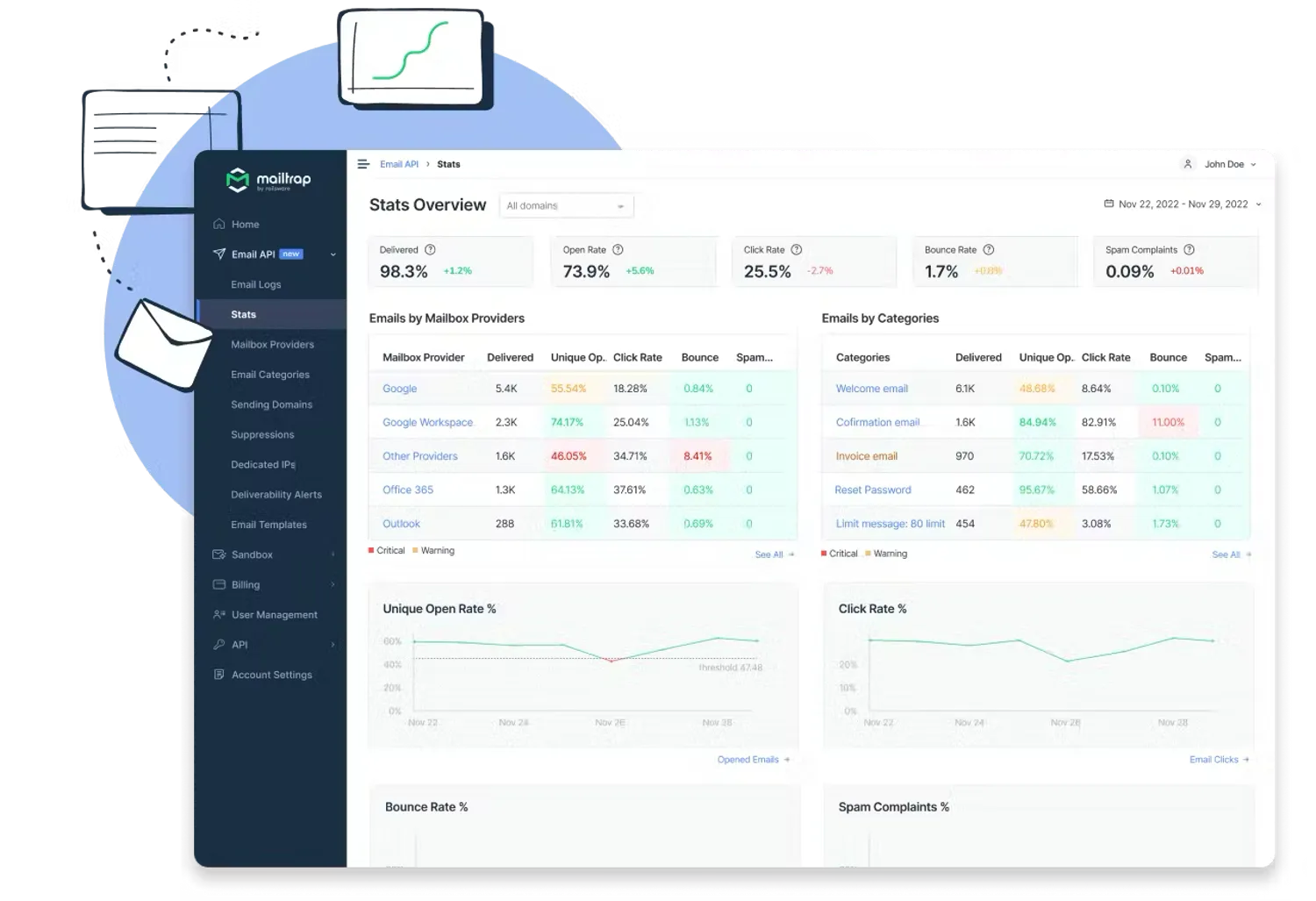
Mailtrap is an all-in-one email delivery platform to test, send, and control your email infrastructure–all in one place! Great for dev and marketing teams.
The platform lets you send both marketing and transactional emails, has a separate steam for bulk emails and comprehensive testing capabilities to check:
- Content
- Spam score
- Attachments
- Cross-platform rendering
- Dynamic content bugs.
The platform offers an intuitive template builder with drag-and-drop and HTML editors, pre-designed email templates, a clear campaign scheduler, and other automation features.
Mailtrap provides advanced analytics with a dashboard and visual graphs to track key deliverability metrics. And drill-down reports on each mailbox provider with detailed insights will help you fine-tune email campaigns while maintaining a strong sender reputation.
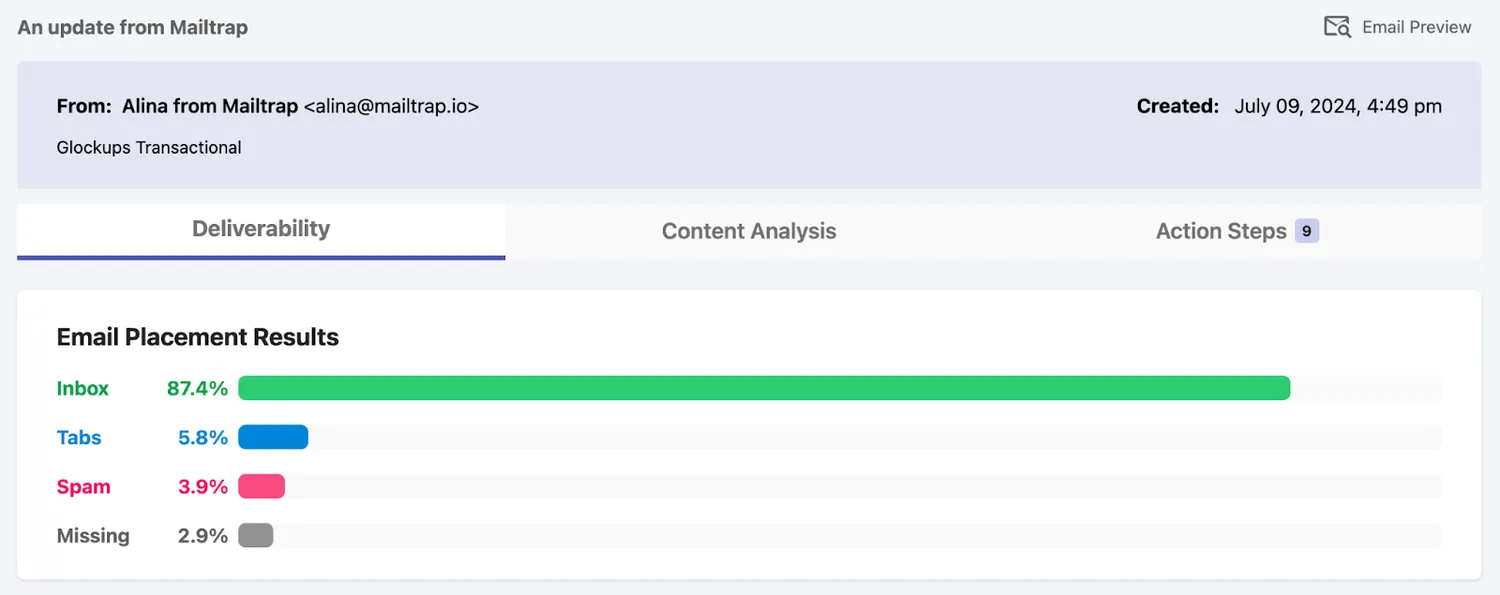
If your main concern is email deliverability and placement, Mailtrap is the right tool for you. Here are the GlockApps test results of emails sent via Mailtrap. As you can see, more than 90% of transactional and marketing emails landed directly in the inbox or relevant tabs, with less than 6% being sent to secondary tabs.
Pricing
Mailtrap’s free plan includes up to 1,000 emails per month, which is usually enought for individuals and small startups. For businesses with larger email-sending needs, Mailtrap has very affordable paid tiers that start as low as $15 per month for 10K emails and an unlimited contact list. The full plan description is here.
Send Marketing Emails with Mailtrap for Free
Wrapping up
If you seriously plan to add email marketing to your service list, be sure to check the following materials:
- What is mail marketing: in-depth guide
- Email deliverability explained
- Types of email marketing
- Email marketing strategy explained