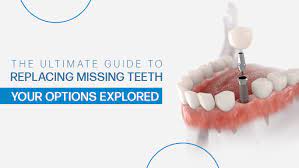
Missing teeth can affect more than just your smile—they can impact your overall oral health, your ability to chew and speak, and your self-confidence. Fortunately, there are several teeth replacement options available today, each with its own set of advantages and considerations. In this guide, we will explore the most common teeth replacement options to help you determine which one is right for you.
1. Dental Implants
What They Are: Dental implants are titanium posts surgically inserted into the jawbone to serve as artificial tooth roots. They provide a strong foundation for fixed or removable replacement teeth.
Pros: Implants look and function like natural teeth, are durable, and help preserve the jawbone. They also do not require alteration of adjacent teeth.
Cons: Implants can be expensive and require a surgical procedure, which involves a longer healing period.
Best For: Individuals with healthy gums and sufficient jawbone density who are looking for a permanent solution.
2. Dental Bridges
What They Are: A dental bridge consists of one or more artificial teeth anchored to the natural teeth or implants on either side of the gap.
Pros: Bridges can restore the appearance and function of your teeth relatively quickly and do not require surgery.
Cons: They may require the alteration of healthy adjacent teeth and do not address underlying bone loss.
Best For: Patients who are missing one or a few teeth and prefer a less invasive option than implants.
3. Dentures
What They Are: Dentures are removable appliances that replace missing teeth and surrounding tissues. They can be full (replacing all teeth) or partial (replacing some teeth).
Pros: Dentures are typically less expensive than implants or bridges and can be adjusted or replaced easily.
Cons: They may not feel as secure or natural as other options and can require regular maintenance and adjustment.
Best For: Individuals who have lost multiple teeth or who are looking for a cost-effective solution.
4. Partial Dentures
What They Are: Partial dentures are removable devices that replace one or several missing teeth, attaching to existing teeth with metal clasps or precision attachments.
Pros: Partial dentures are less invasive than implants and more affordable. They can also be modified to accommodate additional tooth loss.
Cons: They might feel bulky and can affect speech and chewing if not properly fitted.
Best For: Patients who have several missing teeth but still retain some natural teeth.
5. All-on-4 Implants
What They Are: All-on-4 implants involve placing four implants in the jaw to support a full arch of replacement teeth.
Pros: This method provides a stable and secure solution that looks and functions like natural teeth, with less recovery time than traditional implants.
Cons: It can be costly and requires a surgical procedure.
Best For: Individuals who have lost most or all of their teeth and want a fixed, long-lasting solution.
6. Implant-Supported Dentures
What They Are: These dentures are anchored by dental implants, offering more stability than traditional dentures.
Pros: They are more secure and comfortable, improving chewing and speaking abilities.
Cons: They require sufficient bone density for implants and can be more expensive than regular dentures.
Best For: Patients looking for a more stable alternative to traditional dentures.
7. Resin-Bonded Bridges (Maryland Bridges)
What They Are: These bridges use a metal or porcelain framework with wings that are bonded to the back of adjacent teeth.
Pros: They are less invasive and preserve more of the natural tooth structure compared to traditional bridges.
Cons: They are not as strong as other types of bridges and may not be suitable for back teeth or areas with heavy biting force.
Best For: Replacing front teeth where aesthetics and minimal invasiveness are priorities.
8. Removable Partial Dentures with Metal Framework
What They Are: These partial dentures have a metal framework for added strength and durability.
Pros: They are durable, offer a secure fit, and can be designed to blend with natural teeth.
Cons: They may be less aesthetically pleasing due to visible metal clasps and can cause initial discomfort.
Best For: Patients looking for a sturdy and reliable partial denture.
9. Flexible Dentures
What They Are: Made from a flexible plastic material, these dentures are designed to be more comfortable and fit more snugly than traditional rigid dentures.
Pros: They are lightweight, more comfortable, and less likely to cause sore spots.
Cons: They can be more expensive than traditional dentures and may not be suitable for all types of tooth loss.
Best For: Individuals who experience discomfort with traditional dentures.
10. Temporary Dentures (Immediate Dentures)
What They Are: Temporary dentures are placed immediately after tooth extraction, allowing the patient to have teeth while waiting for permanent dentures or implants.
Pros: They provide immediate aesthetics and function, helping patients transition to permanent solutions.
Cons: They may require frequent adjustments as the gums and bone heal and change shape.
Best For: Patients who need an immediate solution after tooth extraction.
Conclusion
Choosing the right teeth replacement option depends on various factors, including the number of missing teeth, overall oral health, budget, and personal preferences. Dental implants offer a permanent, natural-looking solution, while bridges and dentures provide more affordable alternatives. Consulting with a dental professional can help determine the best option for your specific needs, ensuring you restore your smile and oral function effectively. Read more