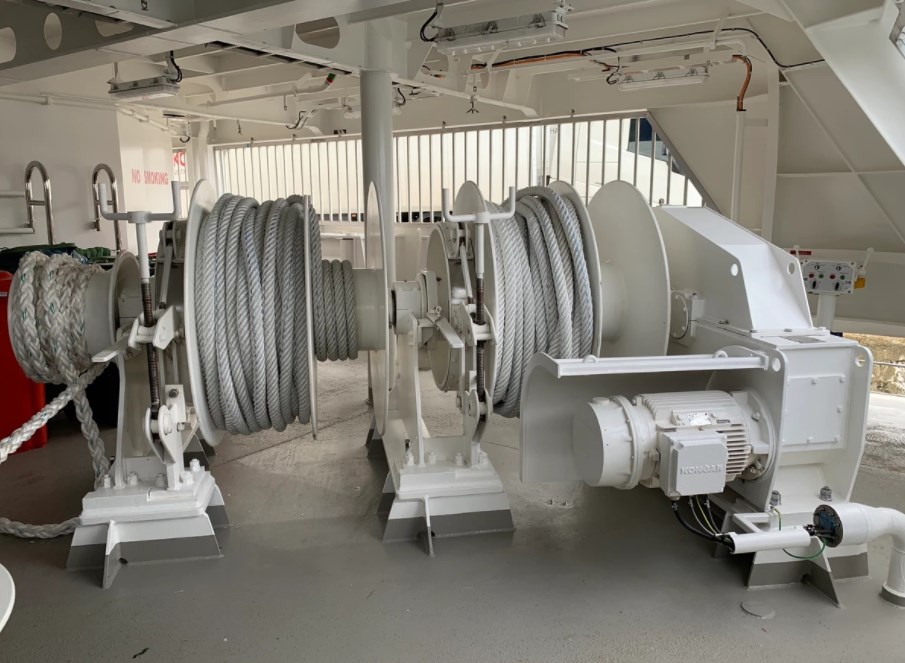
Mooring winches play a critical role in maritime operations by providing the necessary force to secure vessels to docks or other fixed structures. Efficient control of mooring winches is essential for safe and effective vessel mooring procedures. In this article, we will explore different control methods employed in mooring winches.
Manual Control
Manual control is the most basic and traditional method of operating mooring winches. It involves direct physical operation by an operator who manually engages the winch controls. The operator uses a control lever or handle to initiate the winch operation and control the speed and direction of the winch drum rotation. Manual control offers a straightforward and intuitive interface, providing immediate response to the operator's inputs. It is commonly used in small-scale operations or situations where simplicity and reliability are paramount.
Hydraulic Control
Hydraulic control is a widely used control method in hydraulic mooring winches due to its reliability and precise control capabilities. Hydraulic control systems utilize hydraulic power to operate the winch functions. A hydraulic pump generates hydraulic pressure that is distributed through valves to control the winch's speed and direction. The operator operates hydraulic control levers or joysticks to manipulate the winch's movements. Hydraulic control offers smooth and precise control, making it suitable for applications that require accurate positioning and variable speed control.
Electric Control
Electric control is another common method used in mooring winches. Electric control systems utilize electric motors to power the winch's operations. The operator operates electric control switches or buttons to start, stop, and control the winch's movements. Electric control offers ease of use, precise control, and the ability to integrate with other automated systems. It is often used in modern mooring winches that require advanced control features and automation capabilities.
Radio Remote Control
Radio remote control is a wireless control method that provides enhanced mobility and flexibility for operating mooring winches. With a handheld remote control unit, the operator can remotely control the winch's movements from a safe distance. Radio frequency signals transmit commands from the remote control unit to the winch's control system, allowing for precise control over speed, direction, and other winch functions. Radio remote control enables operators to have better visibility and positioning, improving safety and maneuverability during mooring operations.
PLC (Programmable Logic Controller) Control
PLC control is an advanced control method used in modern mooring winches. It involves the use of a programmable logic controller as the central control unit for the winch operations. The PLC is programmed with specific instructions and algorithms to control the winch's movements, including speed, acceleration, and deceleration. PLC control offers precise and automated control, allowing for complex operations and integration with other systems. It enables the implementation of advanced features such as load monitoring, emergency stop functions, and collision avoidance systems.
Each control method for mooring winches offers unique advantages and is selected based on the specific requirements of the application. Factors such as precision, ease of use, reliability, automation capabilities, and safety considerations influence the choice of control method. By selecting the appropriate control method and providing proper training to operators, mooring winches can be effectively controlled, ensuring safe and efficient vessel mooring operations.