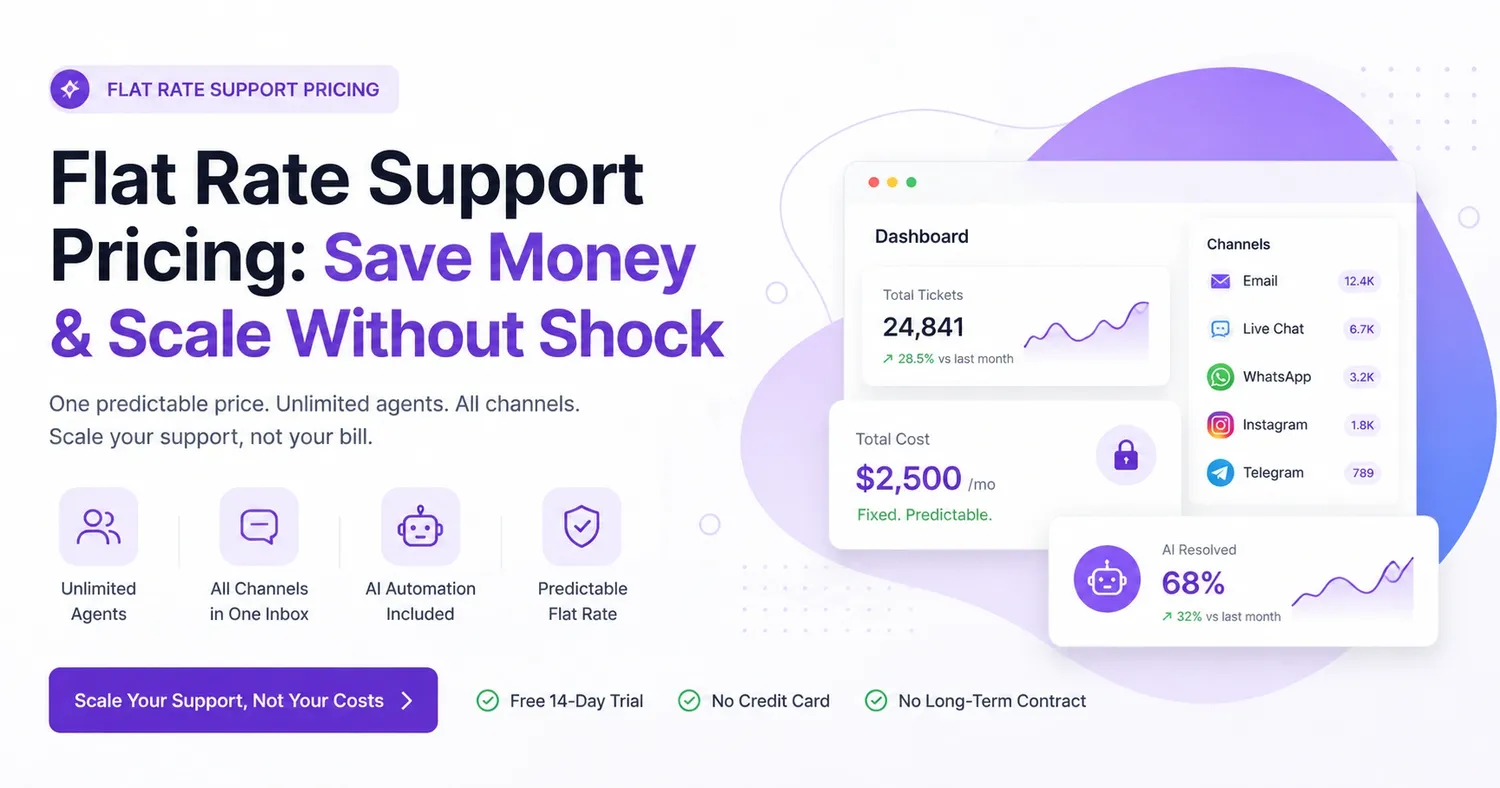
Ever felt that dread when your support tool bill arrives, and it's much higher than expected? We've totally been there. If you're a business owner or a support manager trying to manage expenses while your team expands, you've probably noticed how fast per-seat pricing can get out of hand, especially with scaling operations. Moving to flat-rate support pricing might just be the budget relief you need.
Quick Answers
- Flat-rate support pricing means one predictable monthly fee, no matter how many agents you have or how many tickets come in; this simplifies financial planning.
- Switching from per-seat models removes wasted spending on inactive seats and unexpected charges from sudden ticket surges.
- A unified shared inbox, integrating email, chat, WhatsApp, Instagram, and Telegram into a single workspace, reduces context switching and speeds up response times.
- Most teams can transition quickly, often in less than a day, using a free trial and straightforward data import, without needing long-term contracts.
Why Per-Seat Pricing Hinders Business Growth
Per-seat billing seems fair at first glance; you pay for each agent, right? However, this model quickly becomes problematic as your team expands or ticket volumes soar, causing per-agent costs to balloon uncontrollably. You end up paying for empty seats during slow times and then rushing to add more when demand spikes. Growth shouldn’t feel like a penalty for your financial health.
- The hidden cost of "agent fatigue" means you're paying full price for an agent even if they only handle a few tickets daily.
- Hiring just one new team member can easily add hundreds of dollars to your monthly expenses.
- It's frustrating to manage "read-only" licenses for managers who need oversight but don't actively work on tickets.
- Businesses with seasonal demand or unpredictable ticket volumes experience the most dramatic bill fluctuations.
What Exactly Is Flat Rate Support Pricing?
Flat-rate support pricing truly means what it says: a single, predictable monthly fee for your entire customer support workspace. It doesn't matter how many agents you bring on or how many support requests you handle; the price stays the same. This is the complete opposite of per-seat billing because there's no tax on your headcount or complicated calculations. You get a full suite of tools, including a shared inbox, an AI agent, and multiple communication channels, all for one consistent cost, ensuring transparency rather than vendor profit tied to your team's size.
- Typically includes unlimited agents, allowing your team to grow without increased costs.
- Often bundles essential features like AI automation, a comprehensive knowledge base, and multi-channel support at one price.
- No unexpected overage charges for processing high volumes of tickets, unlike some consumption-based models.
- This model is particularly well-suited for remote teams, agencies, and businesses with frequent customer interactions.
The Biggest Financial Advantage: How Flat Rate Pricing Reduces Support Costs
Let's dive into the financials. The main benefit of a flat rate is its predictability. You’ll know your exact monthly expense—no more guesswork or spreadsheet stress. Plus, when features like AI automation and multi-channel support are included, you can often eliminate several other tool subscriptions. One flat fee replaces numerous line items, which is a financial win for everyone. This makes it one of the smartest advantages of flat-rate support pricing for any growing business.
- Replaces individual costs for live chat, email ticketing, social media DMs, and knowledge base platforms.
- Often offers unlimited storage, message history, and channel integrations without additional fees.
- Eliminates the creeping cost of "per-agent" charges that occur when onboarding seasonal staff.
- Flat per-resolution pricing for AI, as low as $0.04 per ticket, offers huge savings compared to the industry standard of $0.99 for automated assistance.
Operational Wins: Benefits of a Centralized Support Workspace
Imagine managing emails, live chat, WhatsApp, Telegram, and social media DMs all within one chronological, thread-based inbox. Sounds fantastic, right? A unified workspace actually provides this. Your team won't need to switch between multiple tabs anymore. Every conversation appears in the same view, regardless of the channel. This results in faster response times and happier agents. Additionally, since your AI learns from every interaction, it becomes more intelligent with each response.
- Acts as a single source of truth for all customer interactions, preventing anything from being overlooked.
- The AI agent can access context from the entire conversation history, not just one specific channel.
- Agents can seamlessly handle email in the morning and live chat in the afternoon, all from the same interface.
- Integrated translation features allow you to support customers in any language without needing a multilingual team.
The Shared Inbox Advantage: Boosting Team Productivity
A shared inbox does more than just consolidate communication channels; it fosters genuine teamwork. Your team can easily see who is responding to which thread, reassign conversations, and add internal notes without endlessly CC'ing everyone. This eliminates the common "who owns this ticket?" confusion. That level of collaboration, combined with flat-rate pricing, makes scaling your team feel surprisingly simple.
- Allows for internal-only notes, visible to your team but invisible to the customer, ensuring smooth collaboration.
- Incorporates collision detection to prevent multiple agents from accidentally responding to the same ticket.
- Enables assignments and routing based on an agent’s expertise or current workload.
- Provides saved replies and snippets, ensuring consistent messaging across your entire team.
The Migration Blueprint: Switching from Per-Seat to Flat Rate
Switching might sound daunting, but honestly, it's much simpler than you’d imagine. Start by reviewing your current monthly spending: per-agent costs, any monthly fees, and potential overage charges. Then, look for a flat-rate provider that offers a free trial and easy data import from your existing tools. The actual transition usually involves exporting your ticket history, setting up your new workspace, and directing your email domain to the new inbox. Most teams complete this process within a single day.
- Assess your current support spending: tally up agents, separately used features, and any channel add-ons.
- Choose a provider that offers migration assistance and a free trial (typically 14 days).
- Export your ticket history and customer data from your old support system.
- Update your support email's MX or forwarding records to point to the new inbox.
- Train your team on the new shared inbox interface, which usually takes about an hour.
Ready to See the Difference?
You've mapped out the migration steps; now, test it out for free! Start your 14-day trial on Supplo to see how flat-rate pricing can transform your support budget—no credit card required.
What About the AI? Why Flat Rate and Automation Are a Perfect Match
Here’s where it gets exciting. Flat-rate pricing integrates seamlessly with AI automation. Your AI agent can automatically resolve tickets, directly reducing your human team's workload. Plus, since the AI is priced per resolution (at a consistent $0.04) instead of per seat, you gain automation benefits without adding to your per-agent cost structure. The AI learns from your knowledge base and past conversations, handling routine tasks so your team can focus on interactions that truly require a human touch.
- The AI agent efficiently handles common inquiries like order status updates, return policies, and FAQs.
- Its self-learning capability means it continuously improves with every interaction it processes.
- Ensures a smooth transfer to human agents when the AI cannot fully resolve an issue.
- No additional per-seat cost is incurred for allowing your AI to access all communication channels.
Let the AI Handle Repetitive Tasks
Our AI agent operates 24/7 at a consistent cost of $0.04 per resolution, a significant improvement over the $0.99 charged by older tools. It learns from your knowledge base and seamlessly transfers conversations to a human when necessary. Experience it for yourself during your free trial.
See AI Agent Pricing →
Avoiding Hidden Costs: What to Look Out for When Changing Support Pricing
While flat-rate solutions are fantastic, they aren't magic; you still need to review the terms carefully. Some providers might claim "flat rate" but then charge extra for premium channels (like WhatsApp), AI usage, or advanced reporting features. Others might quietly impose limits on your ticket volume or storage capacity. A truly flat rate should cover unlimited agents, all communication channels within the workspace, and essential features like the knowledge base and inbox. Look for clear terms, with no asterisks or hidden surprises.
- Confirm whether integrations for WhatsApp, Instagram, and Telegram are included or if they are considered "add-ons."
- Verify if there are any limitations on API calls, webhooks, or third-party integrations.
- Ask if AI automation credits have limits or if the $0.04-per-resolution rate is truly consistent.
- Look for a pricing page that clearly outlines all included features without any exceptions.
Supplo is not affiliated with any app or website. Please adhere to each app's terms and local regulations.
Real-World Scenarios: When Flat Rate Support Provides the Most Savings
Flat-rate pricing truly shines for three specific types of businesses: rapidly growing startups that quickly add agents, agencies managing multiple client inboxes, and e-commerce stores experiencing seasonal ticket spikes. In each scenario, the consistent flat cost remains stable even when the workload fluctuates wildly. It's also an ideal solution for teams that use AI automation to reduce ticket volume without concerns about usage tiers or agent limits.
- Startup: Hires three new support agents in Q3, but the bill remains unchanged.
- E-commerce: Experiences a fivefold increase in ticket volume during Black Friday, yet the bill stays the same.
- Agency: Manages ten different client inboxes with one team, incurring no per-client seat fees.
- Growing company: Aims to implement multilingual chat and WhatsApp support without incurring per-channel charges.
The Transition Checklist: Steps to Update Your Support Pricing Model
Ready to make the switch? Here’s a quick checklist to guide you:
- Calculate your current total monthly support costs, including all per-seat fees and additional charges.
- Find a flat-rate provider that offers all the channels and AI features your team requires.
- Sign up for a free trial and configure your new workspace.
- Import your existing knowledge base and train the AI with your common responses.
- Direct your email domain, WhatsApp number, and chat widget to the new inbox.
- Inform your team and test with actual customers before fully phasing out your old tool.
- During the trial period, test the AI's accuracy using your own past conversations.
- Before going live, set up canned responses and routing rules.
- Prioritize migrating your knowledge base, then move your inbox.
- Communicate the change to your team clearly so they know where to access conversations.
Make the Switch Without the Hassle
Most teams complete the migration in less than 24 hours. With Supplo, you get a unified workspace, AI automation, and flat-rate pricing that evolves with your business, not against it. Start your free trial and say goodbye to per-seat pricing for good.
Switch to Flat Rate Today →
Key Takeaways
- Flat-rate support pricing offers predictable monthly costs, simplifying budgeting and financial planning.
- Unified support workspaces consolidate various communication channels, significantly boosting operational efficiency.
- AI automation, when paired with flat-rate pricing, can substantially reduce overall support expenses.
- Migrating to a flat-rate system is often simpler than perceived, with many teams completing the transition within a day.
- Genuine flat-rate pricing should encompass unlimited agents, all necessary communication channels, and core features.
FAQ
Is flat-rate support pricing genuinely more affordable than per-seat pricing?
Yes, almost always. Per-seat pricing charges you per agent, meaning costs increase with headcount. Flat rate involves a single fee regardless of how many agents you add, so the more your team grows, the more you save.
Can I transfer my existing ticket history to a flat-rate provider?
Most modern support platforms, including Supplo, provide data import tools that allow you to bring over your past conversations and customer history. This is typically done via a simple CSV or direct API migration.
Does flat rate include AI automation, or is that a separate charge?
This varies by provider. Some bundle AI into the flat fee, while others charge per-resolution. You'll want a provider that explicitly states whether AI is included and, if so, at what cost. Supplo, for instance, includes AI at a consistent $0.04 per resolution.
What if I only need support for a single channel, like email?
Flat rate still works in this scenario because you're paying for the entire workspace, not just the number of channels. Most providers support single-channel setups just as easily as multi-channel ones, so you won't be paying for features you don't use.
Are there any contracts or long-term commitments with flat-rate pricing?
Generally, no. Most flat-rate providers, including Supplo, offer month-to-month plans without long-term commitments. You can cancel at any time without penalties.
Compliance line: Supplo is not affiliated with any app or website. Please adhere to each app's terms and local regulations.