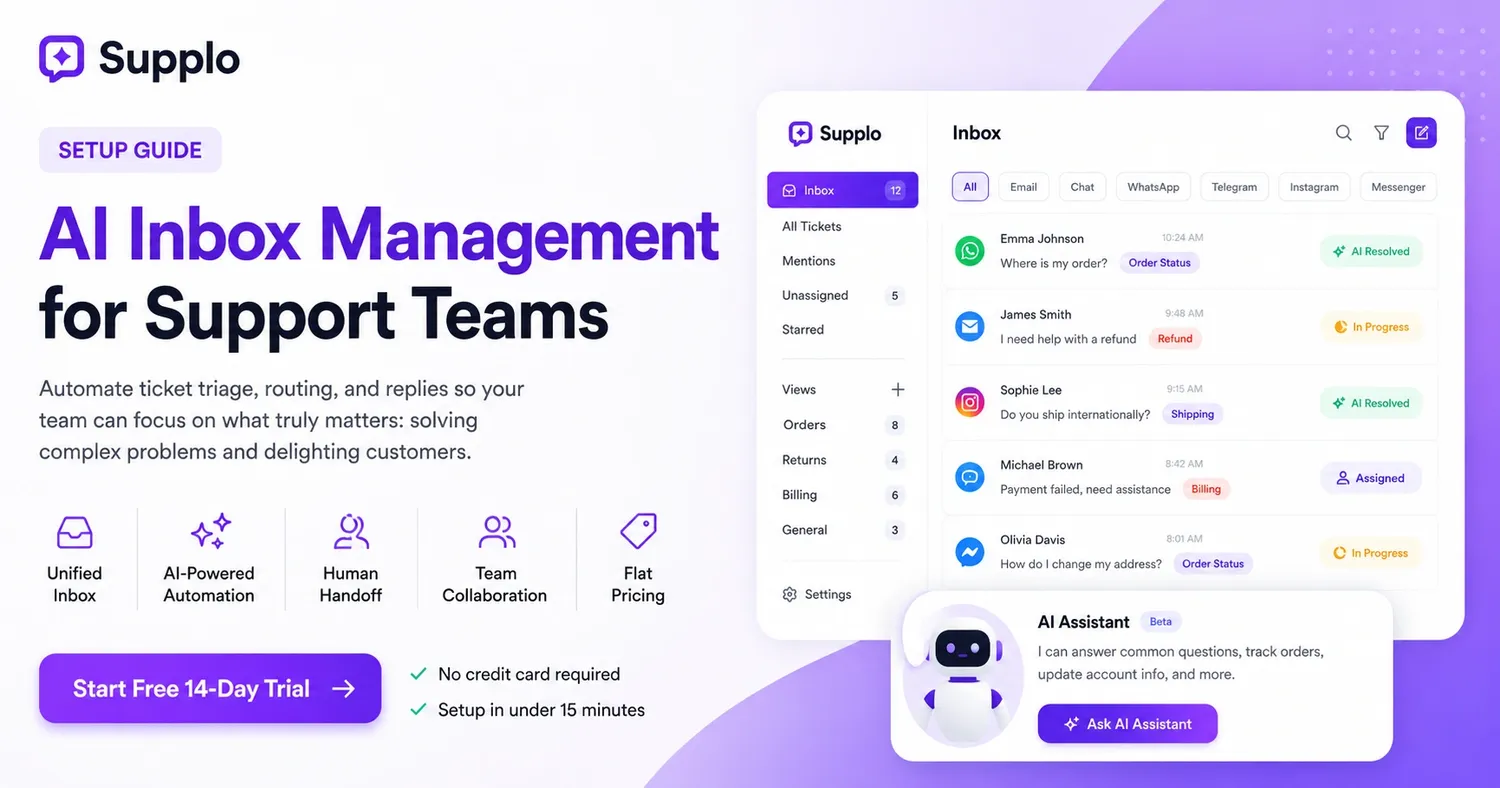
Your team might be manually sorting countless messages that a capable AI could handle in moments. Sound familiar? That's precisely why AI inbox management for support teams is quickly becoming essential. It takes away all that repetitive, tedious work: things like auto-tagging, smart routing, and even handling common questions. This frees your agents to tackle the truly challenging stuff that really needs human thought.
This guide is perfect for support teams aiming to work smarter, not harder, all without breaking the bank on clunky, outdated software. If your inbox feels more like a flood than a controlled stream, then keep on reading!
Quick Answers
- Automate ticket sorting and responses with AI assistance.
- Significantly cut down response times and lower agent burnout.
- Consolidate all communication channels into one central inbox.
- Teach the AI using your existing knowledge base content.
- Establish clear rules for escalating complex inquiries.
- Begin your free 14-day trial at Supplo.io today.
Why Your Support Team Needs a Smarter Inbox Now
Here’s the plain truth: a basic inbox that can't automatically tag, sort, or respond costs you dearly. Every minute an agent spends just triaging messages is a minute lost that could be spent solving actual customer problems. AI inbox management changes this dynamic. It learns from past interactions and instantly directs tickets to the right place. The result? Faster, more efficient service, less stress for your team, and a more enjoyable work environment.
- On average, support agents waste hours daily just sorting messages; AI inbox automation slashes this time to almost zero.
- Customers anticipate prompt replies, usually within minutes. A smart inbox helps you meet these expectations without hiring additional staff.
- Traditional tools often charge per user, but modern AI inbox solutions, such as Supplo, offer flat per-workspace pricing. This means scaling your operations won't suddenly inflate your budget.
What's AI Inbox Management? How It Differs From Old Ticketing Systems
Simply put, AI inbox management uses machine learning to automatically categorize, prioritize, and respond to incoming support messages. This includes communication from email, live chat, social media DMs, and other platforms. Unlike older ticketing systems that demand manual sorting and tagging, an AI-powered inbox learns from your team's actions and your knowledge base. It can either resolve tickets independently or efficiently hand them over to a human.
- It brings all channels together into a single, continuous thread-based inbox, so agents never have to jump between different tabs.
- The AI constantly improves over time without needing constant manual retraining.
- Pricing structures shift from a per-seat model to a per-workspace model, ensuring predictable costs.
The Top 5 Essential Features for AI Inbox Tools
Not all AI inbox tools are created equal; honestly, many look great on paper but fall apart in real-world use. The best ones consistently offer five core features: unified multichannel support, a self-improving AI capable of handling most tickets autonomously, seamless human handoff, strong real-time collaboration tools, and straightforward pricing. If any of these are missing, you’re just creating more manual work for yourself.
- Multichannel unification: Connects email, website widget, WhatsApp, Telegram, Instagram, and Facebook Messenger all into one threaded inbox.
- Self-learning AI: Trains itself using your knowledge base and past conversations to provide accurate answers.
- Seamless handoff: The AI smoothly transfers conversations to a human agent without losing any important context.
- Collaboration tools: Includes internal notes, shared draft replies, and rules for assigning tasks.
- Flat pricing: Ensures no hidden surprises on your bill as your team grows.
Setting Up an AI-Powered Inbox for Customer Support
You can set up an AI inbox in under 15 minutes, provided you choose the right tool. First, link all your customer communication channels—email, chat widgets, WhatsApp, Telegram, Instagram DMs, and Facebook Messenger—to a single workspace. Next, upload your knowledge base to teach the AI about your products and common issues. Finally, establish rules for when the AI should hand off to a human agent, and then watch as it instantly starts resolving tickets. This is how you efficiently implement AI inbox management for support teams, hassle-free.
Connect Your Communication Channels
Begin by linking every channel your customers use to reach you. Whether it’s email, live chat, WhatsApp, Telegram, Instagram DMs, or Facebook Messenger, all communications feed into one central inbox. With Supplo, this setup takes just a few clicks, eliminating the need to constantly switch between different tabs.
Train the AI Using Your Knowledge Base
Upload your existing knowledge base to educate the AI about your products, services, and frequently asked questions. You can also use the integrated knowledge base editor to add FAQs and essential product documentation. The more data you provide, the more intelligent the AI becomes.
Define Escalation Rules
Establish guidelines for when the AI should transfer a ticket to a human agent. You can configure triggers based on factors like customer sentiment, specific keywords mentioned, or how long a ticket has been open. This ensures that complex issues receive human attention, while routine inquiries are handled instantly.
- Start your 14-day free trial to configure your system without any financial commitment.
- Utilize the built-in knowledge base editor for creating FAQs and product documentation.
- Set up escalation triggers based on sentiment, specific keywords, or the age of a ticket.
Automate Your Support Inbox Without Losing the Human Touch
Many people misunderstand this: automation doesn't mean your team disappears. The best AI inbox tools let you precisely decide which requests the AI handles and which ones require human intervention. You can configure tone guidelines, include a clear "talk to a human" option, and ensure complex conversations are always directed to a real person. The key is finding the right balance between speed and empathy.
- Use personalization tokens, like a customer's name or order information, in AI replies to maintain a warm and friendly tone.
- Ensure every automated response includes a clear option for customers to connect with a human agent.
- Review the AI's performance weekly to refine which types of tickets it should manage.
AI Inbox Management for Remote and Distributed Teams
Remote teams face unique challenges: varying time zones, asynchronous communication, and disparate tools. AI inbox management resolves these by providing a single source of truth for every support conversation. Agents can collaborate using internal notes and mentions, and the AI handles initial responses even when no human is available.
- A threaded inbox ensures continuity of context across different shifts and time zones.
- Mobile applications allow agents to respond to inquiries from any location.
- Automated translation capabilities break down language barriers with global customers.
Choosing the Right AI Ticketing System for Small Businesses
Small businesses don't need the complexity of enterprise systems. Instead, they require solutions that are affordable, quick to set up, and straightforward enough not to need a dedicated IT team. Look for flat per-workspace pricing (rather than per-seat charges), easy self-service onboarding, and a free trial period to test it before committing. Supplo's AI inbox automation for small businesses is designed specifically for these needs, offering transparent pricing and no hidden seat limits.
- Opt for flat pricing models instead of per-seat charges, which can penalize business growth.
- Ensure the AI can learn from your existing knowledge base without requiring any coding.
- Check for integrations with your current tools, such as email or Shopify, to streamline workflows.
Setting Up a Smart Inbox for Customer Support
Once your basic inbox is operational, fine-tune it. Create custom tag groups, set up auto-replies for common questions, and use sentiment analysis to highlight urgent tickets. A smart inbox goes beyond just AI responses; it’s about organizing information so your team can focus on what truly matters.
- Establish rule-based auto-tagging for specific issues like product problems, refund requests, or complaints.
- Utilize saved replies for frequently asked questions that the AI might not yet handle.
- Monitor unanswered tickets regularly to improve the AI's coverage and accuracy over time.
Collaboration Features That Make AI Inbox Tools Transformative
AI inbox tools aren't just for automation; they're powerful collaboration centers. Features like internal notes, @mentions, shared drafts, and assignment rules enable your team to work together seamlessly without ever leaving the inbox. This is particularly valuable for distributed teams, where quick, informal communication can be challenging.
- Internal notes remain hidden from customers but are visible to your entire team.
- Shared drafts allow multiple agents to refine a single reply before sending.
- Assignment rules direct tickets to the most appropriate person based on their skills or current workload.
How to Gauge Your AI Inbox's Effectiveness
You need clear metrics: resolution rate, first response time, customer satisfaction (CSAT), and escalation rate. A well-implemented AI inbox should boost your resolution rate without negatively impacting customer satisfaction. Track these metrics weekly and adjust your knowledge base or escalation rules to continuously improve performance.
- Compare response times before and after incorporating AI into your workflows.
- Monitor how many tickets the AI fully resolves versus how many it hands off to human agents.
- Collect customer feedback on automated replies and adjust the tone as needed.
Common Pitfalls and How to Avoid Them When Automating Support
The biggest error? Letting the AI operate without supervision. A poorly trained AI can frustrate customers with irrelevant answers. Other common issues include over-automation (offering no human contact option) and neglecting multilingual support. Always test your AI using real tickets first and ensure there's always a way for customers to reach a human agent.
- Begin by testing with a limited set of tickets, then expand as the AI's accuracy improves.
- Never use AI to automate sensitive account actions, such as password resets or billing changes.
- Regularly update your knowledge base to ensure the AI's answers remain current and accurate.
Future-Proofing Your Support Operations with AI Inbox Automation
AI inbox technology is advancing rapidly. To stay ahead, select a tool that automatically updates its AI models, integrates new communication channels as they emerge, and offers flexible pricing that scales with your business. Look for a solution committed to continuous learning, not just static rules.
- Choose a platform that consistently adds new integrations, such as updates to the WhatsApp Business API.
- Ensure your AI inbox can manage increased ticket volumes without requiring manual scaling efforts.
- Evaluate vendor transparency: do they publish uptime and accuracy statistics for their services?
Key Takeaways
- AI inbox management automates the sorting and responding to tickets, allowing your support team to concentrate on more complex matters.
- The top solutions integrate email, chat, WhatsApp, Telegram, Instagram, and Facebook Messenger into one unified threaded inbox.
- To get started, link your communication channels, train the AI using your knowledge base, and define escalation rules. You can begin a 14-day free trial right away.
- Avoid common mistakes by testing the AI with real tickets and always providing an option for human assistance for sensitive issues.
- Select a tool that supports ongoing learning and frequently adds new integrations to ensure your support operations remain future-ready.
FAQ
Is AI inbox management legal for customer support?
Yes, provided you adhere to data protection regulations like GDPR and CCPA, and clearly inform customers about the use of automated responses. Supplo is not affiliated with any app or website. Always follow each app's terms and local regulations.
Why do some AI inbox tools fail to resolve tickets correctly?
This typically happens when the AI lacks sufficient relevant training data or when the knowledge base it uses is outdated. Regular updates to your FAQs and historical data are crucial for improving accuracy.
Should I opt for a one-time setup or an ongoing service for AI inbox automation?
An ongoing subscription ensures your AI continues to learn from new interactions and adapts to changes in your products or policies. One-time setups quickly become obsolete.
What should I NOT use AI inbox automation for?
Avoid using AI for sensitive account changes, legal disputes, or conversations that demand a high degree of empathy and nuanced judgment. Always escalate these specific cases to a human agent.
How long does it typically take to train an AI inbox for my team?
With a modern tool like Supplo, you can expect to see significant improvements within the first week. Achieving full optimization generally takes about a month, as the AI learns from your team's adjustments and corrections.
Can AI inbox management effectively work for teams that communicate in multiple languages?
Yes, Supplo automatically translates messages, enabling your AI to process requests in any language and respond in the customer's preferred language.
What should I do if my AI inbox resolution rate declines?
Review recent changes to your knowledge base, check for new patterns in ticket types, and update your rules as needed. Most platforms offer analytics that help pinpoint where the AI might be struggling.
Compliance line: Supplo is not affiliated with any app or website. Please follow each app's terms and local regulations.