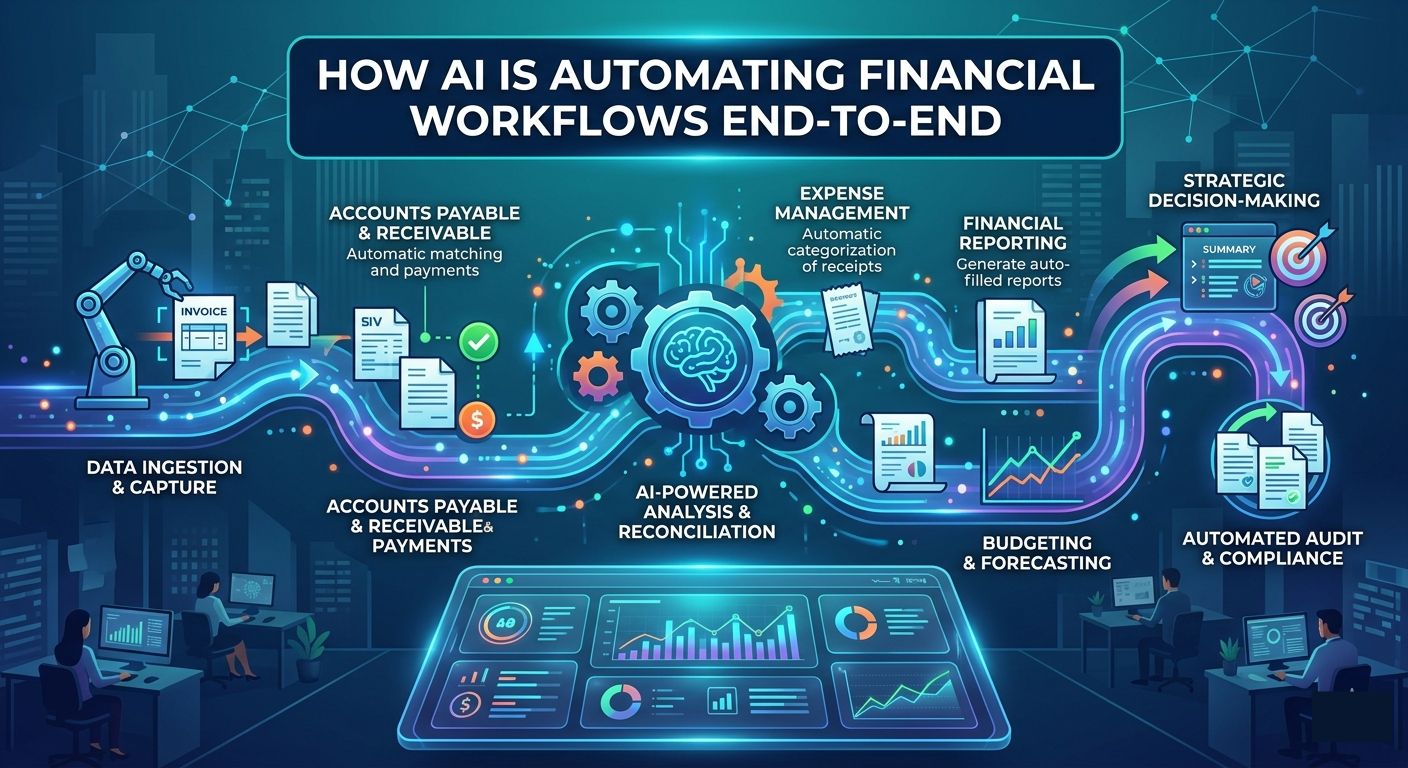
Finance teams handle a wide range of processes that depend on data flowing across systems, documents, and departments. The problem begins when these workflows remain fragmented, with manual steps between systems slowing down operations and increasing the risk of errors. As transaction volumes grow and reporting timelines shorten, these inefficiencies become more visible.
Traditional automation has focused on isolated tasks, leaving gaps between processes. This results in delays, inconsistent data, and limited visibility across finance functions.
AI introduces a different approach by connecting workflows, enabling continuous data movement, and supporting real-time processing. This blog explains how end-to-end financial workflow automation works, where traditional systems fall short, and what changes when AI connects finance operations from start to finish.
What End-to-End Financial Workflow Automation Means
Understanding the concept helps clarify why AI is being adopted across finance functions.
Definition of Financial Workflows in Enterprise Finance
Financial workflows refer to sequences of processes such as invoice handling, reconciliation, reporting, and credit evaluation that move financial data across systems and teams.
What “End-to-End” Covers Across Finance Operations
End-to-end automation connects every stage of a workflow, from data capture to final reporting, without breaks between systems or manual hand-offs.
Difference Between Task Automation and Workflow Automation
Task automation focuses on individual steps, such as data entry. Workflow automation connects multiple steps, ensuring data flows seamlessly from one stage to another.
To understand how AI supports these processes at a broader level, this article on AI in corporate finance explains how financial workflows are being restructured.
Why Traditional Financial Workflows Break at Scale
As operations grow, traditional workflows struggle to maintain efficiency and accuracy.
Fragmented Processes Across Finance Functions
Different finance functions often operate in silos, leading to disconnected workflows.
Manual Data Handling Across Systems and Documents
Manual data entry and validation increase workload and introduce errors.
Delayed Visibility into Financial Operations
Finance teams often rely on delayed data, which affects decision-making.
Dependence on Sequential, Step-Based Processing
Workflows that depend on step-by-step processing slow down overall operations.
These limitations highlight why a connected approach is required.
Core Finance Functions Being Automated with AI
AI is being applied across multiple finance functions to improve efficiency and consistency.
Accounts Payable and Invoice Processing
Invoice data is captured and processed automatically, reducing manual effort.
Accounts Receivable and Cash Application
Incoming payments are matched with invoices more efficiently.
Financial Reconciliation and Close Processes
Reconciliation is handled continuously, reducing delays in closing cycles.
Financial Spreading and Credit Analysis
Financial data is structured and analyzed for credit decisions.
Expense Management and Reporting
Expenses are categorized and reported with minimal manual input.
For a broader view of how automation applies across finance, this resource on financial process automation explains its role in improving financial workflows.
How AI Connects Disconnected Financial Workflows
The real impact of AI lies in connecting processes rather than automating them individually.
Unified Data Flow Across Finance Systems
AI enables data to move seamlessly between systems without manual intervention.
Continuous Data Capture from Documents and Transactions
Financial data is captured in real time from multiple sources.
Linking Upstream and Downstream Finance Processes
Processes such as invoice capture and reconciliation are connected, reducing delays.
Reducing Hand-offs Between Teams and Systems
Fewer manual transitions improve efficiency and consistency.
Key Technologies Powering End-to-End Automation
Several technologies support AI-driven financial workflows.
Document Intelligence for Data Extraction
Financial data is extracted from documents such as invoices and statements.
Machine Learning for Pattern Recognition
Patterns in financial data are identified to improve accuracy.
Natural Language Processing for Context Understanding
Text-based financial data is interpreted based on context.
Workflow Orchestration Across Financial Processes
Processes are coordinated across systems to maintain continuity.
Where Automation Breaks Without Context Awareness
Automation without context leads to limitations that affect outcomes.
Rule-Based Systems Failing with Data Variability
Static rules cannot handle variations in financial data.
Misinterpretation of Financial Line Items
Incorrect classification affects financial analysis.
Handling Exceptions That Do Not Follow Patterns
Unusual cases require deeper understanding beyond predefined rules.
Disconnect Between Data Extraction and Decision Logic
Extracted data may not align with how decisions are made.
What Changes with AI-Driven Financial Workflows
AI introduces a more connected and adaptive approach to workflows.
Context-Aware Processing Across Financial Data
Data is interpreted based on meaning rather than position.
Continuous Workflow Execution Instead of Batch Processing
Processes run continuously instead of waiting for scheduled cycles.
Automated Exception Identification and Routing
Exceptions are identified and directed for resolution quickly.
Real-Time Visibility into Financial Operations
Finance teams gain immediate insight into ongoing activities.
Operational Impact of End-to-End Automation
These changes lead to measurable operational improvements.
Reduction in Processing Time Across Finance Functions
Tasks are completed faster due to continuous processing.
Lower Dependency on Manual Data Entry
Automation reduces repetitive manual work.
Increased Throughput Without Expanding Teams
Higher volumes are handled without adding resources.
Improved Consistency Across Financial Outputs
Standardized processes lead to consistent results.
Financial Impact Across the Organization
The benefits extend beyond operations into financial outcomes.
Better Cash Flow Visibility and Planning
Accurate data supports better financial planning.
Reduced Cost of Finance Operations
Lower manual effort reduces operational costs.
Improved Accuracy in Financial Reporting
Consistent data improves reporting accuracy.
Stronger Control Over Financial Data
Continuous monitoring improves financial control.
The Hidden Gaps in Partial Automation Approaches
Partial automation often leaves critical gaps in workflows.
Automation Limited to Individual Tasks Instead of Workflows
Disconnected automation creates inefficiencies.
Data Silos Between Finance Systems
Lack of integration limits visibility.
Manual Intervention Between Automated Steps
Human intervention slows down processes.
Lack of Continuous Data Synchronization
Data inconsistencies arise when systems are not aligned.
Why End-to-End Automation Is a Data Standardization Challenge
At its core, automation depends on consistent data.
Variability in Financial Documents and Inputs
Different formats create challenges in processing.
Inconsistent Data Structures Across Systems
Data misalignment leads to errors.
Need for Unified Financial Taxonomies
Standard definitions are required for consistency.
Aligning Data Across Multiple Finance Functions
Data must be consistent across all processes.
Decision-Level Benefits of AI-Driven Workflows
Better workflows lead to stronger decision-making.
Faster Financial Close and Reporting Cycles
Continuous processing reduces delays in reporting.
More Accurate Financial Insights for Decision-Making
Reliable data supports better decisions.
Improved Risk Detection Across Transactions
Patterns and anomalies are identified early.
Better Alignment Between Finance and Business Teams
Shared data improves coordination across teams.
How Finance Teams Can Move Toward End-to-End Automation
Transitioning requires a structured approach.
Identifying High-Impact Workflow Bottlenecks
Focus should be on processes that create delays.
Connecting Disparate Systems Through Data Pipelines
Systems must communicate effectively.
Introducing Continuous Processing Across Workflows
Workflows should operate without interruption.
Building Feedback Loops for Ongoing Improvement
Continuous feedback improves performance over time.
Future Direction of AI in Financial Workflows
Financial workflows continue to move toward more connected systems.
Real-Time Finance Operations Across All Functions
Processes will operate continuously across finance functions.
Predictive Insights Based on Financial Data Patterns
Historical data will help anticipate outcomes.
Convergence of Finance, Risk, and Compliance Workflows
Finance processes will integrate with risk and compliance functions.
Organizations that adopt connected workflows can improve both efficiency and accuracy in financial operations. For teams looking to structure financial data and support credit workflows at scale, exploring financial spreading software can provide a more consistent approach.