Driving gets you from one place to another. AI literacy determines where you're allowed to go in the first place.
Here's a simple question worth sitting with: when your child turns 18, will they be ready for a world already running on artificial intelligence — or will they be catching up to it?
We teach children to drive because the world is built around roads. AI is the new road. It runs beneath hiring platforms, healthcare tools, financial systems, and nearly every professional environment your child will step into. Understanding how it works isn't a technical bonus anymore. It's basic preparation for adult life.
And unlike driving, the learning can't wait until 17.
The window is shorter than you think
A child starting Class 6 today enters the workforce around 2035. The World Economic Forum estimates over 85 million jobs will shift due to AI within that window. The students who will thrive aren't necessarily the ones who become engineers — they're the ones who grew up understanding AI well enough to work alongside it, question it, and use it with judgment.
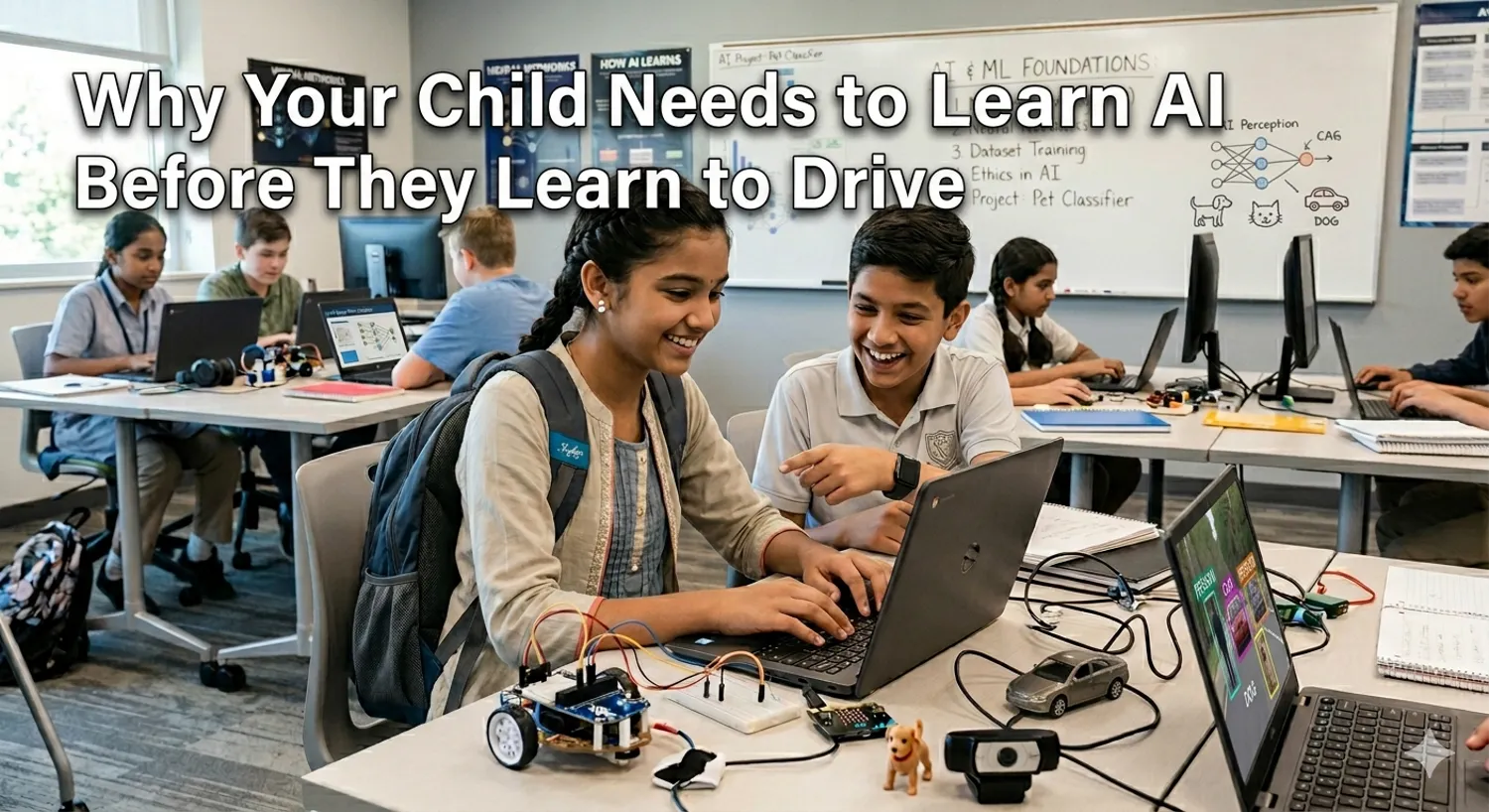
That kind of fluency doesn't come from a one-semester elective. It comes from years of age-appropriate, hands-on exposure — exactly what structured teaching AI in schools programs are designed to deliver, starting as early as Class 3.
Knowing how to use it isn't the same as understanding it
Most children already interact with AI daily — recommendation algorithms, voice assistants, auto-generated content. But using a tool and understanding it are completely different things. A student who has only ever consumed AI is poorly placed in a world that increasingly rewards those who can interrogate it.
Good teaching AI in schools doesn't just show students what AI can do. It shows them how it learns, where it fails, and why the decisions made during its design carry real consequences. A student who has trained a model on biased data and watched it fail doesn't need a lecture on AI ethics. They've already lived it.
Access is the part most people skip over
Right now, meaningful AI education is concentrated in metros and well-funded private schools. Students in Tier 2 and Tier 3 cities — the majority of India's school-going population — are largely left out. Not because they're less capable, but because nobody brought the program to their school yet.
That gap compounds. Miss three foundational years and you don't just lack a skill — you lack the confidence and vocabulary to build on later.
Learning to drive is a rite of passage. Learning AI is a head start. One of them can reasonably wait until 18. The other, given how fast the ground is shifting, genuinely cannot.