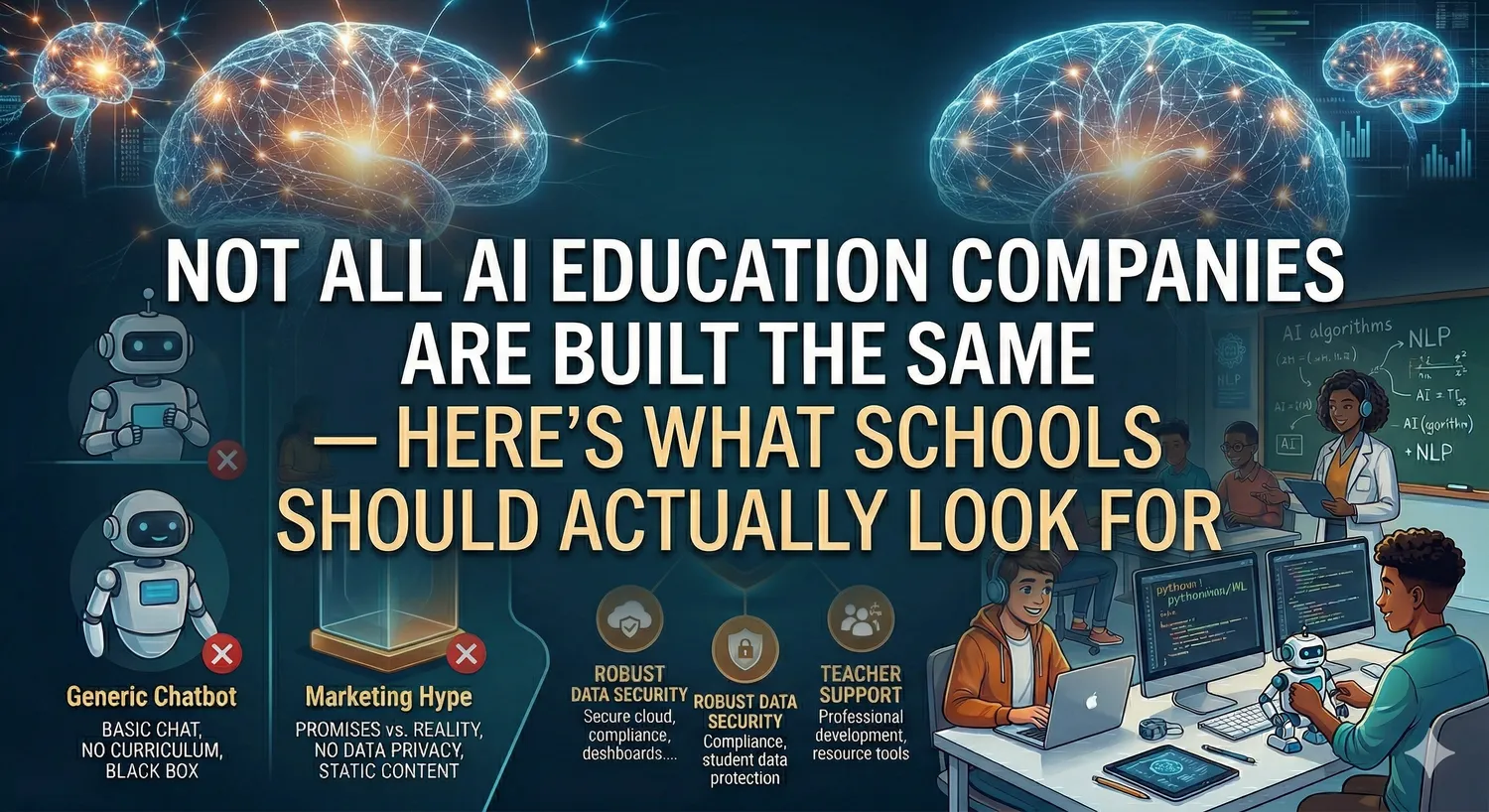
Spend five minutes searching for AI education programmes for schools and you'll find no shortage of options. Platforms, apps, bootcamps, curriculum kits, online courses — the market has exploded. Everyone, it seems, wants a piece of the EdTech moment.
Which is great, in theory. More options mean more access, more competition, and ideally better outcomes for students. But here's the problem nobody talks about loudly enough: most schools have no reliable framework for evaluating what's actually worth bringing into their classrooms — and a lot of what's being sold is, at best, surface-level.
So what should a principal, a trustee, or an academic director actually look for when choosing among AI education companies?
Certifications Are the Starting Point, Not the Finish Line
Every company in this space will lead with credentials. Global partnerships, recognised certifications, university affiliations — it's the first thing on every brochure. And yes, certifications matter. A student walking out with a globally recognised credential has something tangible to show for their learning.
But a certificate without capability is just paper. The more important question to ask any provider is: what did the student build to earn it? If the answer is "they completed a series of modules and passed an assessment," that's a very different outcome from "they designed and presented an AI project." One produces a qualified student. The other produces a confident one.
Who Is Actually Doing the Teaching?
This is the question most schools forget to ask — and it matters enormously.
There's a significant difference between a programme designed by practitioners who have actually built AI systems at scale and one assembled by curriculum designers working off research papers. The former brings real-world texture to the learning — the kind of nuance, war stories, and practical insight that no textbook can replicate.
Also Read: AI for Schools in India
The best AI education companies don't just have impressive advisor lists. They have those advisors actively involved in shaping what gets taught and how. When a student learns that a particular approach to machine learning has real limitations — not because a slide said so, but because a mentor who worked on it at a major tech company explained why — that lesson sticks differently.
Does It Fit the School, or Does the School Have to Fit It?
A common frustration among school administrators who've adopted EdTech programmes is rigidity. The programme arrives with its own schedule, its own devices, its own assessment model — and the school has to contort itself to accommodate it.
Good AI education programmes work the other way around. They're designed to integrate into existing school structures, align with the national curriculum framework, and flex around a school's specific constraints — class sizes, teacher availability, infrastructure. If a company can only deliver its programme under a very specific set of conditions, it's not really built for Indian schools. It's built for an idealised version of them.
Ask for Outcomes, Not Testimonials
Testimonials are warm. Outcomes are useful. When evaluating any programme, ask for specific, measurable results — not just quotes from happy students. How many students went on to pursue AI-related pathways? What did their projects look like? How did teacher confidence change after implementation? What does Year 2 look like compared to Year 1?
Companies that have been doing this long enough and well enough will have real answers to those questions. Those that don't will redirect you to another testimonial.
The Bottom Line
The explosion of AI education companies entering the school market is a good thing — but only if schools develop the discernment to choose well. The right partner doesn't just deliver a programme. It shifts the culture of a school around technology, builds lasting capability in students, and leaves teachers more empowered than it found them.
That's a high bar. But for something as consequential as preparing children for an AI-driven future, it's exactly the bar schools should be holding every provider to.