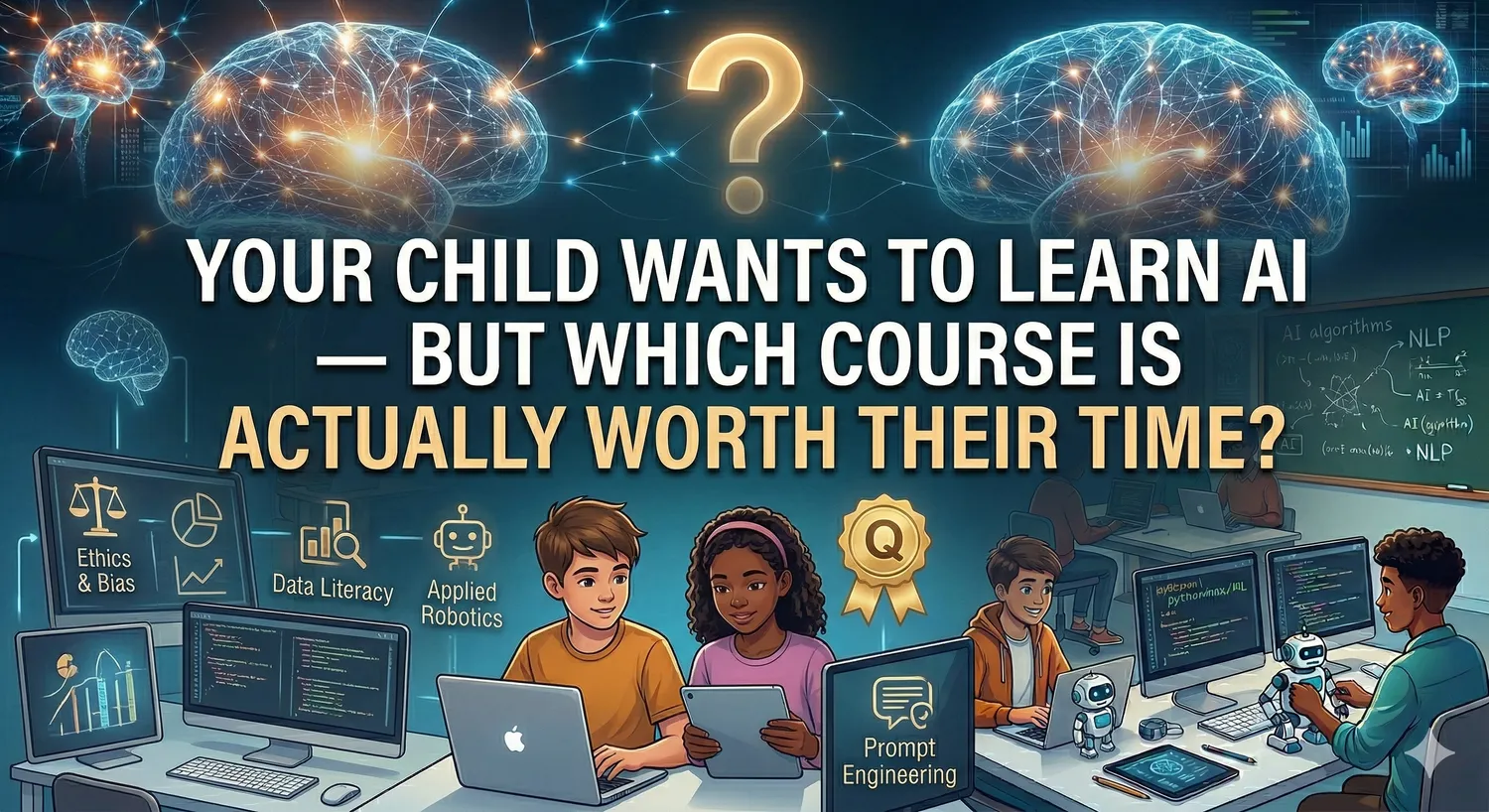
It usually starts with a moment of curiosity. A student watches a video about self-driving cars, or asks ChatGPT something and gets a surprisingly good answer, or sees a peer build something impressive at a science exhibition. Suddenly, they want in. They want to understand how it works. They want to build something themselves.
So the parent opens a browser. The school sends home a brochure. The child starts watching YouTube tutorials. And within about twenty minutes, everyone is thoroughly overwhelmed.
The market for AI courses for school students has grown faster than most families can make sense of. So before anyone spends money — or more importantly, a child's time and enthusiasm — here's what's actually worth paying attention to.
The YouTube Rabbit Hole Is Not a Curriculum
There's genuinely excellent free content online about artificial intelligence. No argument there. A motivated teenager can learn a surprising amount from the right channels and resources.
But self-directed online learning has a structural problem: it has no arc. A student might understand how neural networks work on Tuesday, have no context for why that matters on Wednesday, and lose interest entirely by Friday. Curiosity without scaffolding tends to fizzle — not because the student isn't capable, but because learning without progression feels like wandering rather than building.
A well-designed AI course for school students does something a playlist of videos simply cannot: it builds on itself. Each concept earns its place because of what came before and what comes next. That cumulative structure is what turns a curious student into a capable one.
Age Matters More Than Most Courses Acknowledge
Here's something the EdTech marketing rarely admits: a lot of AI courses pitched at "school students" are actually designed for late high school or early college learners. Hand them to a Class 7 student and you'll get glazed eyes within the first session — not because the child isn't bright, but because the content wasn't built for where they actually are developmentally.
Also Read: Artificial Intelligence in Education
The most effective programmes treat Class 4 and Class 11 as genuinely different learners — because they are. A younger student needs to build intuition: what does it mean for a machine to learn? What is data, really? An older student is ready for project complexity, specialisation, and career-adjacent thinking.
If a course doesn't specify who exactly it's designed for — and how it adapts across age groups — that's worth questioning before enrolling.
Theory Without a Project Is a Wasted Semester
Ask any student who has sat through a term of AI theory what they remember six months later. Then ask a student who spent that same term building a working AI project — however simple — what they remember.
The difference isn't subtle. Doing something with knowledge cements it in a way that no amount of reading or note-taking replicates. The best AI courses for school students are built around creation. The theory exists to serve the project, not the other way around.
When a Class 9 student in a mid-sized Indian city trains a simple image classifier and demonstrates it to their class, something shifts — not just in their understanding of AI, but in their sense of what they're capable of. That's the outcome a good course should be aiming for.
What to Actually Check Before Enrolling
Skip the brochure language and ask three practical questions. First, what will my child have built by the end of this? Second, who designed the curriculum and do they have real experience in AI — not just in education? Third, how does the course handle a student who falls behind or races ahead?
The answers will tell you more than any feature list or celebrity endorsement.
Enthusiasm Is the Asset — Don't Waste It
A child who is curious about AI is sitting on something genuinely valuable. That curiosity, pointed in the right direction, can compound over years into skills, confidence, and opportunities that will define their professional life.
The wrong course won't just waste a few months. It'll teach a motivated student that AI is boring, difficult, or not for someone like them — and that lesson is much harder to undo than it is to prevent.
Choose carefully. The right AI course for school students doesn't just teach artificial intelligence. It teaches a child that they belong in the conversation.