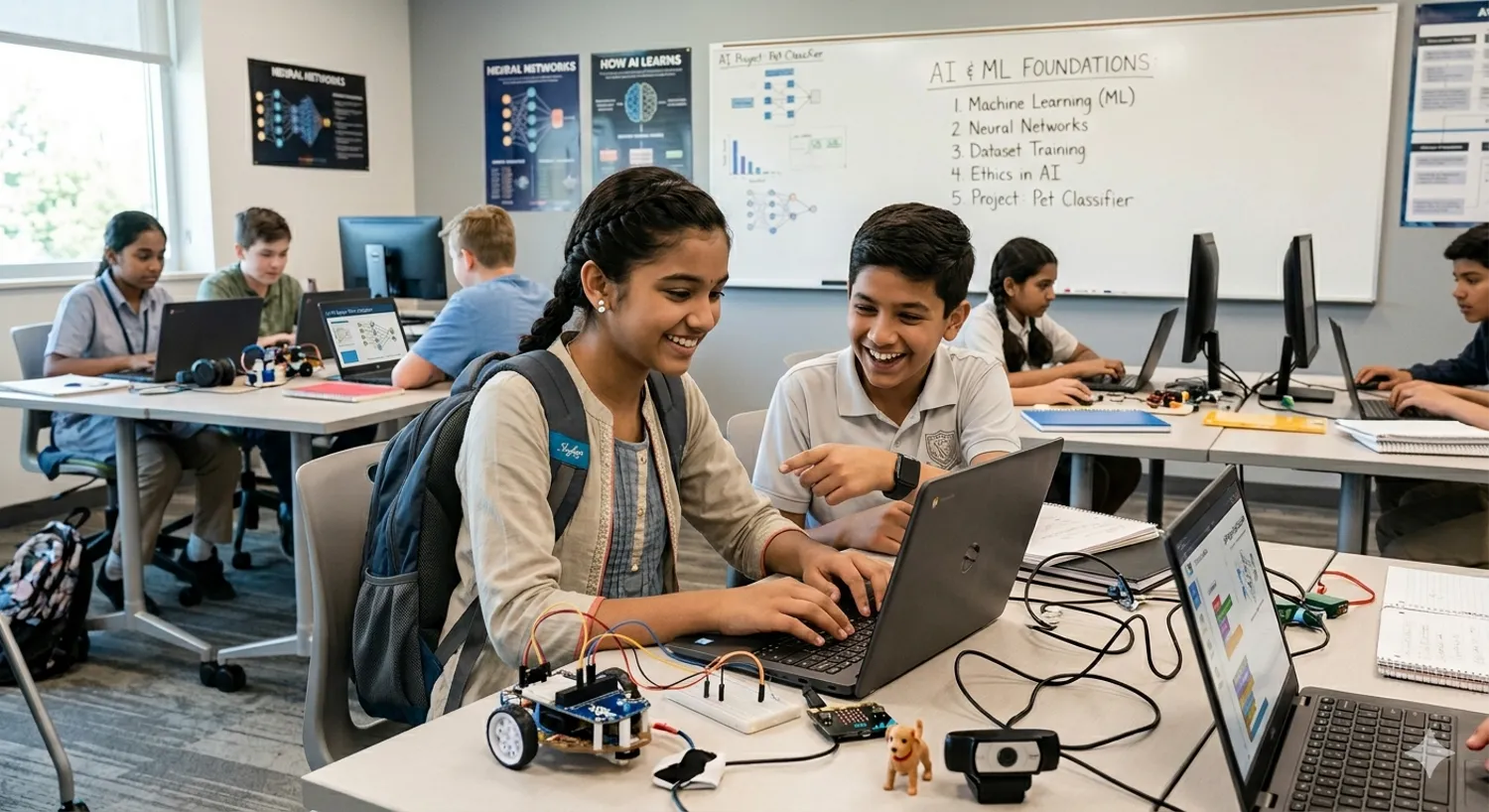
Ask most parents what happens in an AI class and you'll get one of two guesses: kids staring at lines of code, or kids watching robots bump into walls. Ask the 8th grader who just walked out of one, and you'll get a different answer entirely.
"We built something that actually works." That's the kind of sentence worth paying attention to.
There's a widespread misconception that artificial intelligence in education — especially at the school level — is either too advanced to be meaningful or too dumbed-down to be worth taking seriously. The reality, when it's done right, is neither. A well-designed Class 8 AI curriculum sits in a genuinely interesting middle ground: intellectually demanding without being exclusionary, practical without being shallow.
So what actually happens inside that classroom? Let's get specific.
It starts with how machines think — not how humans code
The entry point for most Class 8 students isn't programming syntax. It's a question that sounds almost philosophical: how does a computer learn? Not execute — learn. There's a difference, and once a 13-year-old grasps it, something clicks that no amount of Excel tutorials could have triggered.
Students are introduced to the concept of neural networks — loosely, the idea that machines can be trained using examples rather than explicit rules. They see how a system exposed to thousands of images of cats doesn't get told "a cat has pointy ears and whiskers." It figures out patterns on its own, the same way a child does. This framing — AI as pattern recognition rather than programmed instruction — changes how students think about the technology they interact with every day.
Suddenly, the recommendation algorithm on YouTube isn't magic. It's math. And more importantly, it's something they can understand.
Also Read: Advancing Education with AI
The projects are where it gets real
Theory, even well-taught theory, only sticks when it collides with something concrete. This is where project-based learning earns its reputation — and where the right artificial intelligence in education framework separates itself from the pack.
A typical Class 8 AI project might involve building a basic image classifier — training a model to distinguish between two categories of objects using a visual dataset. Students collect data, label it, feed it into a simple training interface, and observe what happens when the dataset is too small or too biased. That last part is especially instructive: watching their own model fail because of bad data teaches them something no lecture on AI ethics could fully replicate.
These aren't hypothetical exercises. They're portfolio pieces. By the time students finish Class 8, they have documented, working projects they can point to — something remarkably few adults can say about their own professional experience with AI.
Critical thinking gets baked in early
One thing that distinguishes a serious AI curriculum from a tech gimmick is how it handles the uncomfortable questions. What happens when an algorithm is wrong? Who's responsible when an AI system discriminates? Can a machine be fair?
These aren't discussions reserved for ethics electives in college. They're woven into the Class 8 experience — not as abstract debates, but as natural extensions of the projects students are already working on. When a student's own classifier makes an error because their training data lacked diversity, the lesson about bias becomes visceral rather than theoretical. They didn't read about it. They caused it, observed it, and were asked to fix it.
That kind of learning leaves a mark.
The mentorship dimension changes everything
Here's something that standard school curricula cannot replicate on their own: exposure to people who actually build AI systems for a living. When a student in a Tier 2 city gets to hear directly from engineers at Google AI or OpenAI — not through a video someone uploaded in 2019, but through live interaction with working professionals — the sense of what's possible shifts dramatically.
It's not just motivational. It's directional. A student who asks a mentor "how did you get here?" gets an answer that a textbook simply cannot provide. Careers in AI stop being abstract and start looking like a series of steps that someone actually took. For many students, this is the first time artificial intelligence in education feels like something that belongs to them — not just to engineers in Bangalore or researchers in California.
What they walk away with
By the end of a strong Class 8 AI program, students don't just know what artificial intelligence is. They know how it learns, where it fails, how to build a basic version of it, and why the choices made during that process carry real consequences. They've presented work. They've faced feedback. They've iterated.
That's not a shallow digital literacy tick-box. That's the beginning of a genuinely different way of engaging with the world — one that will compound quietly but powerfully over the next decade of their education and career.
The 8th grader who walks out of that class isn't an AI expert. But they're no longer a passive observer of technology that shapes their life. That shift — from user to understander — is exactly what it means to start building fluency. And fluency, as always, starts early.