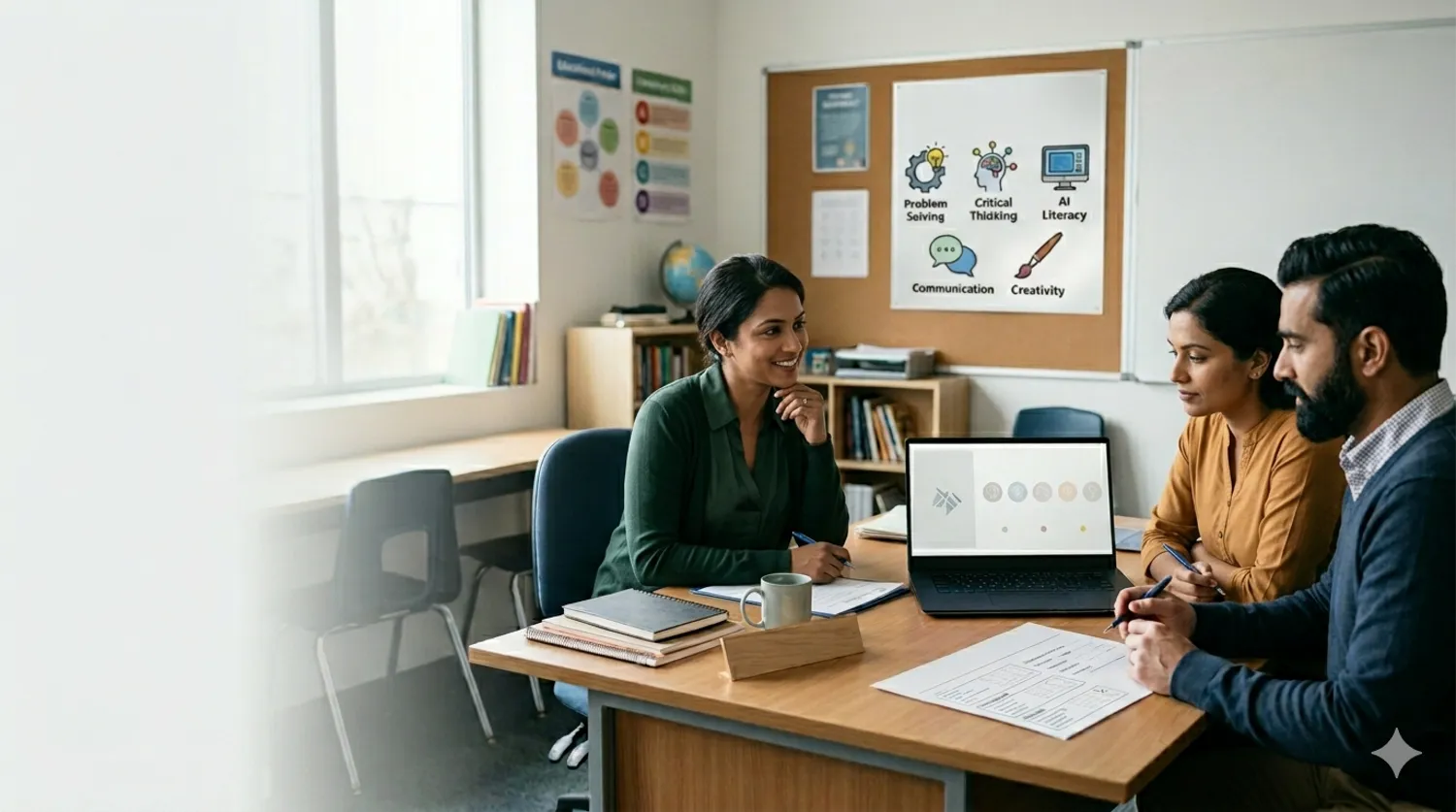
Every PTM covers attendance, marks, and behaviour. Not one of them asks whether your child knows how the world they're walking into actually works.
Parent-teacher meetings follow a familiar script. How is Riya doing in Maths? Is Arjun paying attention in class? Are the grades improving since last term? These are reasonable questions — nobody's arguing otherwise. But there is a glaring absence in almost every one of these conversations, and it's becoming harder to ignore.
Nobody asks about AI.
Not the parents, not the teachers, not the school leadership. And yet artificial intelligence in schools is no longer a futuristic talking point — it is the single most consequential skill gap that today's students will carry into tomorrow's workforce if we don't address it deliberately and soon.
The gap isn't about grades
Here's what makes this particular silence so costly: the students who will struggle aren't necessarily the ones failing their exams. They could be the ones topping their class — diligent, hardworking, genuinely bright — but graduating into a world where the baseline expectation has quietly shifted beneath them.
Industries across every sector — healthcare, agriculture, finance, design, even teaching itself — are being reorganised around AI tools. The professionals thriving in those spaces aren't just the ones with the best degrees. They're the ones who understand how these systems work, can work alongside them, and know when to question what they produce.
That kind of literacy doesn't appear on a report card. It doesn't come up at a PTM. And it almost certainly won't develop on its own.
What schools in Madhya Pradesh are already doing differently?
AI for Schools — MP's first dedicated AI initiative for students — was built specifically to close this gap. Across 250+ partner schools, students from Class 3 to Class 12 follow a structured, NEP 2020-aligned curriculum that introduces artificial intelligence in schools not as an add-on, but as a core part of how they learn to think.
A Class 7 student isn't just reading about machine learning — they're beginning to understand how machines identify patterns. A Class 10 student is building an actual AI project and adding it to a portfolio. A Class 12 student is preparing for career pathways with globally recognised certifications, backed by mentors from Google AI, OpenAI, Meta, Apple, and Scale AI.
These aren't elite opportunities reserved for students in Delhi or Bengaluru. They're happening right here — in Tier 2 cities, in schools where nobody expected Silicon Valley mentorship to show up.
The conversation that needs to happen
The next time you sit across from your child's teacher, it's worth asking a question that isn't on the standard PTM agenda: what is this school doing to prepare my child for a world shaped by artificial intelligence?
If the answer is uncertain, that's not a criticism — it's an opening. Because the gap exists not from neglect but from the simple fact that most schools haven't yet been shown a practical, structured way to fill it.
AI for Schools exists to be exactly that — the practical answer to a question most PTMs haven't thought to ask yet. The students already inside this program aren't waiting for the conversation to catch up. They're building, learning, and moving forward. The only question is whether your child's school will join them.
AI for Schools is MP's first AI education initiative, bringing NEP 2020-aligned, hands-on AI learning to students from Class 3 to Class 12 across 250+ partner schools — with real projects, global certifications, and mentorship from Google AI, OpenAI, Meta, Apple, and Scale AI.
Also Read: Advancing Education with AI