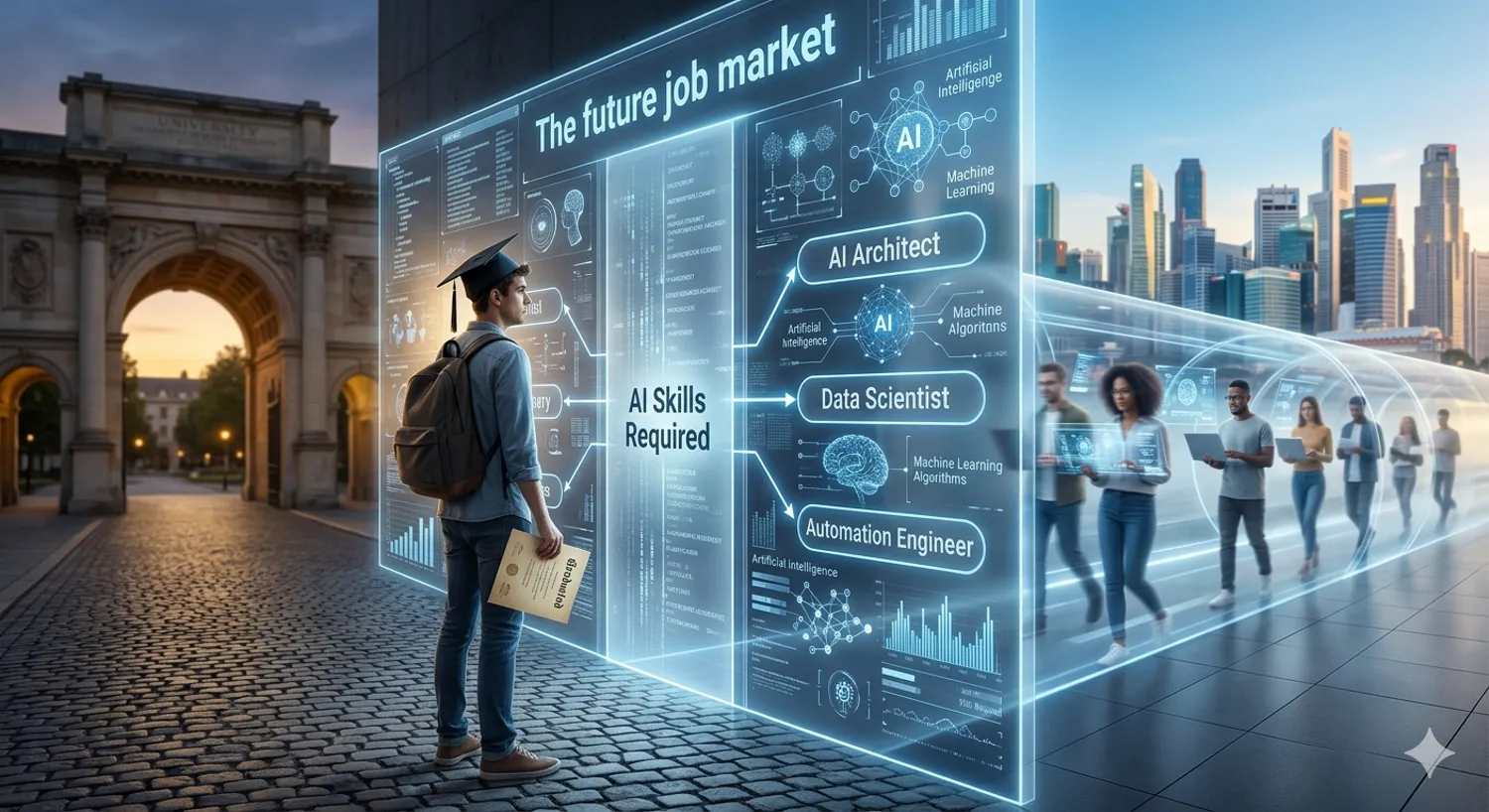
There’s a question most school administrators aren’t asking yet — but probably should be.
What actually happens to a student who spends twelve years in school, clears their boards, maybe even scores well, and steps into the world with zero understanding of artificial intelligence?
The short answer: they struggle. The longer answer is what nobody wants to say out loud.
The Job Market Isn’t Waiting
Recruiters at mid-size and large companies across India are already filtering candidates differently. It’s not just about degrees anymore. The ability to work withAI tools — to prompt, evaluate, iterate, and apply — is quietly becoming a baseline expectation in fields ranging from marketing to medicine, logistics to law.
A 2023 World Economic Forum report flagged AI literacy as one of the most critical skills for the workforce of the next decade. That future? It’s already here for freshers graduating today.
Students who can navigate AI tools confidently walk into interviews differently. They solve case studies faster. They prototype ideas in hours, not weeks. The ones who can’t? They often don’t even realize what they’re missing — and that’s the most uncomfortable part.
It’s Not About Becoming an Engineer
Here’s a misconception worth clearing up: AI education doesn’t mean every child needs to become a data scientist or write Python code at sixteen.
What it actually means is this — understanding how AI systems think, knowing when to trust them and when not to, being able to use them as creative and analytical tools, and eventually, building simple AI-powered solutions to real problems. These are the skills that separate an average graduate from a genuinely future-ready one.
This is exactly why the conversation around AI for schools in India is gaining urgency. It’s not a luxury conversation for elite metro schools. It’s a ground-level necessity — especially for students in Tier 2 and Tier 3 cities who are competing in the same national (and increasingly global) job market.
The Classroom Gap Is Widening
Some schools have started integrating AI into their curriculum. Most haven’t. And the gap between those two groups is compounding quietly, year after year, batch after batch.
A student at a school with structured AI educationbuilds a project portfolio by Class 10. They’ve worked with real tools, received mentorship, earned certifications. By the time they apply to college or sit for an interview, they have something to show — not just marks.
The student without that exposure? They’re not less intelligent. They’re just less prepared. Through no fault of their own.
The Fix Isn’t Complicated
Schools don’t need to overhaul everything. They don’t need a new building or a massive budget. They need a structured, age-appropriate AI curriculum — starting as early as Class 3 — that grows in depth alongside the student.
The discomfort isn’t in the problem. The problem is obvious. The discomfort is in continuing to delay the solution while another batch of students graduates unprepared.