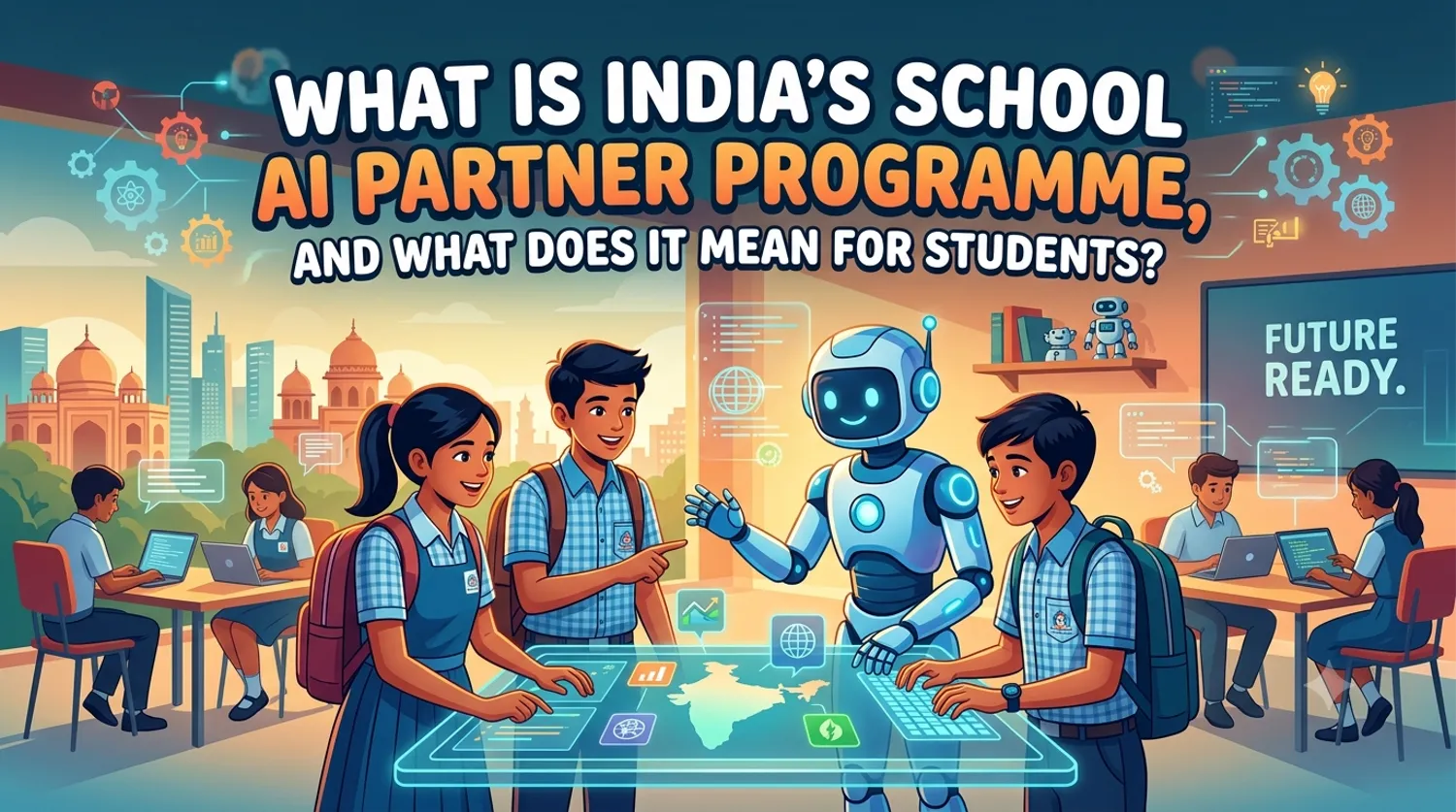
If you've noticed your teacher using a chatbot to plan lessons, or your textbook suddenly has a QR code linking to an AI assistant, you're not imagining things. Over the past year, India has quietly become one of the biggest classrooms in the world for artificial intelligence — and the school AI partner programme India has launched isn't run by just one company. It's a growing web of collaborations between the government, global tech firms, and schools themselves.
Why Is This Happening Now?
India's National Education Policy (NEP) 2020 already flagged AI as a priority area, calling for tools that support teaching, assessment, and personalized learning. That policy groundwork is now meeting real momentum: tech companies see India's massive student population as fertile ground for AI adoption, and the government sees an opportunity to close skill gaps early. The Union Budget 2025–26 backed this push with the announcement of a Centre of Excellence in Artificial Intelligence, reinforcing India's commitment to lead in the global AI landscape.
Who's Actually Involved?
The school AI partner programme India has attracted isn't one neat initiative — it's several running in parallel:
- OpenAI's Learning Accelerator is working with India's Ministry of Education to provide ChatGPT access for teachers in government schools from Classes 1 to 12, alongside training programs meant to build AI literacy among both students and educators.
- Google DeepMind has partnered with Atal Tinkering Labs, which serves more than 10,000 Indian schools and 11 million students, to weave robotics, coding, and a curriculum-grounded Gemini assistant into local classrooms.
- Google for Education is also rolling out a free Gemini training series for teachers, localized into six Indian languages including Hindi, Marathi, and Punjabi, in partnership with several state governments.
- Nonprofits like Wadhwani AI are working alongside the government to develop AI tools for platforms such as SWAYAM, aiming to reach tens of millions of students and educators in the coming years.
What This Means Inside the Classroom
For students, the practical effect is showing up gradually rather than overnight. Some schools now use AI to generate practice quizzes or personalized study guides. Teachers are increasingly leaning on AI to draft worksheets and lesson plans, freeing up time for actual mentoring. And features like ChatGPT's "Study Mode" were specifically designed to walk students through problems step by step rather than just handing over answers — a small but meaningful shift toward learning over shortcuts.
The Other Side of the Story
Not everything about this rollout is smooth. Many schools are still figuring out how to tell AI-assisted work from a student's own effort, and there's no single national policy yet spelling out exactly how AI should — or shouldn't — be used for homework and exams. Teachers report mixed results: some students use these tools to genuinely understand tricky topics, while others use them to skip the thinking part entirely.
The Takeaway for Students
Whatever shape it eventually takes, the school AI partner programme India is building right now isn't going away — it's becoming part of how Indian classrooms function. The students who benefit most won't be the ones who let AI do their thinking for them, but the ones who learn to use it as a study partner: asking better questions, checking its answers, and using the extra time it saves to actually understand the material rather than just finish faster.