There's a question that more school principals and trustees across India are beginning to ask themselves — quietly, sometimes anxiously — in board meetings and staff rooms: Are we already behind?
The topic is AI for schools in India, and the honest answer, for most institutions, is that they are underprepared in ways they haven't fully mapped yet. Not because of a lack of intent, but because the gap between awareness and action in this space is wider than it looks.
The "We Have a Computer Lab" Trap
Walk into most schools today — even well-funded private ones — and you'll find a computer lab. Maybe a smartboard or two. Perhaps a subscription to some educational software. And leadership will point to these proudly when the topic of "technology in education" comes up.
But here's the thing: having computers in school in 2025 is roughly equivalent to having books in school in 1980. It's a baseline, not a differentiator. The question isn't whether your school has technology. It's whether your students are being taught to think with it, build with it, and eventually lead with it.
AI literacy is not just another subject to add to the timetable. It's a fundamentally different way of engaging with problems — and most schools haven't yet made that mental shift.
What NEP 2020 Actually Demands (And What's Being Ignored)
India's National Education Policy 2020 is explicit about integrating AI into school curricula as part of a shift toward skill-based, future-ready learning. It's not a suggestion buried in an appendix — it's a core pillar of the policy's vision.
And yet, walk through the actual implementation in schools on the ground, and you'll find the conversation mostly stuck at the level of "should we add a coding elective?" That's not what NEP 2020 is pointing toward. It's pointing toward a reimagination of how students across all subjects and grades engage with computation, data, and intelligent systems.
The schools that get this right won't just be adding AI as a class. They'll be weaving it into how students think about science experiments, how they approach creative projects, how they build arguments in a debate.
The Tier 2 and Tier 3 City Problem Nobody Talks About Enough
Here's a pattern worth noticing: the schools that have taken early steps toward genuine AI education are, almost exclusively, concentrated in metros. Mumbai, Bengaluru, Delhi, Hyderabad — the same cities that already have a disproportionate share of educational resources, coaching centres, and exposure to global careers.
Students in Bhopal, Indore, Nagpur, Lucknow, or smaller towns and cities are being handed the same standardised curriculum, but without any of the informal exposure that helps metro students understand why any of it matters. A student in Connaught Place might casually absorb the vocabulary of machine learning simply by proximity to people in tech. A student in a smaller city has no such luck.
This is the digital divide — and it's not just about internet access anymore. It's about whether a 14-year-old in a Tier 3 city has any realistic chance of building the skills that the job market of 2035 will reward.
Also Read: Future of AI in Education
The Theory vs. Practice Chasm
Even schools that have introduced AI-related content tend to make the same structural mistake: they treat it like a knowledge subject rather than a skill subject.
Students read about how neural networks work. They watch videos about machine learning. They appear in tests that ask them to define supervised learning. And then... nothing. No project. No creation. No experience of actually building something that uses AI.
Compare this to how schools teach, say, chemistry. You don't just read about titration — you do titrations. The lab is non-negotiable. There's a tacit understanding that some knowledge only becomes real through doing.
AI is no different. In fact, the doing is arguably more important for AI than for most other subjects, because AI tools are so accessible. A 16-year-old with a laptop and the right guidance can build a functioning machine learning model. They can train a classifier. They can create something that's actually useful. The barrier isn't technical capacity — it's the absence of structured, hands-on learning pathways inside schools.
What Silicon Valley Mentorship Looks Like in an Indian Classroom
One of the more interesting developments in the Indian school education space is the arrival of programs that bridge the gap between global AI expertise and classroom-level delivery. The model that's gaining traction brings mentors from organisations like Google AI, OpenAI, Meta, and Apple into the learning loop — not as distant, aspirational figures that students read about, but as active participants in guiding projects and shaping learning pathways.
What does this actually mean for a student in Class 9 sitting in a school in Madhya Pradesh?
It means that when they build their first AI project, they're not doing it in isolation, hoping their school's computer teacher can answer their questions. They're working within a structured framework developed by people who have spent careers building AI at scale. The feedback loops are different. The ceiling on what students can achieve is raised dramatically.
Initiatives like AI for Schools — which has already partnered with over 250 schools and claims the distinction of being the first AI initiative of its kind in Madhya Pradesh — are structured around exactly this model. Their programs span Class 3 through Class 12, building from foundational digital literacy to AI specialisation, with an explicit focus on project-based learning and certifications that carry real global credibility. The philosophy is straightforward: students should learn to create AI tools, not merely consume them.
The Certification Gap — And Why It Matters More Than Parents Think
Here's a practical reality that most school administrators haven't fully internalised: in the next five to ten years, university admissions processes and early-career hiring will increasingly look for demonstrable AI skills.
Not "we had a computer elective" — but actual, verifiable evidence that a student knows how to work with AI systems. Portfolios. Project exhibitions. Global certifications backed by recognisable institutions.
This isn't speculative. The World Economic Forum has identified AI literacy as among the most critical skills for future employment. Universities in the US, UK, and increasingly in India are already factoring in evidence of applied technical capability when evaluating candidates from a crowded applicant pool.
A student with a globally recognised AI certification, a portfolio of real projects, and demonstrated ability to work with machine learning tools is not the same as a student who merely scored well on a theory paper. Schools that help their students build that evidence are giving them something tangible.
What "Ready" Actually Looks Like
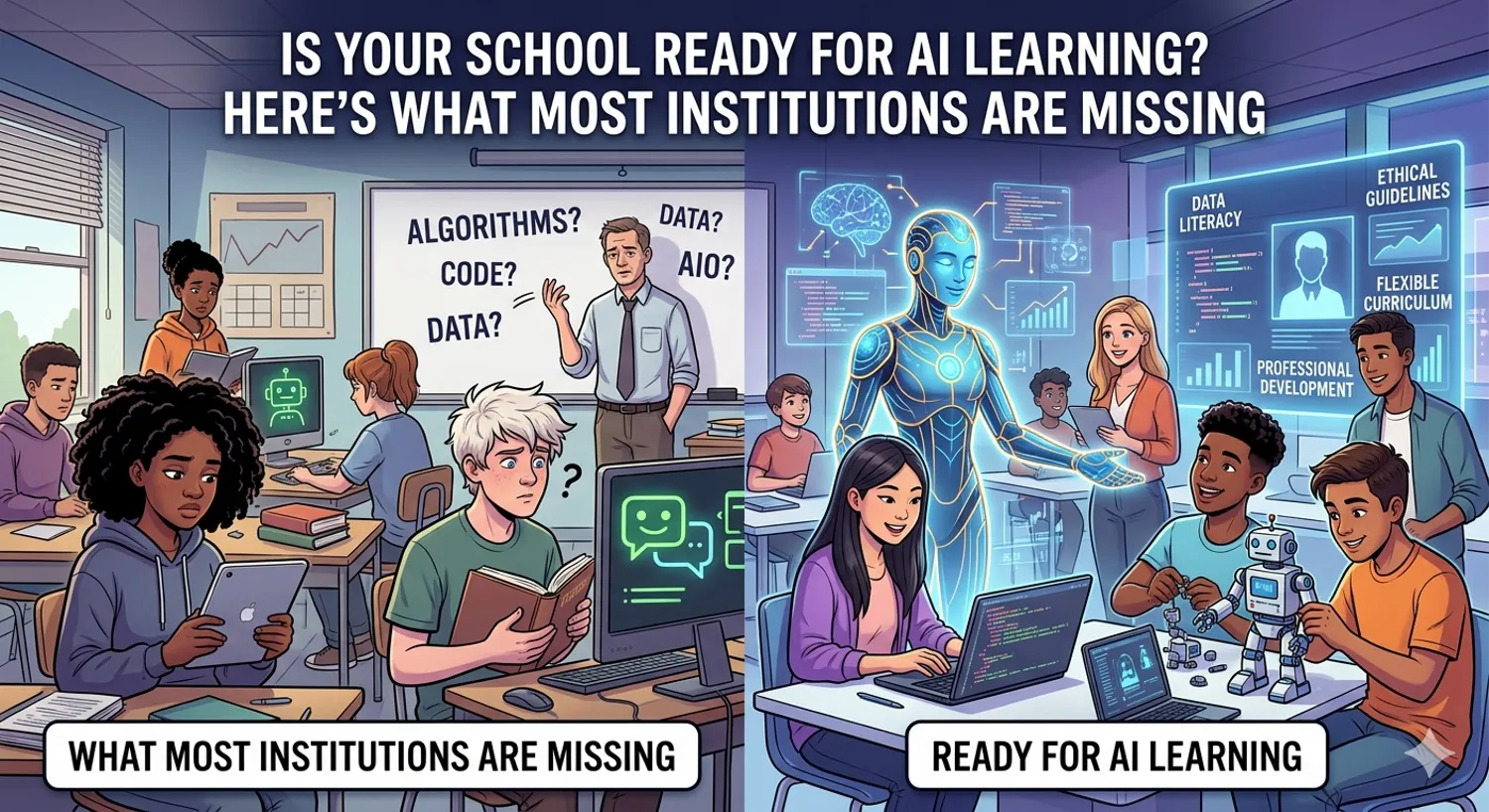
So what does an AI-ready school actually look like? It's not a checklist, but there are some clear markers:
The curriculum isn't just talking about AI — it's having students work withAI. There are structured projects, not just exercises. Students are building things they can show someone.
There's a progression that makes sense. A Class 4 student exploring digital literacy and a Class 11 student developing specialised AI applications are on different points of the same journey, not in disconnected silos.
Teachers are supported. One of the biggest failure modes in school technology integration is deploying a program and expecting overworked, under-trained teachers to deliver it without proper backing. Institutions that get this right provide their educators with training, resources, and curriculum guidance that doesn't require them to become overnight experts.
There's a pathway that extends beyond school. AI literacy that terminates at Class 12 with no clear connection to what comes next — whether that's higher education, vocational training, or entrepreneurship — is a missed opportunity. The best programs build explicit career pathways into their design.
The Uncomfortable Question for School Leaders
If you run a school, here's the question worth sitting with: in ten years, when your current Class 6 students are entering the workforce, what will they say about what their school prepared them for?
The window for easy, unhurried action is narrowing. Schools that move thoughtfully but promptly — that build genuine AI learning infrastructure rather than adding a checkbox to their brochure — will have given their students a head start that compounds over time.
Those that wait for a government mandate, or for the "right" curriculum to arrive fully formed, risk sending a generation of students into a world where the baseline has already shifted dramatically past what they were taught.
The good news is that the infrastructure to do this well already exists in India. Organisations working at the intersection of global AI expertise and local accessibility are actively partnering with schools — in metros and in smaller cities alike. The frameworks are battle-tested. The curricula are NEP-aligned. The mentorship pipelines are real.
The only remaining question is whether school leadership is willing to move from conversation to commitment.
The Bottom Line
When it comes to AI for schools in India, the gap isn't primarily about resources or geography — it's about imagination. Imagining what school could look like when students are taught not just to use AI, but to think critically about it, build with it, and shape it. When Tier 2 and Tier 3 city students have access to the same quality of mentorship and credentials as anyone in a global tech hub. When the classroom is not just a place where content is delivered, but where future innovators are made.
That future is possible. It just requires schools to stop asking whether they're ready and start deciding to become ready.