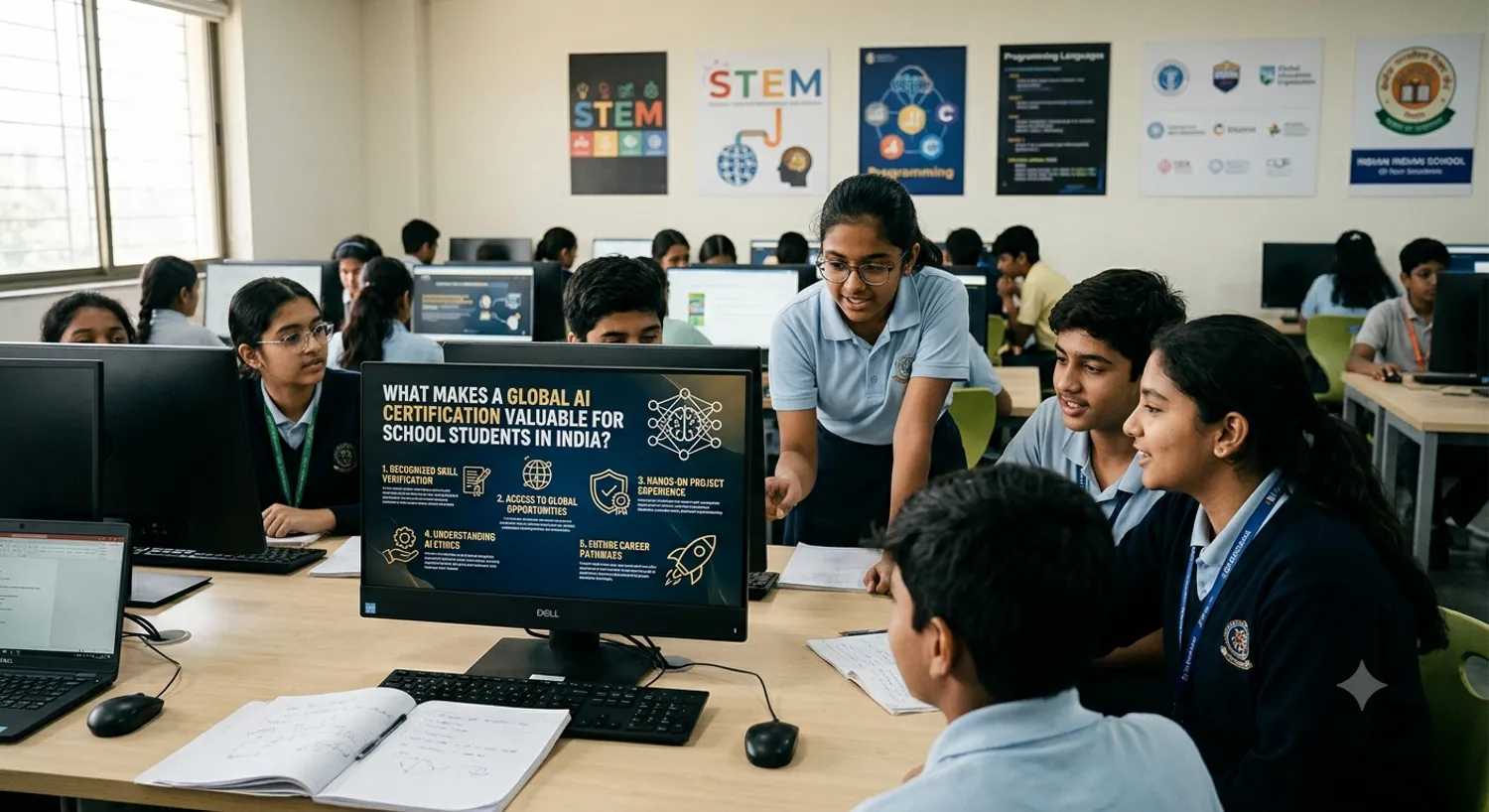
Every parent has heard it by now — "AI is the future." But here's the question nobody seems to ask out loud: if every platform is handing out certificates, what makes one actually worth something?
It's a fair concern. Especially in India, where students are already juggling board exams, tuition, and a dozen extracurriculars — the last thing a family needs is a shiny PDF that collects digital dust.
So let's talk about what separates a meaningful AI certification from one that's just noise.
It Has to Be Backed by Something Real
A certificate is only as credible as the name behind it. That's just the truth.
When a student earns a certification through an AI learning platform in Indiathat's a Google for Education Professional Development Partner — like AI for Schools — it carries institutional weight. It's not a random startup slapping a logo on a completion badge. It's a credential tied to a globally recognised ecosystem, one that universities, scholarship committees, and future employers actually understand.
That difference matters more than most parents realise.
The Learning Has to Come First
Here's where a lot of programs get it backwards — they design for the certificate, not the learning.
What's the point of a certification if a student can't explain what they actually built or learned? Real value comes when the curriculum makes students dosomething — solve problems, build projects, apply tools. When a Class 9 student in Bhopal can walk into an interview or college application and say, "I built this AI project," that's a conversation-starter. A certificate is just the proof.
AI for Schools structures its programs around exactly this — hands-on, project-based learning from Class 3 all the way to Class 12, so the certification reflects actual skill development, not just attendance.
Relevance to India's Current Direction
India's NEP 2020 didn't mention AI by accident. The national policy is explicitly pushing for skill-based, technology-integrated learning — and schools that align with that vision are going to produce students who are genuinely ready for what comes next.
A certification that's built on an NEP 2020-aligned curriculum signals something important: this student didn't just learn AI in isolation. They learned it within a framework that India's education system recognises and is actively moving toward.
The Mentor Behind the Material
Curriculum matters. But so does who designed it.
There's a significant difference between content built by people working in the industry versus content built by people who read about it. When a program draws on expertise from Silicon Valley mentors — professionals who are shaping AI in practice — students get current, contextual knowledge, not a recycled textbook chapter.
The Bottom Line
A global AI certification is valuable when it's earned through genuine learning, backed by credible partners, aligned with national education goals, and designed by people who actually know the field.
For Indian school students, that combination isn't just an achievement. It's a head start.
Interested in bringing structured, certified AI education to your school? Explore programs at aiforschools.in