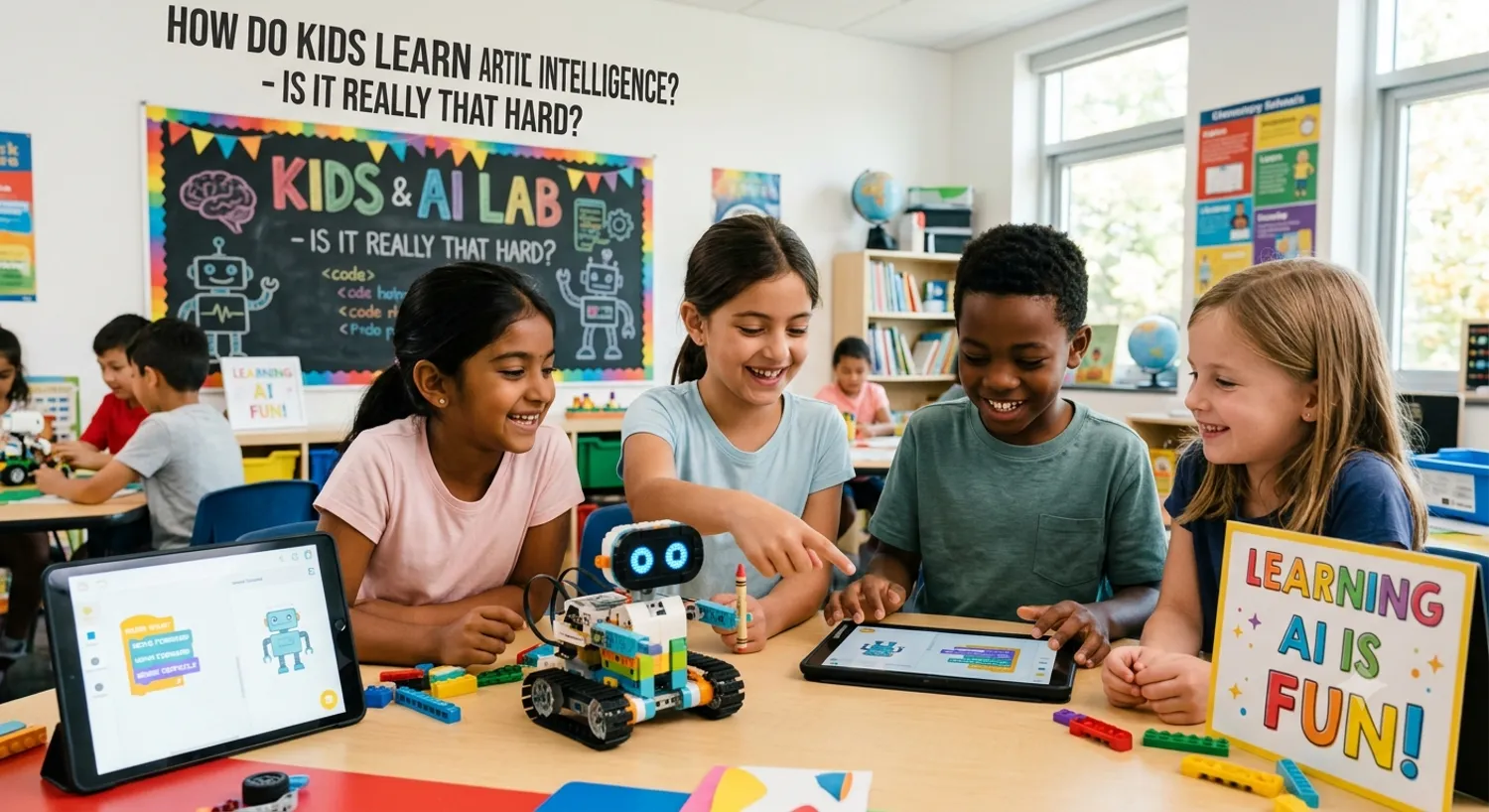
Ask any parent in India what they imagine an AI class looks like — and most will describe something between a coding bootcamp and a JEE coaching centre. Dense, intimidating, and definitely not for a 12-year-old who still needs reminders to finish homework.
That image isn't just wrong. It's costing kids real opportunities.
Nobody Starts with the Hard Stuff
Here's something that surprises most parents when they actually sit in on one of our sessions: there's no scary math on the board. No one's asking a Class 5 kid to write Python.
What you'll actually see — at least in the early grades — is a student teaching a computer to tell apart pictures of cats and dogs by showing it enough examples. Or a Class 7 group figuring out why their voice assistant got confused when someone spoke in Hinglish. These aren't simplified "kiddie" versions of AI concepts. This is how machine learning actually works, just experienced before the jargon gets piled on top.
Kids don't find this hard. They find it interesting. The "this is too complex" reaction almost always comes from adults who learned to associate AI with the most extreme version of it they've seen online.
India Has a Specific Problem Here
Across most Indian schools — even good ones — AI education for kidsis either absent or exists only on paper. A mention in the prospectus. A "coding club" that mostly does Scratch. CBSE introduced AI as an elective in Class 9 back in 2019, and yet walk into a random school in Indore or Nagpur today and ask a Class 9 student what they learned in AI last week. Silence, more often than not.
NEP 2020 has now mandated computational thinking from Grade 3. That's a significant policy shift. But mandates don't automatically become classrooms. The schools that have already figured out how to teach this — with real structure, trained faculty, and student projects that go beyond theory — are operating in a completely different league right now.
What "Actually Learning AI" Looks Like in Practice
At AI for Schools, we work across 250+ schools, mostly in Madhya Pradesh, and the thing that stands out isn't how smart these kids are — though they are. It's how quickly the hesitation disappears once they start building something.
A Class 9 student in Bhopal recently put together a basic recommendation model as part of her year-end project. She's not going to Google next year. But she understands, in a way most adults don't, how the algorithm deciding what she watches on YouTube actually functions. That kind of intuition — built young — doesn't go away.
Our sessions run inside school premises, offline, tied into the regular school day. No extra tuition centre. No weekend classes. Just AI woven into where students already are, taught by faculty who've been trained specifically for this.
So Is It Hard?
For kids taught properly — genuinely, no. The subject isn't the barrier. The shortage of schools doing it well is.
If your child's school hasn't started yet, the conversation worth having isn't "is my kid ready for AI." It's "why isn't my kid's school ready yet."
AI for Schools runs structured AI programs in 250+ schools across India, from Class 3 to Class 12. If you want your school on that list — let's talk.
Useful Links:
How Do I Learn AI as a Student in India? Here’s an Honest Answer
AI Course after 12th in India: Why Starting Early Changes Everything