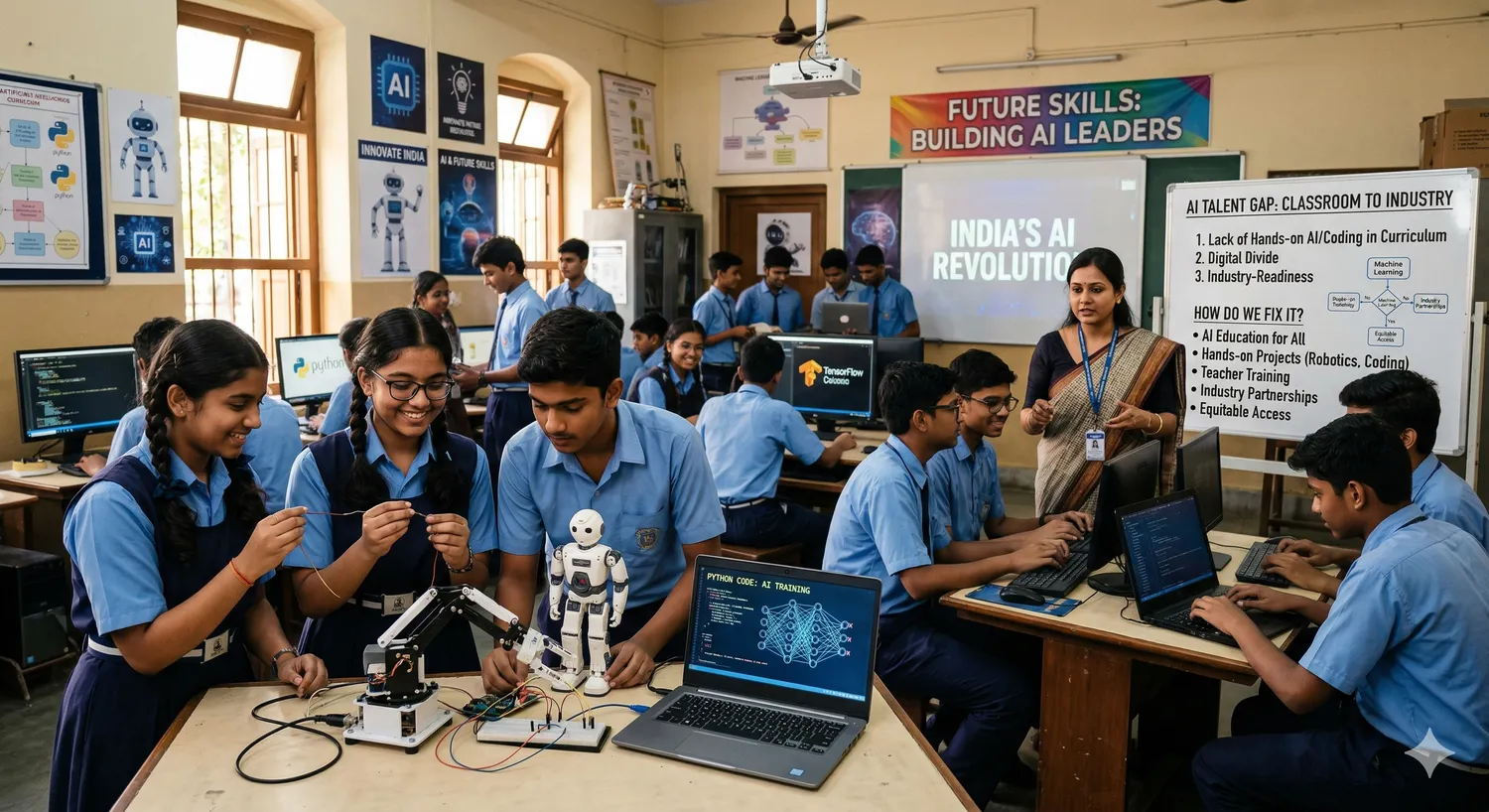
Walk into most Indian classrooms today and you'll find students memorising theorems, solving past papers, and preparing for board exams. What you won't find — in the majority of schools at least — is a single lesson on artificial intelligence. And that silence is becoming expensive.
India produces over 1.5 million engineering graduates every year. Yet companies across sectors — from healthtech to fintech to manufacturing — are struggling to find people who can actually work with AI. The disconnect isn't a coincidence. It's a curriculum problem, and it starts well before college.
Also Read: AI Course for School Students
The Gap No One Talks About Loudly Enough
Most conversations about India's AI future focus on IITs, research labs, and startup ecosystems. Fair enough — those matter. But the talent that feeds those spaces comes from somewhere. It comes from Class 9 students who either got curious about technology early, or didn't. It comes from a Class 6 kid in Bhopal or Nagpur who either had access to meaningful AI learning, or was handed a textbook about MS Paint.
The uncomfortable truth is that AI education in India is largely a metro privilege. Students in Delhi, Bengaluru, and Pune have access to coding bootcamps, robotics clubs, and tech-forward schools. Students in Tier 2 and Tier 3 cities — which make up the overwhelming majority of India's school-going population — largely don't.
This isn't a talent gap. It's an access gap wearing a talent gap's clothes.
Why Schools Are the Right Place to Start
By the time a student reaches a college computer science department, they've already formed their relationship with technology. Those who were exposed to hands-on, creative tech learning early arrive curious and confident. Those who weren't often arrive intimidated — even if they're equally intelligent.
This is why initiatives like AI for Schools are not just timely — they're necessary. Rather than waiting for students to "discover" AI in college or through YouTube tutorials, the idea is to bring structured, age-appropriate AI education directly into the school system, starting as early as Class 3. By the time those students reach Class 12, they don't just know what AI is — they've built things with it.
That shift — from consumer to creator — is exactly what India's talent pipeline needs.
What Fixing It Actually Looks Like
It doesn't require every school to hire a PhD in machine learning. What it requires is a practical curriculum, mentorship from people who've worked in the field, and a learning approach built around projects rather than theory.
When a Class 9 student in a small city builds an AI tool and showcases it at an exhibition, something changes in them. They stop seeing artificial intelligence as something that happens in Silicon Valley and start seeing it as something they can participate in — and eventually lead.
India's AI ambitions are real. But ambitions need pipelines. And pipelines start in classrooms.
The question isn't whether we can afford to bring AI for schools — it's whether we can afford not to.