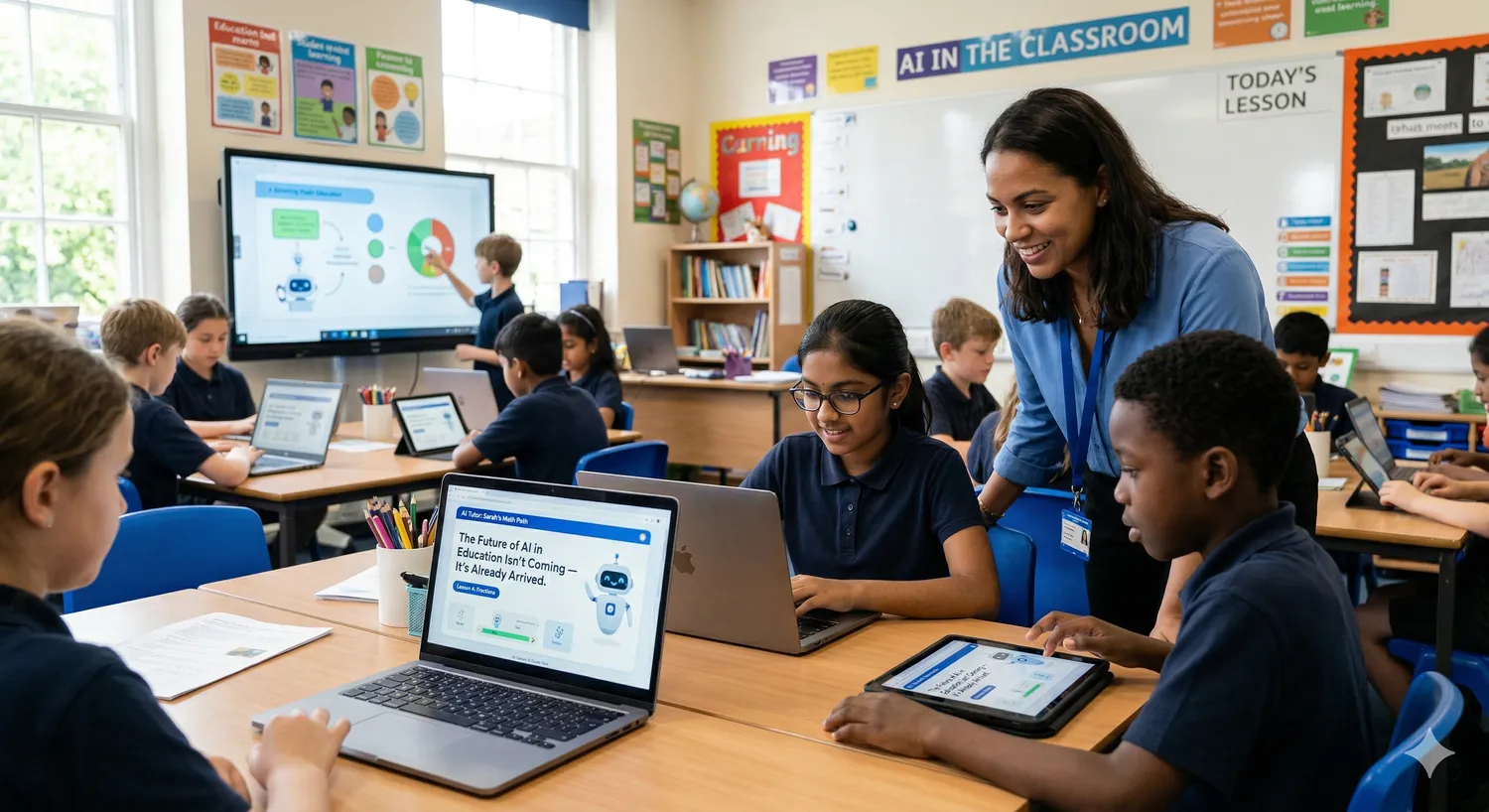
We have a habit of talking about the future as though it arrives all at once — a single switchover, a dramatic before and after. The future of AI in education gets discussed this way constantly. Breathless predictions. Conference keynotes. Policy papers full of "by 2030" statements.
But futures don't arrive uniformly. They arrive in patches. And in some classrooms across India right now — particularly in Madhya Pradesh — the future that everyone else is busy predicting is already the present.
The more useful question isn't what's coming. It's why some students are already living it while most are still waiting.
From Passive Learner to Active Creator
For most of the history of education, the student has been on the receiving end. The teacher delivers, the textbook explains, and the student absorbs. Even the best digital tools of the last decade were fundamentally consumption experiences — interactive on the surface, passive underneath.
AI education changes that dynamic in a way nothing before it quite has. For the first time, a school-age student can sit down, define a problem they actually care about, and build a functioning intelligent system to address it — without a computer science degree, without a research lab, without years of prerequisite learning.
This is precisely the philosophy behind initiatives like AI for Schools, which partners directly with schools to bring structured AI learning to students from Class 3 through Class 12. The entire model is built around creation over consumption — students don't just study artificial intelligence, they build with it. Projects, portfolios, exhibitions. Real outputs from real learning.
That shift is arguably the most significant thing the future of AI in education holds. Not AI that teaches students, but students who teach themselves what they're capable of by building something that didn't exist before they walked into class.
The Teacher's Role Evolves — But Doesn't Diminish
When AI becomes a subject in the classroom rather than just a tool outside it, something interesting happens to the teacher's role. They stop being the sole authority on a topic and start being the facilitator of exploration. That's actually a more demanding job — and a more rewarding one.
A Class 8 student working on an AI project will ask questions their teacher may not immediately know the answer to. That's not a failure of the curriculum. That's the curriculum working exactly as intended. It creates intellectual partnerships between students and teachers that traditional subject delivery rarely does.
What makes programmes like AI for Schools particularly thoughtful is that they don't drop a curriculum into a school and disappear. They bring mentorship — from practitioners who've worked at Google AI, OpenAI, Meta, and Scale AI — so that both students and teachers are learning in an environment that connects directly to how AI is actually being built and used in the world. The teacher gains confidence. The student gains context. Both gain something a textbook alone could never provide.
Personalisation Has Always Been the Goal — AI Education Makes It Visible
Every experienced teacher knows that a class of forty students contains forty different learners. Some grasp a concept immediately. Others need the same idea approached from three different directions. A few are quietly disengaged for reasons that have nothing to do with the subject.
Traditional curriculum delivery has always struggled with this reality. The pace is set for the middle, and students on either end of that range quietly lose out.
When AI becomes the subject being taught — rather than a backend system managing the classroom — something shifts. Project-based AI learning naturally accommodates different speeds and strengths. A student who grasps machine learning concepts quickly can push their project further. A student who needs more time with the fundamentals can build at their own pace without falling behind a standardised syllabus. The learning becomes inherently more responsive — not because an algorithm is tracking them, but because the nature of building something is personal by definition.
The Equity Angle Is the Most Important One
Here's the part of this conversation that doesn't get enough attention. The future of AI in education isn't just a quality story — it's an access story.
A student in a well-resourced private school in Mumbai or Bengaluru has always had advantages. Exposure to technology, stronger networks, more extracurricular depth. Those advantages compound over twelve years and show up as outcomes at the other end.
AI education, brought directly into schools in Tier 2 and Tier 3 cities, begins to redistribute some of those advantages. A student in Bhopal, Sagar, or Rewa with access to Silicon Valley-mentored AI learning is no longer operating at the disadvantage their geography used to guarantee. The playing field doesn't become perfectly level — but it becomes less tilted than it has ever been.
This is not an abstract aspiration. AI for Schools is already working with 250+ partner schools, with a particular focus on exactly these underserved geographies. The mission isn't to serve the schools that already have everything. It's to reach the ones that have been waiting the longest.
The Only Future That Actually Matters
Forecasts about AI in education tend to fixate on technology — what systems will exist, what the classroom will look like, what jobs will change. Those are interesting questions, but they're secondary.
Also Read: AI Curriculum for Schools
The future that actually matters is a student in a city nobody has heard of, building something with AI that nobody expected them to build, and realising — perhaps for the first time — that the world of technology isn't a closed room they're peering into from outside.
That future is already happening. AI for Schools is already making it happen. The only real question is how quickly the rest of India's classrooms decide their students deserve it too.