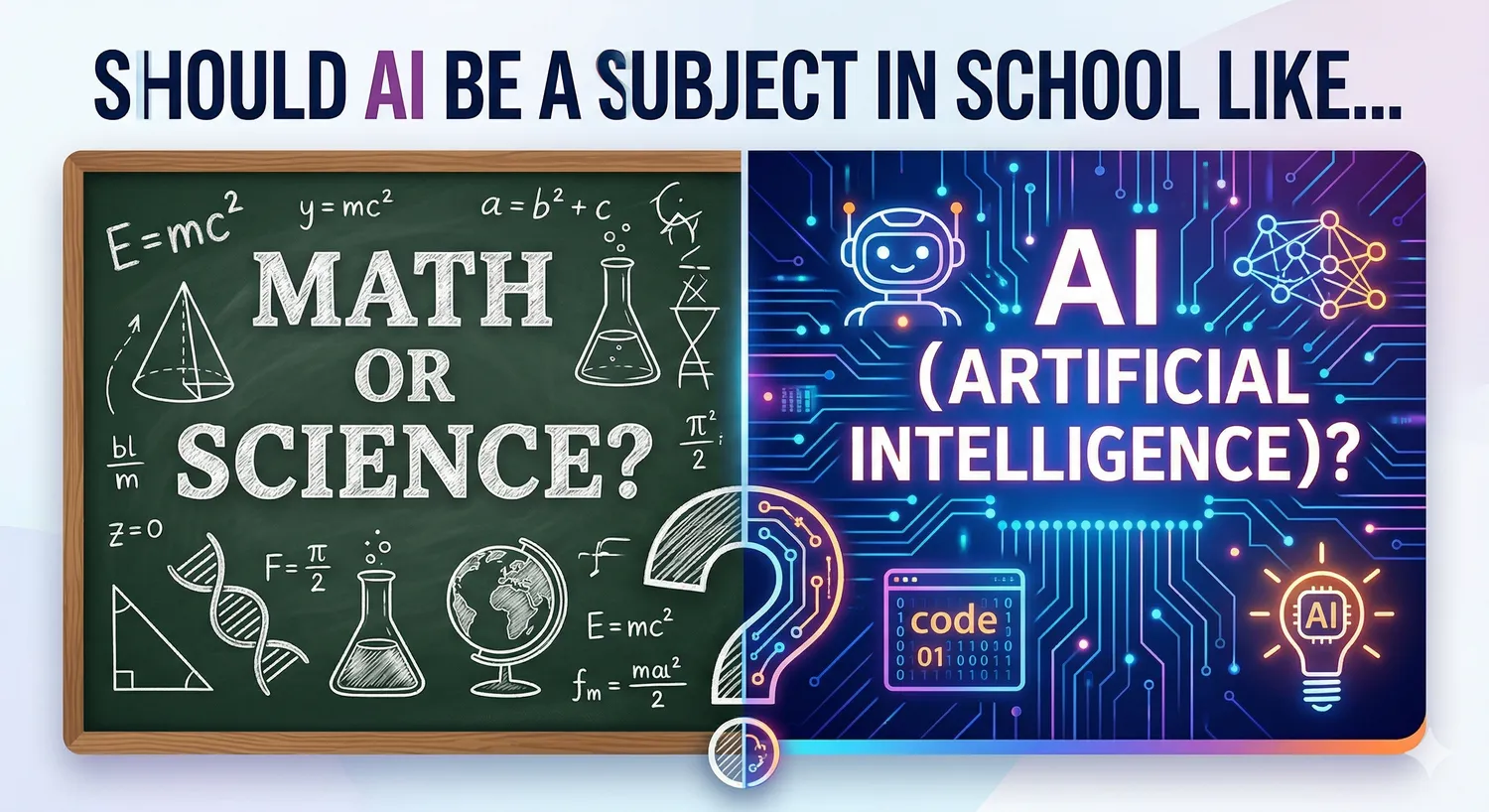
There was a time when computer science wasn't considered a "real" subject. Schools treated it as an extra, a club activity, something for the technically inclined few. Then the internet happened, smartphones happened, and suddenly digital literacy wasn't optional anymore. We added it to the curriculum and moved on.
We're at that exact same crossroads with AI — except the stakes are considerably higher, and the window to act is narrower than most people realise.
The Subject Debate Is the Wrong Starting Point
When educators debate whether AI deserves a dedicated period on the timetable, they're often asking the wrong question. The real question isn't "should we add another subject?" It's "what kind of graduates are we producing, and are they prepared for the world they're walking into?"
Math teaches logical thinking. Science teaches the discipline of inquiry. English teaches communication. Each subject exists not just for its content but for the cognitive muscle it builds. By that standard, artificial intelligence in education isn't a tech elective — it's a thinking framework for the 21st century.
A student who learns how AI systems make decisions develops critical thinking about information, bias, and problem-solving that no other subject currently addresses. That's not a supplementary skill. That's a core one.
The "It's Too Complex" Myth
One of the most common objections from school administrators is that AI is simply too advanced for school-age children. It's an understandable concern — and a mistaken one.
You don't teach calculus to a Class 4 student, but you do teach them to count, group, and spot patterns. The same logic applies to AI. A Class 5 student doesn't need to understand gradient descent. But they absolutely can understand that machines learn from examples, that data can be biased, and that they — yes, they — can build simple intelligent tools.
Also Read: Teaching AI in Schools
Age-appropriate AI learning isn't about dumbing the subject down. It's about meeting students where they are and growing with them — which is precisely what good curriculum design does for every other subject already on the timetable.
What Other Countries Are Already Doing
China introduced AI as a mandatory subject in select high schools back in 2018. Finland has been integrating AI literacy across subjects for years. Singapore has a structured national AI curriculum running from primary school upward. These aren't experimental pilot programmes anymore — they're mainstream.
Meanwhile, the conversation in most Indian schools is still stuck at "should we?" rather than "how do we?" That gap, left unaddressed, becomes a competitiveness problem within a single generation.
Where Artificial Intelligence in Education Actually Fits
The good news is that artificial intelligence in education doesn't have to displace anything. It can be woven into existing subjects — data and probability in Math, observation and prediction in Science, ethical reasoning in Social Studies. And for schools ready to go further, a dedicated AI strand from Class 6 onwards gives students the depth they need to genuinely build with it.
The schools already doing this aren't producing students who just know about AI. They're producing students who think differently — more analytically, more creatively, more confidently.
That shift doesn't happen by accident. It happens when schools stop asking whether AI belongs in the classroom and start asking how soon they can bring it in.