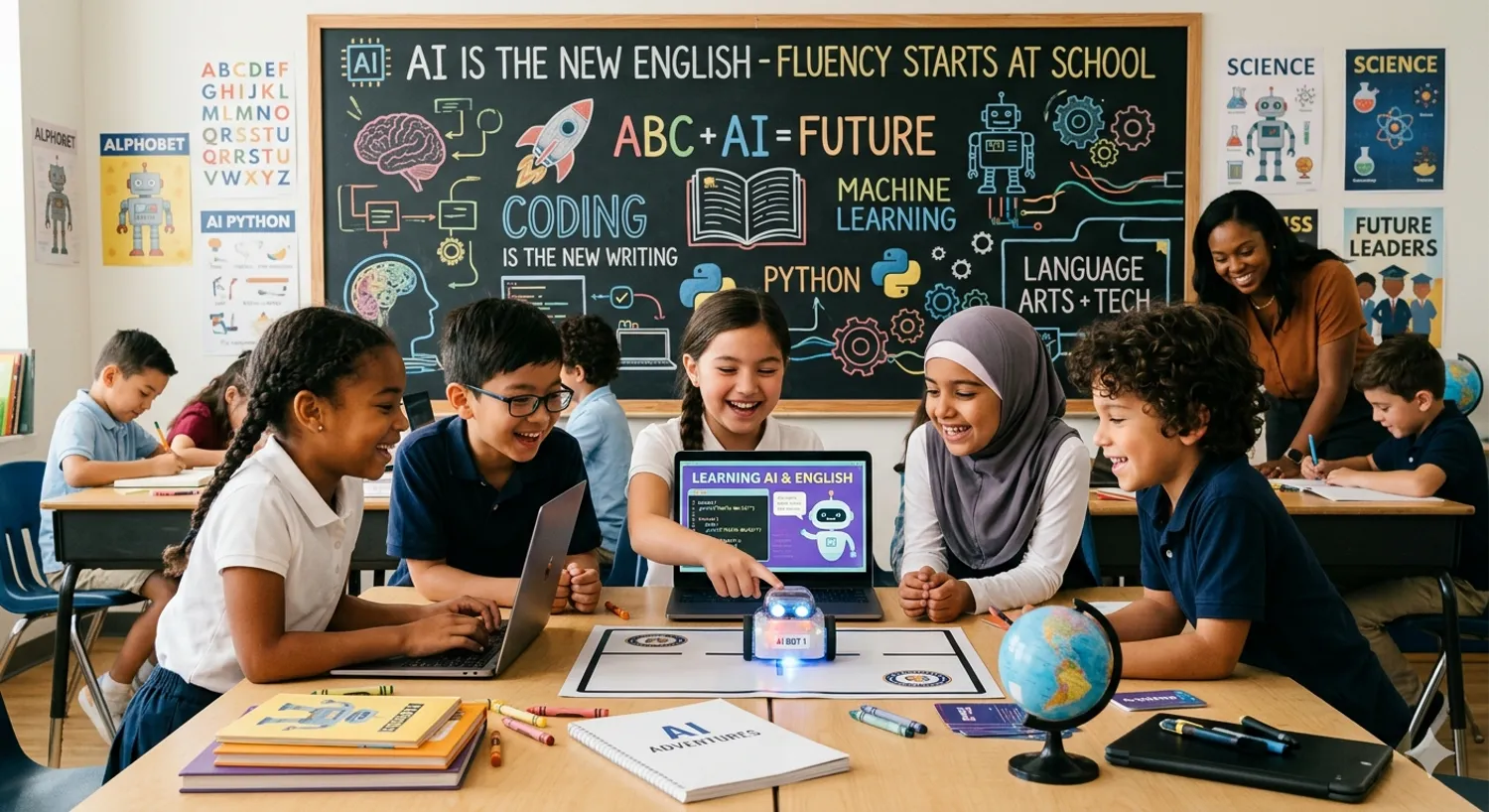
A generation ago, a child who couldn't read English was at a disadvantage. Today, a child who can't speak AI may be left behind entirely.
Think about how English became the world's professional language. It didn't happen overnight — schools made it compulsory, teachers made it accessible, and over time, fluency stopped being a luxury and became a baseline. We're at a similar inflection point with artificial intelligence. The difference is that this shift is happening in years, not decades.
And yet, most school curricula haven't caught up. Students are still being prepared for a world that no longer exists.
The comparison isn't metaphorical — it's structural
When we say AI is the new English, we don't mean it loosely. English gave students access to global opportunities — jobs, research, collaboration, and communication beyond their immediate geography. AI literacy does the same, except the opportunities it unlocks are exponentially larger. The World Economic Forum has identified AI skills as critical for the future workforce. India's own NEP 2020 calls for integrating AI into school curricula. The mandate isn't ambiguous — the gap in execution is.
This is precisely the problem that AI for schools programs are designed to solve. Not just by teaching theory, but by making AI tangible, learnable, and genuinely exciting for students as early as Class 3.
The real risk isn't robots — it's irrelevance
Parents and teachers often worry that AI will replace human thinking. The more urgent concern is different: students who don't understand AI will struggle to compete with those who do. It's less about robots taking jobs and more about one group of graduates walking into interviews with portfolios of real AI projects — and another group walking in with nothing but a textbook education in a field that's already shifted beneath them.
Also Read: Future of AI in Education
A well-designed AI for schools curriculum doesn't just teach students to use AI tools. It teaches them to build with them. There's a meaningful difference between a student who knows how to prompt a chatbot and one who understands machine learning concepts, has built a neural network project, and can explain what a model actually does. The latter isn't just more employable — they think differently.
Fluency requires early, consistent exposure
Nobody becomes fluent in a language by studying it for one semester in Class 11. Fluency comes from years of incremental, age-appropriate exposure — starting simple, layering complexity, building intuition over time. The same logic applies to AI education. A Class 4 student doesn't need to understand deep learning. But they absolutely can learn what AI is, where it shows up in their daily life, and how technology makes decisions. By the time that same student reaches Class 10, those foundations support something genuinely sophisticated.
This structured progression — from digital literacy in primary school to AI specialisation and career pathway preparation by Class 12 — is what separates a serious AI for schoolsprogram from a one-off workshop or an elective that gets dropped when the timetable gets tight.
Access is the other half of the equation
There's a version of this conversation that only happens in metro cities, in schools with sprawling labs and generous edtech budgets. But most of India doesn't look like that. Students in Tier 2 and Tier 3 cities, in government schools, in towns where a decent science teacher is already a luxury — they deserve the same fluency. The digital divide in AI education isn't just an equity issue; it's a national competitiveness issue. India cannot build an AI-ready workforce if that pipeline only draws from a narrow slice of its population.
This is why the location of a program matters as much as its content. Meaningful AI for schools work happens not just in the schools that are easy to reach, but in the ones that need it most.
The window is now
English didn't wait for every school to be ready before it became essential. AI won't either. The students sitting in classrooms today will graduate into a world where AI literacy isn't a differentiator — it's an expectation. The schools that move now aren't getting ahead of the curve; they're keeping up with it.
Fluency starts early. It starts with the right curriculum, the right mentors, and the belief that every child — regardless of where they grow up — deserves to be part of the future being built around them.
AI for Schoolsis an initiative empowering Indian students from Class 3 to Class 12 with hands-on, globally mentored AI education — aligned with NEP 2020 and built for every school, in every city.