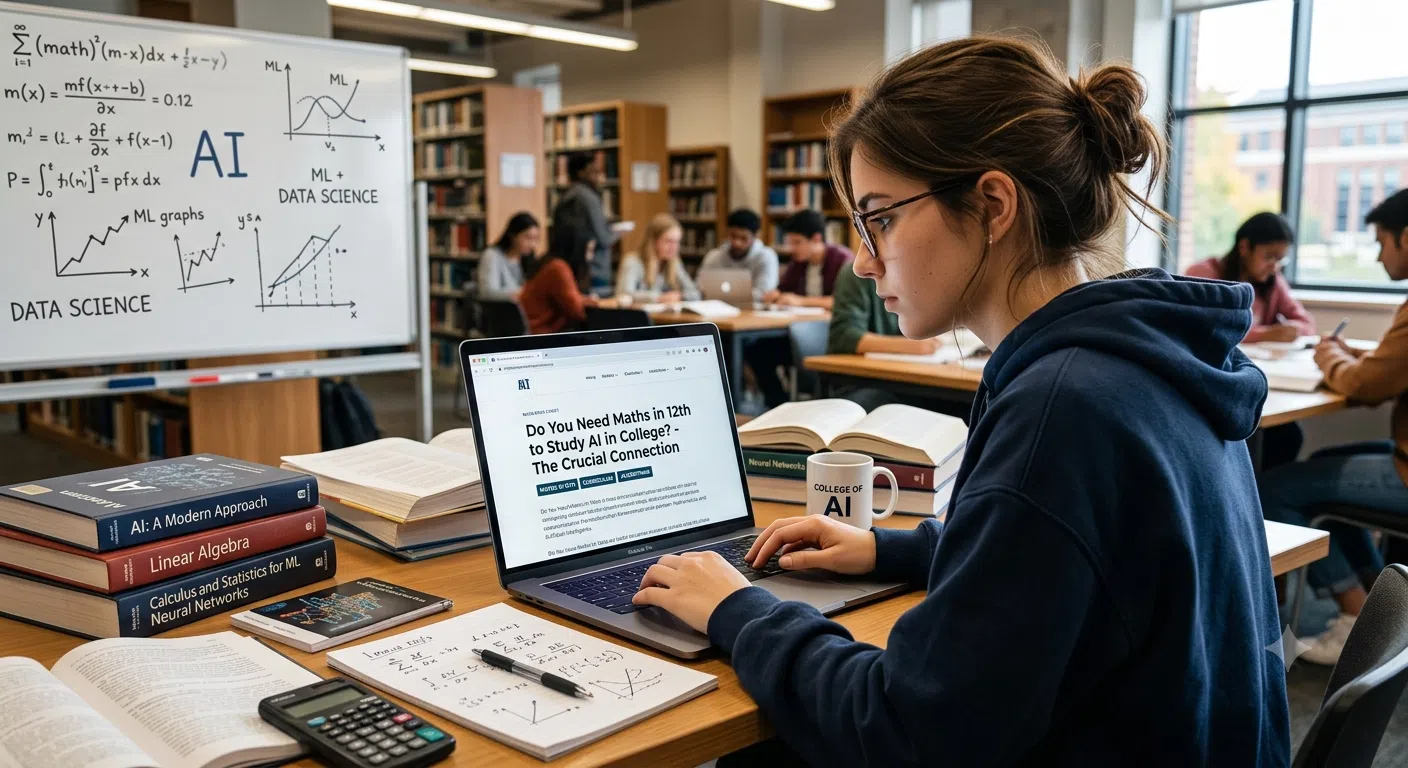
If you've ever typed "AI course after 12th in India" into Google at 1 AM, panicking about whether your Maths marks are good enough — take a breath. This is one of the most common questions students ask, and the honest answer is: it depends on what you mean by "study AI."
Let's break it down properly.
The short answer: yes, for most core AI degrees.
If you're aiming for a B.Tech in Artificial Intelligence, Computer Science with AI specialization, or a B.Sc in Data Science and AI, most Indian universities will expect Maths (and often Physics) in your 12th boards, especially if you're going through JEE Main or a similar entrance route. AI, at its core, runs on statistics, linear algebra, probability, and calculus. Colleges use Maths as a proxy for whether you can handle that logical, pattern-based thinking.
But here's what most blog posts won't tell you.
Not needing Maths in 12th doesn't mean you can't build a career in AI. There are diploma programs, foundation courses, and even some private university BCA/BBA-AI hybrid programs that accept non-Maths students, especially those from Commerce or even Humanities backgrounds who show strong logical or coding aptitude. AI today isn't just about writing algorithms — it's about ethics, product thinking, data storytelling, and application design too. Not every role needs someone who can solve a differential equation blindfolded.
That said, if you're serious about a core technical AI career — machine learning engineer, AI researcher, or similar — dropping Maths in 12th will make your college options noticeably thinner. It's not impossible, just harder.
So what should you actually do?
This is exactly why the conversation needs to start earlier than 12th grade. Waiting until Class 12 to figure out whether you "like AI enough" to study Maths is leaving it too late. This is where a proper AI module for school students in India makes a real difference — not a one-off workshop, but a structured, multi-year exposure that lets a student figure out, by Class 9 or 10, whether AI genuinely excites them.
That's the gap organizations like AI for Schools are trying to close. Through their school AI partner programme in India, students from Class 3 all the way to Class 12 get hands-on, project-based exposure to AI — not just theory, but building real tools, working with global mentors from Silicon Valley, and walking away with certifications backed by Google for Education. By the time a student reaches Class 11 or 12, they're not guessing whether to pick Maths for an AI career — they already have a portfolio and a informed opinion.
This kind of AI training for schools also solves a quieter problem: access. A lot of this exposure has historically been limited to Tier 1 cities and expensive private schools. Structured, offline, in-school programs change that equation, especially for Tier 2 and Tier 3 towns where good AI mentorship is hard to find otherwise.
Bottom line
Yes, Maths in 12th keeps more doors open for core AI degrees. But the real decision shouldn't be made in Class 12 under exam pressure — it should be shaped years earlier, through consistent, hands-on exposure to what AI actually involves. That's a far better foundation than any last-minute stream switch.