India's most ambitious education reform explicitly called for AI in classrooms. Four years on, the gap between intent and action is still very real — and growing costlier by the year.
NEP 2020 wasn't vague about technology. It named coding, computational thinking, and AI as skills that Indian students need, and it called on schools to build them into the learning experience — not park them in an optional lab session that gets skipped when exams approach. The policy gave schools both a direction and a mandate.
What most schools are still waiting for is a way to actually execute it.
The mandate exists. The roadmap often doesn't.
Wanting to act on NEP's AI vision and knowing how to are two different things. Which curriculum? Which age group starts first? How do teachers who were never trained in AI suddenly teach it with confidence? These are fair, practical questions — and they're exactly the ones that AI education companies built for the Indian school context are designed to answer.
AI for Schools was built precisely around this gap. It is Madhya Pradesh's first AI initiative for schools, and its entire program structure is NEP 2020 aligned — from Class 3 all the way to Class 12. Each year builds on the last: digital literacy in primary classes, AI foundations in middle school, neural networks and real-world problem solving by Class 8 and 9, and full AI specialisation with career pathway preparation by Class 12.
That progression isn't accidental. It mirrors exactly how NEP 2020 envisions skill-based learning — layered, practical, and connected to the world students will actually graduate into.
What "acting on it" looks like in practice
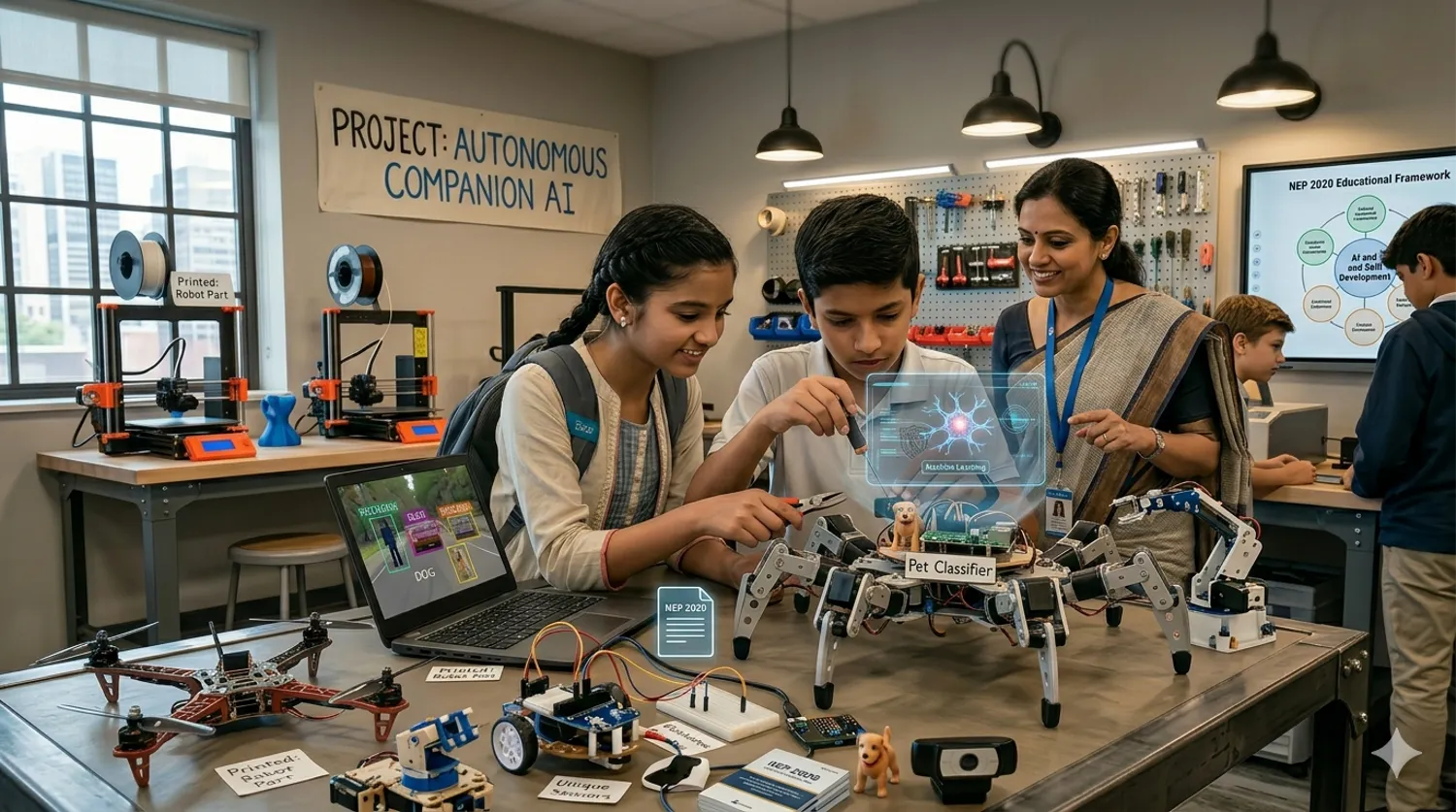
For a school that partners with AI for Schools, NEP compliance isn't a checkbox — it becomes visible in what students produce. Every student works on hands-on AI projects. They don't just learn about machine learning; they build with it. They don't just hear about AI tools used at companies like Google and Meta; they receive mentorship directly from professionals at those organisations — engineers and researchers who have built real AI systems at scale.
That last part matters more than it might seem. One of NEP 2020's core arguments is that Indian education has leaned too hard on theory and not hard enough on application. When a Class 10 student in Bhopal is building an AI project and getting feedback from a mentor at OpenAI, that is skill-based learning — not as a concept, but as a lived experience.
Students also walk away with globally recognised certifications backed by collaborations with Google for Educators and OpenAI. These aren't participation certificates. They're credentials that travel — ones that open doors to opportunities far beyond the city, the state, or the school.
The cost of waiting another year
Schools that treat NEP's AI mandate as a future priority rather than a current one aren't standing still — they're falling behind relative to the 250+ schools that have already moved. The students in those schools are building portfolios right now. They're gaining confidence with AI tools right now. That head start compounds.
The strongest AI education companiesaren't selling software. They're delivering a structured, proven curriculum that meets schools where they are — and moves students to where the future is going. NEP 2020 pointed in that direction clearly. The question for every school leader is simple: how much longer can you afford to point back at the policy and call it a plan?