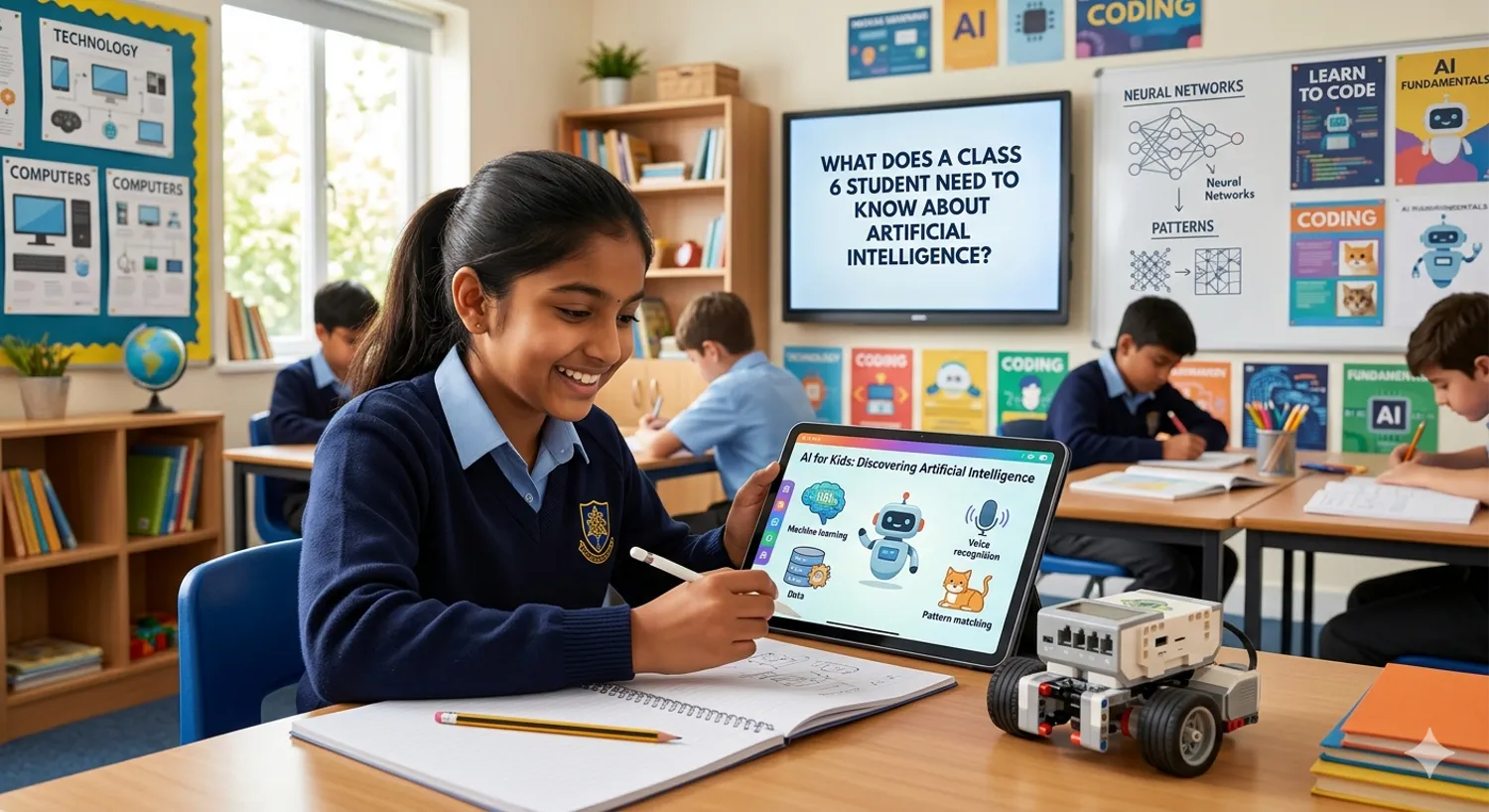
There's a moment in almost every Class 6 classroom — someone mentions AI, and half the students think of robots from science fiction movies. The other half have used it without even realizing, through voice assistants, recommendation engines, or autocorrect on their parents' phones. Neither group, however, has been formally introduced to what AI actually is, how it thinks, or why it matters to themspecifically.
That's a gap worth closing — and closing early.
Start With the "What," Not the "How"
At Class 6, the goal isn't to teach a student to write machine learning code. It's to build awareness — a solid, intuitive understanding of what artificial intelligence is and where it already exists in everyday life.
A well-designed AI course for school students at this level would help a 11 or 12-year-old recognize that when Netflix suggests a show or Google Maps reroutes around traffic, that's AI working in the background. It demystifies the technology before the technology becomes intimidating.
This foundational awareness is exactly what AI for schools programs emphasize in their Class 6 curriculum — not complexity, but clarity.
The Three Things Every Class 6 Student Should Understand
1. AI learns from data, not instructions
Unlike a calculator that follows fixed rules, AI systems learn patterns from large amounts of information. A simple analogy works beautifully here — just like a student gets better at identifying dog breeds by seeing hundreds of pictures, an AI model learns by processing thousands of examples.
2. AI is a tool, not a decision-maker
One of the healthiest things a young student can internalize early is that AI assists human thinking — it doesn't replace it. Teaching this at Class 6 builds both confidence and critical thinking. Students learn to question AI outputs rather than blindly trust them.
3. AI has real-world applications, right now
From healthcare diagnostics to weather forecasting, from language translation to crop monitoring — AI is already embedded in systems that affect daily life. Connecting these dots for a Class 6 student makes the subject feel relevant, not abstract.
Why This Age Is the Right Starting Point
Class 6 sits at a sweet spot. Students are old enough to grasp conceptual thinking but young enough that their curiosity hasn't yet been dulled by exam pressure. Introducing AI for schools at this stage plants a seed that grows naturally through Classes 7, 8, and beyond — each year adding a layer of depth to what was introduced here.
Programs like AI for Schools understand this progression. Their curriculum isn't a one-size-fits-all module — it's a structured learning journey that meets students exactly where they are.
The Bottom Line
A Class 6 student doesn't need to become an AI engineer overnight. They need to become AI-aware — curious, informed, and unafraid. The right AI course for school students does exactly that: it turns a buzzword into something a twelve-year-old can genuinely understand, engage with, and eventually build upon.
That's where the future starts — not in college labs, but in middle school classrooms.
Also Read: AI for Schools in India