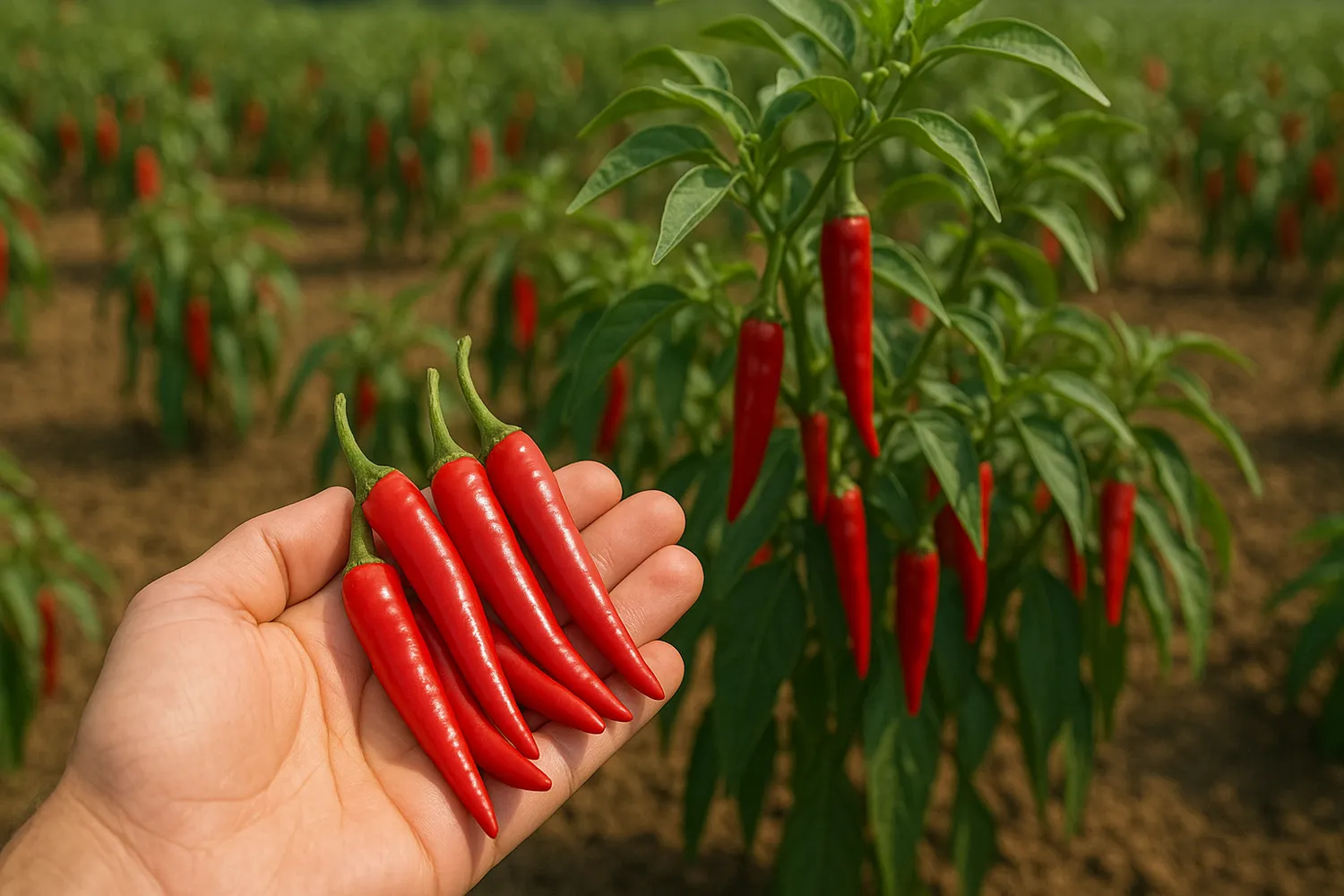
When I first started cultivating chilli on my family’s two-acre plot, I assumed that the biggest challenge would be managing irrigation or perhaps fending off major pests like thrips or aphids. But I was wrong. What really caught me off guard was something far less dramatic, yet just as damaging—leaf distortion.
It began subtly. Some leaves curled slightly, others shrank in size or twisted unnaturally. At first, I thought it was a minor issue, maybe a temporary stress response. But within weeks, nearly 40% of my crop showed signs of stunted growth, reduced leaf area, and flower drop. This seemingly small problem had the potential to slash my expected yield by almost half if not addressed quickly.
Spotting the Symptoms Early
Fast vegetative growth and vivid green leaves are characteristics of chilli plants. I therefore recognized something was amiss when the upper leaves started to exhibit odd bending and crinkling.
The key early indicators I noticed included:
- Upward curling of tender leaves, almost forming a spoon-like shape
- Pale green or yellow mottling on newer foliage
- Reduced leaf size and narrow, elongated leaf tips
These were not merely aesthetic distortions. The impacted plants experienced difficulty with photosynthesis, resulting in weak branches, fewer blooms, and poor fruit set.
The majority of novice farmers, like myself at the time, believed it to be a result of overfertilization or a nutrient shortage. Nothing changed even after I applied a foliar dosage of micronutrients. I realized it was time to look further at that point.
The Real Culprits Behind the Curl
After consulting with a knowledgeable agronomist and sending samples to a nearby plant pathology lab, the diagnosis indicated two primary causes: pest vectors such as thrips and whiteflies, and viral infections, mainly the Chilli Leaf Curl Virus.
In addition to feeding on plant sap, these pests also serve as viral carriers. The plant cannot recover once infected. The only method to stop the disease from ever developing is to control the insect vector as soon as possible.
This completely altered my strategy. Targeting the source was more important than merely treating the symptoms. I required a comprehensive plan that would safeguard the plant's defenses against diseases as well as its structural integrity.
My Multilayered Management Strategy
Here’s what I did to gradually bring my crop back under control, and I believe it’s something any farmer can adapt:
- Started with healthy seedlings
I sourced virus-free, hardened seedlings from a certified nursery. Planting healthy stock is crucial since infected plants act as disease reservoirs. - Implemented strict vector management
I installed yellow sticky traps and began regular monitoring. Sprays targeting whiteflies and thrips were rotated every 7 days, with a focus on avoiding resistance buildup. - Foliar applications with balanced nutrients
Zinc and calcium deficiencies can mimic curl symptoms. I included chelated micronutrients and amino acid sprays to strengthen plant immunity. - Used plant protectants as a shield
The game changer for me was starting preventive applications early. I chose to Buy Wilt Special Plant Protector Online, which was recommended by a neighboring farmer. It helped prevent viral transmission by acting as a plant immune booster. Applications made in the early stages made a noticeable difference in how new leaves developed and resisted curl symptoms.
After a month, I saw a nearly 65% improvement in overall plant health, a reduction in pest load, and much better branching and flowering.
“Leaf distortion may look small, but its impact is wide—affecting every aspect of yield, resilience, and income. A farmer’s true skill is not just in seeing the damage, but in recognizing its cause.”
Secondary Factors: Environment and Stress
Although pests and viruses were the main reason, I discovered that environmental stress contributes silently to the problem's worsening.
Unbalanced nitrogen treatment, excessive temperature fluctuations, or erratic watering tend to weaken plant tissues and increase their vulnerability to insect infestation. In my situation, microzones of stressed plants were initially exhibiting symptoms of leaf curl due to inconsistent irrigation.
The situation improved with the addition of organic mulch and a drip watering system with a steady flow. Root systems become more robust and the soil was better able to hold onto moisture.
Interestingly, I also noticed that windbreaks around the field reduced aphid and whitefly movement. It's a small, natural step with a surprisingly high benefit for disease containment.
Lessons from Fellow Farmers
During my visits to neighboring farms, I picked up additional insights:
- One farmer used neem oil sprays twice a week in early vegetative stages and had almost zero leaf distortion incidents.
- Another incorporated marigold as a border crop to repel whiteflies and aphids.
- A third farmer introduced Encarsia formosa, a parasitic wasp that preys on whiteflies, as part of his biological control strategy.
These methods demonstrated that controlling leaf distortion involves judiciously combining several defenses rather than relying solely on one product or method, especially when paired with a good spray schedule and cultural practices.
Scientific Backing and Resources
The chilli pest management guideline from ICAR states that up to 75% of virus transmission can be prevented by using integrated pest management (IPM) techniques that include crop rotation, biological controls, and targeted sprays. To keep fields healthy, they advise using resistant cultivars, avoiding monoculture planting, and detecting problems early.
Additionally, last year, The Hindu BusinessLine featured an article about how smallholder farmers were able to recover 40–50% of their yields by using pest barrier crops and staggered planting dates.
I was reassured by this data that I was headed in the right direction, especially since my own field was improving steadily every week.
FAQs
- Is leaf curl in chilli always viral?
Not always. It can also be caused by thrips feeding damage or severe micronutrient deficiency. Accurate diagnosis is key. - How early should I start protective sprays?
Ideally during the nursery phase and definitely within 10 days of transplanting. Early action prevents virus establishment. - Can I use homemade remedies?
Neem-based sprays, fermented buttermilk, and garlic-chili extracts can be effective as part of IPM but may not fully replace targeted treatments during high infestation periods. - Do organic methods work against leaf curl?
They can help prevent pest buildup, but for viral infections, once a plant is infected, it remains stunted. Prevention is better than cure. - Should I remove infected plants?
Yes, rogue plants showing severe symptoms should be removed and burned to prevent acting as virus sources for healthy plants.
What Worked and What I’d Do Differently
As I thought back on the season, I saw that the sooner I took action, the better the outcome. After the virus spread, recovery became challenging since vectors had an advantage due to the delay in pest management. I also discovered how important it is to preserve records since it helps adjust crop cycles in the future by revealing what worked and when.
If I had to start over:
- I’d use reflective mulch to deter insects.
- Establish traps and protective barriers from day one.
- Integrate biological control much earlier.
My perspective on minor symptoms in the field has been altered by this encounter. If left untreated, what appears to be a few curled leaves could indicate a serious outbreak.
We learn from farming that control is about creating a robust system, not about getting rid of every threat. And time, attention to detail, and observation are as crucial in that system as any spray or treatment.