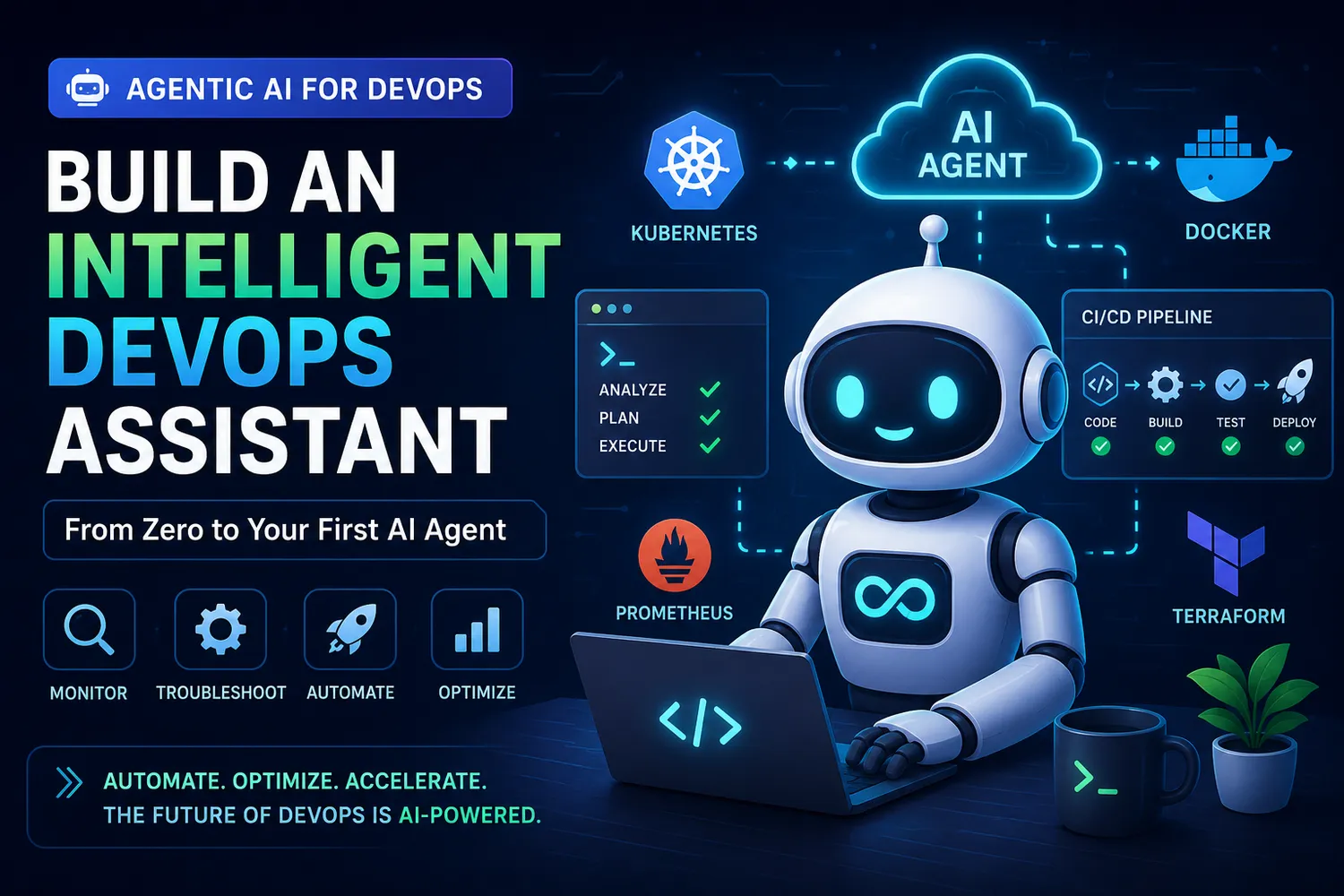
The world of DevOps is evolving rapidly. As organizations adopt cloud-native architectures, Kubernetes, Infrastructure as Code (IaC), and continuous delivery pipelines, the complexity of managing modern systems continues to grow. Traditional automation tools help reduce manual effort, but they often require predefined rules and workflows.
This is where Agentic AI comes into play.
Agentic AI represents a new generation of artificial intelligence systems capable of reasoning, planning, making decisions, and executing actions autonomously. Unlike traditional chatbots that simply answer questions, AI agents can perform tasks, interact with tools, monitor systems, and even take corrective actions when issues arise.
For DevOps engineers, Agentic AI offers exciting possibilities. Imagine having an intelligent assistant that can:
- Monitor infrastructure health
- Analyze logs automatically
- Troubleshoot deployment failures
- Generate Infrastructure as Code templates
- Optimize cloud resources
- Automate incident response
In this guide, you'll learn what Agentic AI is, how it applies to DevOps, and how to build your first AI-powered DevOps Assistant.
What Is Agentic AI?
Agentic AI refers to AI systems designed to act independently toward specific goals.
Unlike traditional AI models that simply generate responses, AI agents can:
- Understand objectives
- Plan actions
- Use external tools
- Gather information
- Execute tasks
- Learn from outcomes
An AI agent operates similarly to a human engineer:
- Receives a task
- Collects information
- Analyzes the situation
- Determines the best action
- Executes the action
- Evaluates results
This capability makes Agentic AI especially valuable in DevOps environments.
Why DevOps Teams Need AI Agents
Modern DevOps teams manage:
- Cloud infrastructure
- CI/CD pipelines
- Kubernetes clusters
- Monitoring systems
- Security controls
- Application deployments
The number of alerts, logs, and operational tasks can quickly overwhelm teams.
AI agents help by automating repetitive activities and assisting engineers with operational decisions.
Benefits of Agentic AI in DevOps
Faster Incident Response
AI agents can analyze logs and metrics immediately after detecting issues.
Automated Troubleshooting
Instead of manually searching through dashboards, AI agents can identify probable root causes.
Infrastructure Optimization
Agents can recommend cost-saving opportunities and performance improvements.
Continuous Monitoring
AI-powered assistants never stop watching your infrastructure.
Improved Productivity
Engineers spend less time on routine tasks and more time on innovation.
Key Components of an AI-Powered DevOps Assistant
A DevOps AI agent typically consists of several components.
Large Language Model (LLM)
The reasoning engine behind the assistant.
Examples include:
- OpenAI GPT models
- Anthropic Claude
- Google Gemini
- Open-source alternatives such as Llama
Tool Integration
The agent connects to DevOps tools like:
- GitHub
- GitLab
- Jenkins
- Kubernetes
- Docker
- Terraform
- Prometheus
Memory
Stores previous interactions and operational knowledge.
Planning Engine
Determines the sequence of actions required to achieve goals.
Use Cases for Agentic AI in DevOps
1. Kubernetes Troubleshooting
Instead of manually checking cluster status:
kubectl get pods

kubectl describe pod

kubectl logs
The AI agent can automatically:
- Check pod health
- Analyze logs
- Identify failures
- Recommend fixes
2. CI/CD Pipeline Analysis
An AI agent can:
- Detect failed builds
- Analyze error messages
- Suggest solutions
- Generate fixes
For example:
"Deployment failed because the Docker image tag does not exist."
The agent immediately identifies the root cause.
3. Infrastructure as Code Generation
Prompt:
Create Terraform code for an AWS EC2 instance running Ubuntu.
The AI agent generates infrastructure code automatically.
This reduces setup time and minimizes configuration errors.
4. Log Analysis
AI agents can process:
- Application logs
- System logs
- Security logs
and identify anomalies faster than manual analysis.
5. Cloud Cost Optimization
The assistant can:
- Detect idle resources
- Identify oversized instances
- Recommend cost-saving actions
This helps organizations reduce cloud spending.
Building Your First DevOps AI Assistant
Step 1: Define the Goal
Choose a simple task.
Examples:
- Kubernetes monitoring
- CI/CD troubleshooting
- Log analysis
- Cloud cost recommendations
For beginners, Kubernetes troubleshooting is a great starting point.
Step 2: Select an AI Model
Popular choices include:
- GPT models
- Claude
- Gemini
- Llama
The model will provide reasoning and decision-making capabilities.
Step 3: Connect DevOps Tools
Your assistant needs access to operational data.
Common integrations:
- Kubernetes API
- GitHub API
- Jenkins API
- Prometheus API
These tools provide real-time information for decision making.
Step 4: Create Agent Workflows
Example workflow:
- Receive alert
- Collect metrics
- Analyze logs
- Determine root cause
- Generate recommendation
- Notify engineer
This forms the foundation of an autonomous DevOps assistant.
Step 5: Add Automation
After sufficient testing, allow the assistant to perform actions such as:
- Restarting failed pods
- Scaling deployments
- Opening GitHub issues
- Triggering rollback procedures
Always implement approval mechanisms before production deployment.
Agentic AI vs Traditional DevOps Automation
Traditional AutomationAgentic AIRule-basedGoal-basedStatic workflowsDynamic planningLimited adaptabilityAdaptive reasoningManual updates requiredLearns from contextFixed actionsIntelligent decisions
Agentic AI introduces flexibility that traditional automation tools cannot provide.
Best Practices
Start Small
Build one capability at a time.
Keep Humans in the Loop
Critical production actions should require approval.
Secure Credentials
Use secret management solutions and least-privilege access.
Monitor Agent Activity
Track every decision and action performed by the AI assistant.
Validate Outputs
Always verify generated code and recommendations.
The Future of DevOps and Agentic AI
Agentic AI is transforming how DevOps teams operate. Future AI assistants will not only recommend actions but also execute complex workflows across cloud platforms, CI/CD pipelines, and Kubernetes environments.
As AI agents become more capable, DevOps engineers will shift from performing repetitive operational tasks to supervising intelligent systems that manage infrastructure autonomously.
Organizations that adopt Agentic AI early will gain advantages in efficiency, reliability, scalability, and operational excellence.
Conclusion
Agentic AI is quickly becoming one of the most important innovations in DevOps. By combining reasoning, automation, monitoring, and decision-making, AI agents can help teams manage increasingly complex infrastructure with greater speed and accuracy.
Whether you're a beginner or an experienced DevOps engineer, now is the perfect time to start exploring AI-powered automation. Building your first DevOps AI Assistant today can prepare you for the next generation of cloud operations and intelligent infrastructure management.
Keywords: Agentic AI, DevOps AI, AI Agents, AIOps, Kubernetes Automation, Infrastructure Automation, DevOps Assistant, CI/CD Automation, Cloud Operations, Intelligent Infrastructure.