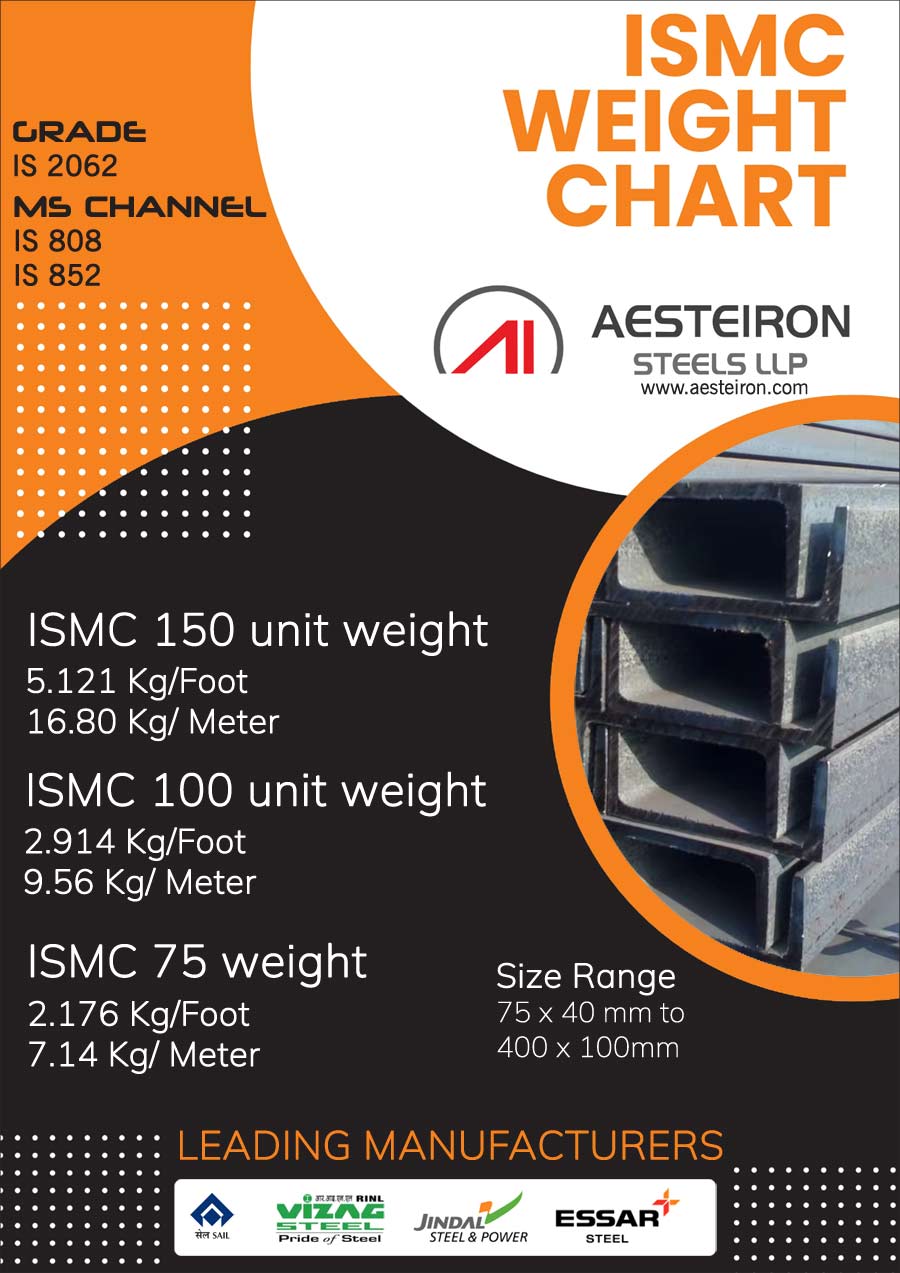
When it comes to structural engineering and construction, accuracy and consistency are the backbone of any successful project. These charts serve as quick reference guides that provide standard weights and dimensions for Indian Standard Medium Beams and Indian Standard Medium Channels, helping professionals ensure both safety and efficiency in their designs.
Understanding the ISMB and ISMC Weight Charts
The ISMB Weight Chart lists the weight per meter of the length of I-beams or H-beams, also called universal beams. They are widely used in the construction of frames, bridges, and other forms of construction frameworks. The chart gives the standardized values on the basis of the size and kind of the beam, which is imperative in determining the entire capacity of the load and the material needed. Likewise, the ISMC weight chart has all the benefits of similar channel sections, which are typically used for lighter structural frameworks, bracings, and support elements.
The two charts eliminate guesswork, allowing engineers and contractors to select the right beam or channel for their specific project with precision.
Why Engineers and Builders Rely on These Charts
1. Precision in Planning:
When planning a structure, each kilogram of steel counts, whether it is a high rise building or an extensive industrial venture. Using these two charts, i.e., the ISMB Weight Chart and the ISMC Weight Chart, the engineers will be able to get the right estimate of the amount of steel that will be needed and the amount of weight that each section will hold. This will enable its design to be optimally done to be cost effective and safe as well.
2. Time-Saving Tool:
Time is money in construction, where the pace is high. These weight charts assist in making decisions fast. Professionals no longer need to calculate dimensions and weights manually to advance the planning and procurement stages of any project since they can immediately access the charts.
3. Standardization Across the Industry:
Consistency is one of the greatest problems in construction. The ISMB and ISMC charts are made in accordance with the Indian Standards (IS 808:1989), enabling the design, procurement, and implementation of projects all over India. This minimizes mistakes and expands dependence during the construction process.
4. Optimized Material Usage:
The wastage of funds may occur through over or underutilization of materials. By working with these charts, the correct beam/ channel size of the given load and span will be chosen, thereby minimizing the wastage of material and maximizing the performance of the structure.
Real-World Applications
Whether it is metro work, residential tower, bridge, or industrial warehouse, the applicability of such charts cannot be over emphasized. They are applied by the architects in the concept stage, engineers in the design stage, and contractors in the implementation stage. These charts are also useful even when it comes to maintenance or retrofitting.
Conclusion
In a field where every calculation impacts safety, budget, and timelines, the ISMB Weight Chart and ISMC Weight Chart are not just helpful; they are essential. They also fill in the void existing between planning and implementation and assist the professionals in giving life to safe and effective buildings. No matter whether you are a civil engineer, a builder, an architect or a project manager these charts are quick and easy to use tools that streamline complicated decisions and provide the same quality in your completed work.