3D printing technology, also known as additive manufacturing, has revolutionized the field of orthopedic implants by enabling the customization of implant shapes and the precise control of complex microstructures. This technology has allowed for the dual adaptation of implant shape and mechanical properties to match the body's own bone, making it a preferred choice in the field of medical equipment. Among the various materials used in 3D printing, titanium and its alloys stand out due to their superior properties.
Advantages of Titanium in Orthopedic Implants
Titanium is highly favored for orthopedic implants due to its high specific strength, low elastic modulus similar to cortical bone, low density, high corrosion resistance, and excellent biocompatibility. These properties make titanium an ideal material for various orthopedic applications, including trauma bone nail plates, knee/hip joint prostheses, and spine implants.
3D Printing Techniques for Titanium Implants
The primary 3D printing techniques for titanium implants are Selective Laser Melting (SLM) and Electron Beam Melting (EBM). Each technique has its unique advantages and limitations:
- Selective Laser Melting (SLM): This technique uses a high-power optical laser (200-500W) to fuse metal powder into solid parts. SLM provides high molding accuracy, making it suitable for producing fine parts and complex structures. However, it has a lower molding efficiency, larger residual stress, and often requires secondary heat treatment.
- Electron Beam Melting (EBM): EBM uses magnetic conductive sub-beams to melt metal powder layer by layer in a high vacuum atmosphere. It offers high molding efficiency, low residual stress, and typically does not require secondary heat treatment. Although EBM has slightly lower accuracy than SLM, its efficiency and suitability for direct molding make it ideal for orthopedic implants.
Globally, major medical device companies have launched a variety of 3D printed orthopedic implant products, including hip joints, knee joints, spine, and craniomaxillofacial prostheses. In China, the market features 3D printed titanium alloy products such as acetabular cups, artificial vertebrae, spine interbody fusion cages, and metal bone trabecular AVN reconstruction systems, predominantly produced using EBM technology.
Bonetech Medisys: Leading the Way in India
Bonetech Medisys is a pioneering company in the Indian market, utilizing 3D printing technology to manufacture and export orthopedic implants. The company focuses on producing spine cages and other orthopedic solutions using advanced 3D printing methods. Bonetech Medisys has established itself as a leader in the industry by leveraging the benefits of 3D printing to enhance the quality and performance of its products.
Products and Innovations
Bonetech Medisys offers a range of 3D printed orthopedic implants, including:
- Spine Cages: These are used for spinal fusion procedures and are designed to support the spine and facilitate bone growth. The use of 3D printing allows for the production of cages with intricate structures that promote osseointegration and provide optimal mechanical support.
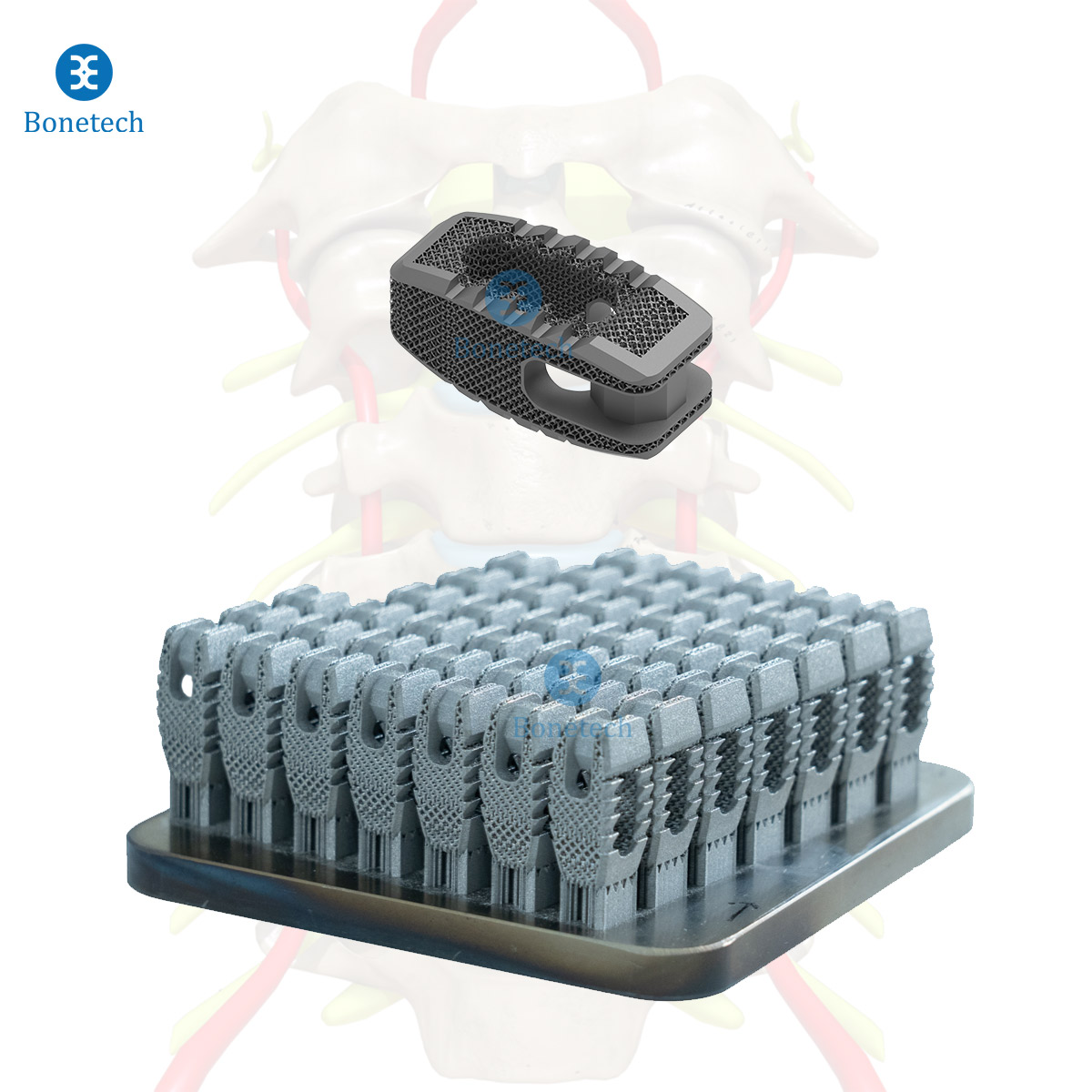
- Customized Implants: By utilizing 3D printing, Bonetech Medisys can produce patient-specific implants that match the anatomical requirements of individual patients. This customization improves the fit and effectiveness of the implants.
Technology and Quality
Bonetech Medisys employs state-of-the-art 3D printing technologies, ensuring high precision and consistency in its products. The company adheres to stringent quality control measures and international standards, making its implants reliable and safe for medical use.
Conclusion
The integration of 3D printing technology in the production of titanium orthopedic implants has significantly advanced the field, offering customized and high-performance solutions for patients. Companies like Bonetech Medisys are at the forefront of this innovation in India, providing cutting-edge products that enhance patient outcomes and set new standards in orthopedic care.
Bonetech Medisys' commitment to utilizing advanced 3D printing techniques and producing high-quality orthopedic implants positions it as a key player in the global medical device market. As the technology continues to evolve, the potential for further improvements in implant design and functionality remains vast, promising even better solutions for orthopedic patients worldwide.