CCTV camera technology has become an important part of modern security planning for homes, offices, commercial establishments, warehouses, educational institutions, healthcare facilities, and industrial environments. A properly planned surveillance solution can help organisations monitor important areas, review incidents, improve situational awareness, and support security teams in their daily responsibilities.
However, selecting surveillance equipment should not be based only on image resolution or the number of cameras. A reliable solution requires proper planning of camera locations, lighting conditions, networking, recording capacity, storage, monitoring, cybersecurity, maintenance, and privacy considerations.
For Adit Group, effective security planning begins with understanding the actual requirement of a property rather than simply selecting equipment. Every site has different entry points, operational areas, lighting conditions, security risks, and monitoring requirements.
Understanding a CCTV Camera System
A CCTV camera system is a combination of cameras, recording equipment, networking infrastructure, storage, monitoring displays, power arrangements, and management software. Together, these components capture, transmit, record, and display video footage.
The basic objective is straightforward: provide visibility of selected areas and preserve useful footage for monitoring or investigation.
A typical installation may include cameras positioned at entrances, reception areas, corridors, parking zones, loading areas, production floors, server rooms, storage areas, and other locations requiring security observation.
The recording equipment can store footage locally, while network-connected systems can provide authorised remote access. Depending on the project, additional features such as motion detection, video analytics, alerts, and user access controls can also be incorporated.
Types of Surveillance Cameras
Different environments require different camera designs. Choosing the appropriate type depends on the location, field of view, lighting, mounting position, environmental conditions, and required image detail.
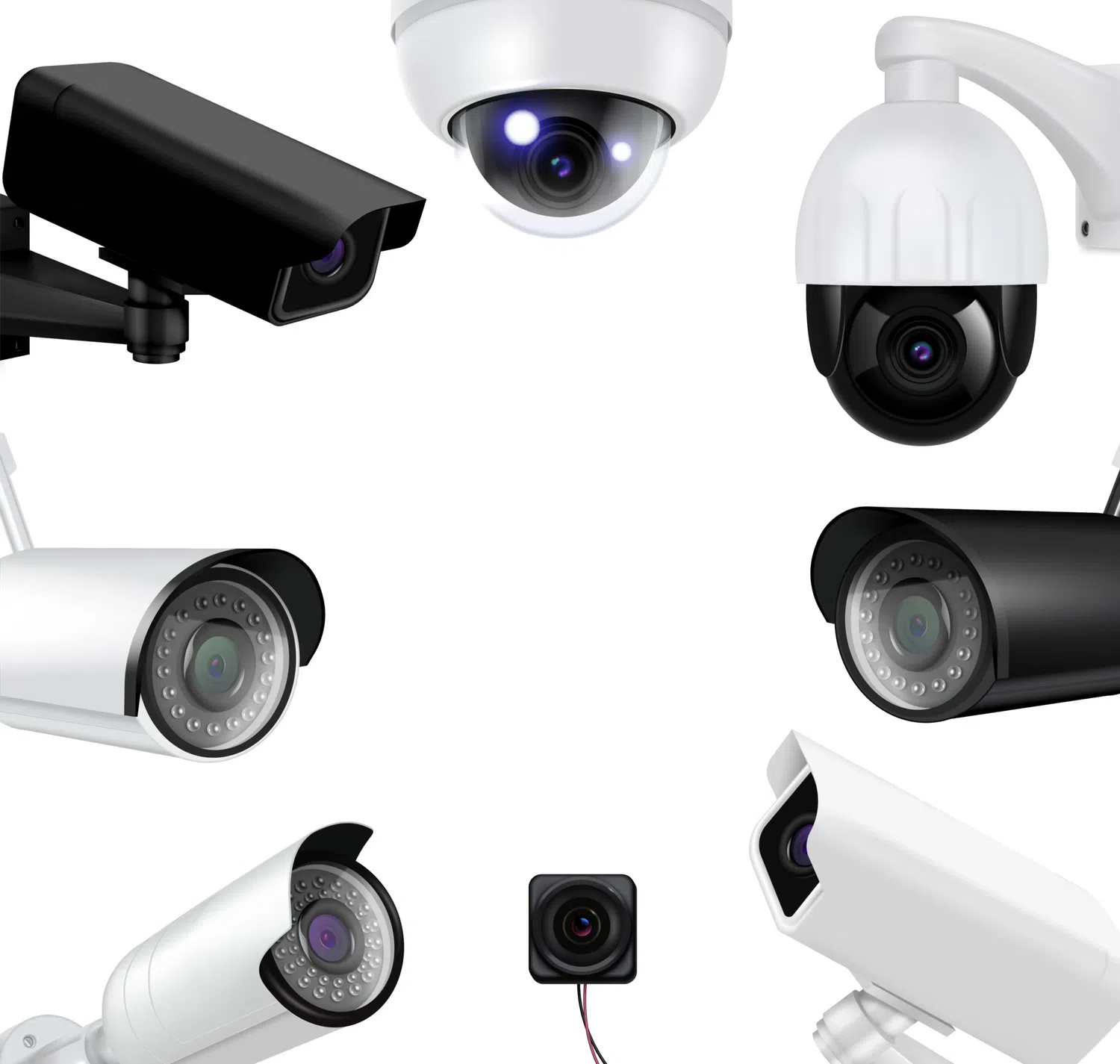
Dome cameras: These are commonly used indoors and can provide a discreet appearance. They are suitable for offices, reception areas, retail environments, and corridors.
Bullet cameras: Their directional design makes them suitable for areas where a clearly defined viewing direction is required. They are often considered for outdoor applications and perimeter monitoring.
PTZ cameras: Pan, tilt, and zoom functionality allows operators to control the viewing direction and magnification. These cameras can be useful for larger areas where active monitoring is required.
Turret cameras: These provide flexible positioning and are suitable for several indoor and outdoor applications.
Specialised cameras: Certain projects may require cameras designed for low-light environments, wide dynamic range, harsh industrial conditions, or specific monitoring requirements.
The correct selection should always follow a site assessment rather than relying solely on a product specification sheet.
IP Camera System and Network Infrastructure
An IP camera system transmits video through a network infrastructure, allowing cameras and recording equipment to communicate over Ethernet or other suitable connectivity methods.
This approach can provide advantages such as centralised management, flexible scalability, remote monitoring, and easier integration with other network-based security technologies.
Network planning is particularly important because high-resolution video can generate substantial data traffic. Network switches, cabling, bandwidth, power delivery, addressing, cybersecurity controls, and recording equipment should therefore be considered together.
A poorly designed network can affect video availability even when the cameras themselves are technically capable.
Choosing the Right Camera Resolution
Resolution determines the amount of image detail captured by a camera. Higher resolution can provide more visual information, but resolution alone does not guarantee useful footage.
Lens selection, sensor performance, lighting, camera placement, compression, viewing distance, and field of view also influence image quality.
For example, a camera positioned too far from an entrance may provide a broad scene but insufficient facial or identification detail. A properly selected lens and mounting position can often make a greater practical difference than simply increasing resolution.
A 4K IP camera can provide significantly higher image detail than lower-resolution cameras when suitable lighting, optics, storage, and network infrastructure are available. However, the additional resolution also needs appropriate bandwidth and storage planning.
Businesses should therefore identify what they need to observe before deciding on resolution.
Security Camera for Office Environments
A security camera for office environments should be selected according to the areas being monitored and the organisation's operational requirements.
Common areas include:
Main entrances and exits
Reception desks
Corridors and common areas
Parking facilities
Server and equipment rooms
Storage areas
Loading and delivery points
Restricted-access zones
Building perimeters
Camera placement should avoid unnecessary monitoring of areas where people have a reasonable expectation of privacy. Clear policies should also define who can access live and recorded footage.
For businesses, surveillance should form part of a broader security strategy rather than operate as an isolated technology. Access control, alarm systems, visitor management, lighting, network security, and security procedures can work together to create a more coordinated approach.
The Information Commissioner's Office explains that organisations using surveillance systems to process personal information should consider lawfulness, fairness, transparency, security, retention, and access controls.
Storage and Recording Considerations
Recording capacity is one of the most important elements of surveillance planning.
Storage requirements depend on factors such as:
Number of cameras
Resolution
Frame rate
Compression method
Recording schedule
Motion-based recording
Required retention period
Number of simultaneous streams
Continuous recording generally requires more storage than event-based recording. Businesses should calculate storage requirements before finalising the recording infrastructure.
A suitable recording platform should also provide reliable search and playback functions. There is little practical value in retaining large amounts of footage if authorised personnel cannot quickly locate a relevant event.
Storage security is equally important. Recorded information should be protected from unauthorised access, accidental deletion, tampering, and unnecessary disclosure.
Installation Planning and Camera Positioning
Professional installation begins with a site survey.
The survey should identify important entrances, vulnerable zones, lighting conditions, mounting surfaces, cable routes, network points, power requirements, environmental conditions, and monitoring locations.
Cameras should be positioned to minimise blind spots while avoiding unnecessary coverage.
Lighting must also be considered carefully. A camera facing a strong light source may produce an image where important details are difficult to identify. Wide Dynamic Range, suitable infrared capability, appropriate lens selection, and correct positioning can help address challenging conditions.
Outdoor installations should also consider rain, dust, temperature, vibration, physical protection, and cable routing.
Cybersecurity for Network-Based Surveillance
Modern surveillance infrastructure is increasingly connected to networks, making cybersecurity an important part of system design.
Default passwords should not be retained. Administrative accounts should use strong authentication practices, and access should be limited to authorised users.
Network segmentation can help isolate surveillance devices from unrelated systems. Firmware and software should also be maintained according to the manufacturer's security recommendations.
Remote access should be configured carefully. Organisations should understand which users can view live footage, retrieve recordings, modify settings, or administer the system.
Security is therefore not limited to the physical camera. The complete infrastructure—from the endpoint to the recording platform and network—requires protection.
Maintenance and Performance Monitoring
Regular maintenance helps maintain reliable surveillance performance.
A maintenance programme may include:
Checking camera positioning
Cleaning lenses and protective covers
Testing recording functionality
Reviewing storage health
Checking network connectivity
Verifying time and date settings
Testing backup arrangements
Reviewing user permissions
Inspecting cables and connectors
Checking night-time image quality
Periodic testing can identify problems before an incident occurs.
Organisations should also maintain documentation covering camera locations, equipment information, network details, maintenance activities, authorised users, and system changes.
Privacy and Responsible Surveillance
Responsible deployment is an essential part of modern surveillance planning.
The purpose of monitoring should be clearly defined before installation. Organisations should collect only information that is necessary for their stated objectives and should establish appropriate retention and access practices.
The ICO advises that surveillance operators should use visible information and signage where appropriate, restrict access to authorised people, and securely store recorded information.
For domestic installations, the ICO also recommends positioning cameras so that they capture the owner's property wherever possible. If footage extends into neighbouring property, public areas, or communal spaces, additional data protection considerations may apply.
These principles demonstrate why surveillance planning involves both technical expertise and responsible information management.
How to Plan a Complete Surveillance Project
A structured project approach can make implementation more effective.
Step 1: Identify objectives
Determine whether the primary requirement is deterrence, monitoring, incident investigation, perimeter observation, operational visibility, or a combination.
Step 2: Conduct a site survey
Assess the building layout, lighting, access points, vulnerable areas, cable routes, network availability, and environmental conditions.
Step 3: Select camera types
Choose cameras according to viewing distance, lighting, indoor or outdoor conditions, required detail, and mounting position.
Step 4: Design the network
Plan cabling, switches, bandwidth, power, addressing, network segmentation, and recording connectivity.
Step 5: Calculate storage
Estimate the storage required based on camera count, resolution, recording mode, and retention requirements.
Step 6: Configure access controls
Define user roles and ensure that live and recorded footage is available only to authorised personnel.
Step 7: Test the complete system
Verify image quality, recording, playback, remote access, alerts, time synchronisation, and network performance.
Step 8: Establish maintenance procedures
Schedule inspections and performance checks to keep the installation dependable.
Role of Professional Security Integration
A successful surveillance project requires coordination between cameras, networking, recording, power, software, storage, and physical installation.
Professional system integration helps ensure that these components work together as a complete solution.
For commercial and industrial environments, the design may also need to integrate surveillance with access control, fire detection, building management, public address, and other electronic security technologies.
The aim should not simply be to install more cameras. The objective is to create a system that provides useful visibility, reliable recording, controlled access, and practical support for security operations.
CCTV Camera: Complete Guide for Homes, Offices and Businesses — Key Selection Factors
Before implementing a surveillance solution, organisations should evaluate several factors together:
Coverage: Identify which areas actually require monitoring.
Image quality: Select suitable resolution and optics for the intended purpose.
Lighting: Consider daylight, low-light, backlighting, and night conditions.
Connectivity: Ensure sufficient network infrastructure and bandwidth.
Storage: Calculate recording requirements before deployment.
Security: Protect cameras, accounts, networks, and recorded information.
Scalability: Allow room for future cameras or additional functionality.
Maintenance: Plan regular inspection and system testing.
Privacy: Avoid unnecessary monitoring and establish appropriate controls.
Integration: Consider compatibility with other security and building systems.
These factors provide a practical foundation for developing a surveillance architecture suitable for the property.
Frequently Asked Questions
1. What is the main purpose of a surveillance system?
The main purpose is to monitor selected areas and record visual information that can support security, incident investigation, and operational awareness. Its effectiveness depends on proper planning, installation, monitoring, and maintenance.
2. Is higher camera resolution always better?
Higher resolution can capture more image detail, but useful performance also depends on lens selection, lighting, viewing distance, sensor quality, bandwidth, and storage. Resolution should therefore be selected according to the intended application.
3. Can network-based cameras be monitored remotely?
Yes, network-connected surveillance systems can support remote monitoring when the appropriate network infrastructure, authentication, access controls, and secure remote-access configuration are implemented.
4. How often should surveillance equipment be maintained?
There is no universal maintenance interval for every installation. Maintenance frequency should reflect the environment, equipment, operating conditions, manufacturer recommendations, and importance of the monitored area.
5. Are privacy considerations important when installing surveillance?
Yes. Surveillance can process information about identifiable individuals, so organisations should consider applicable privacy and data protection requirements. The ICO recommends appropriate transparency, secure storage, controlled access, and proportionate surveillance practices.
CCTV Camera: Complete Guide for Homes, Offices and Businesses — Conclusion
CCTV camera technology has evolved from basic video recording into an important component of modern security and building infrastructure. From homes and offices to warehouses, factories, and commercial facilities, the right solution can provide valuable visibility when it is designed around actual operational requirements.
From an industry influencer's perspective, the most important lesson is that effective surveillance is not simply about choosing advanced equipment. It is about combining suitable cameras, correct positioning, reliable networking, adequate storage, cybersecurity, responsible data management, and regular maintenance into one coordinated solution.
Businesses should therefore approach surveillance as a long-term infrastructure investment in safety, visibility, and operational control. A professionally planned system can be easier to manage, expand, maintain, and integrate with other technologies as organisational requirements develop.