If you’re looking at property in Ahmedabad, these two terms will show up sooner or later — Sale Deed and Agreement to Sell. They sound close enough to be interchangeable. People use them that way too. But legally, they’re not even playing the same role.
And that gap… that’s where most confusion starts.
Why This Gets Blurry in Real Conversations
Spend a little time around brokers or even casual property discussions, and you’ll notice how loosely things are phrased.
“Agreement ho gaya, deal ho gayi.”
“Registry baad mein kar lenge.”
Nothing unusual about that. It’s just how deals are talked about on the ground. But the paperwork doesn’t follow that tone. It’s far more exact. Only one document actually moves ownership.
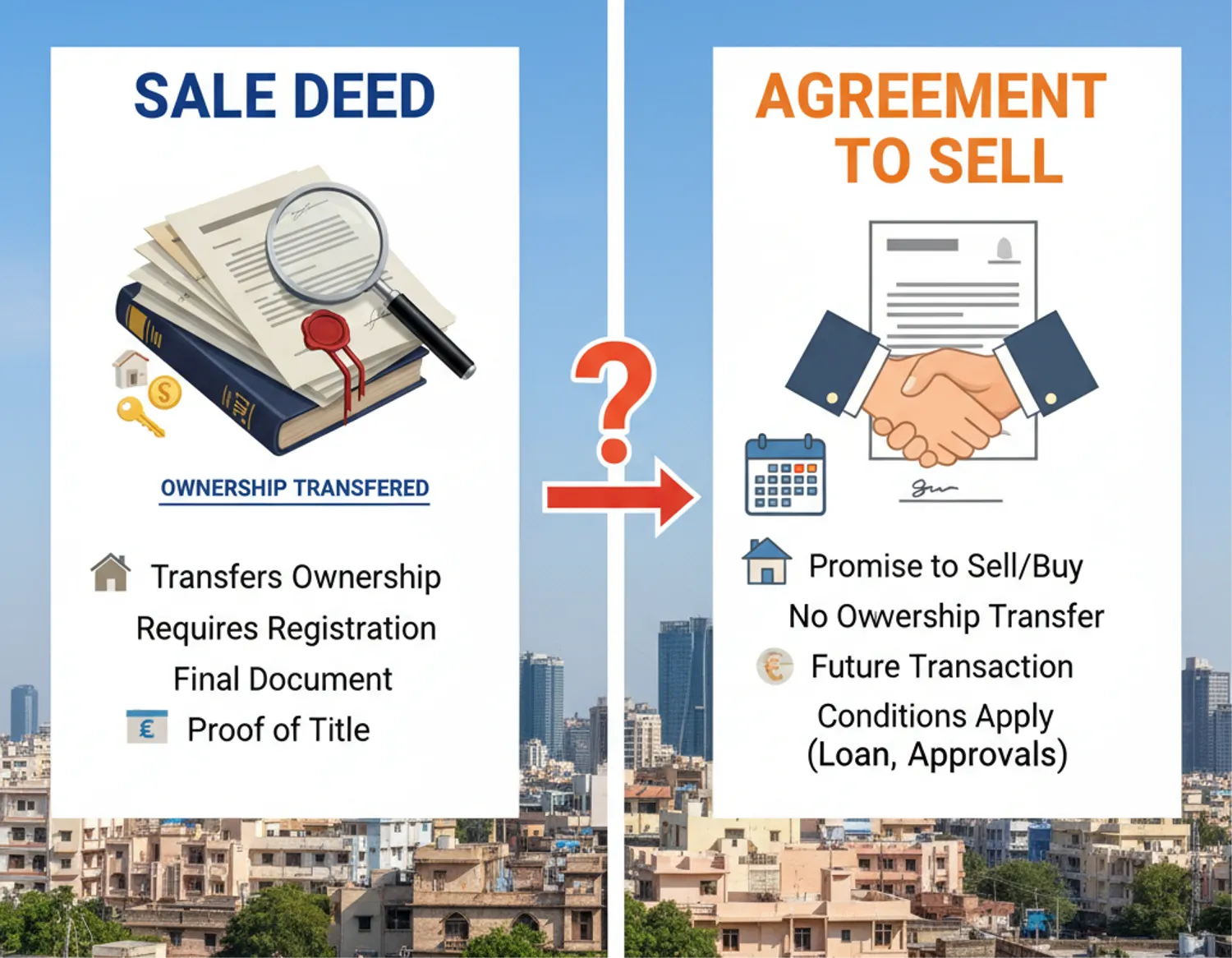
Agreement to Sell — What It Really Does
An Agreement to Sell is, at its core, a commitment.
It sets the intent:
- This property will be sold
- At this price
- Under these terms
It usually shows up when money has started moving but the deal isn’t fully closed yet — booking amounts, loan processing, ongoing construction, that kind of phase. It has legal weight, no doubt. You can’t just ignore it. But it doesn’t make you the owner. Not yet.
Sale Deed — Where Things Actually Shift
The Sale Deed is where the transaction settles into something final. Ownership moves here. Not before. It’s executed, registered, and recorded. After that, there’s no ambiguity about who the property belongs to.
Everything leading up to it matters, but this is the point where it becomes official.
The Difference, Without Dressing It Up
Strip it down and it’s fairly straightforward:
Basis — — — Agreement to Sell — — — -Sale Deed
Nature ……………Intent……………………..Completion
Ownership……....Pending………………….Transferred
Legal Standing…..Conditional……..………Conclusive
Registration……...Not always………….…..Mandatory
Exposure……..……Some……………….…….Minimal
Or more simply:
Agreement says the deal will happen.
Sale Deed says it has happened.
How It Usually Plays Out
In most Ahmedabad transactions, the flow is predictable, even if the timelines aren’t.
Agreement comes first.
Some payment is made.
Loans, checks, paperwork move along in the background.
Then the final payment.
Then the Sale Deed.
Nothing surprising there.
Why the Agreement Still Matters
Even without ownership, the Agreement to Sell isn’t just a formality.
It holds the structure of the deal:
- Price is fixed
- Timelines are outlined
- Responsibilities are split
If things go off track, this is the document that defines what was supposed to happen. So while it doesn’t complete the transaction, it shapes it.

Where Things Tend to Go Wrong
Not in dramatic ways. Usually in small assumptions.
Agreement Being Treated as “Enough”
It feels like progress — money paid, document signed. Easy to assume that’s close to ownership.
It isn’t.
Registry Getting Pushed
Sometimes deliberately, sometimes just because things drag.
But until the Sale Deed is registered, ownership is still technically elsewhere.
Clauses Getting Ignored
Agreements aren’t always balanced. Penalties, timelines, exit terms — they’re all in there.
And often skipped over.
A Quick Look at Local Patterns
In areas like Gota, Chandkheda, New Ranip, South Bopal — you’ll see deals sitting in that in-between stage longer than expected.
Agreements done, but registry pending.
Sometimes for practical reasons, sometimes just inertia.
It’s not rare. But it does leave things open-ended.
So Which One Actually Matters More?
They don’t compete.
The Agreement to Sell sets things up.
The Sale Deed closes it.
One without the other leaves the process incomplete in different ways.
Final Thought
Most of the property buying process feels gradual — payments, paperwork, timelines. But ownership isn’t gradual. It flips at a very specific point.
Until the Sale Deed is registered, you’re still on the way there.