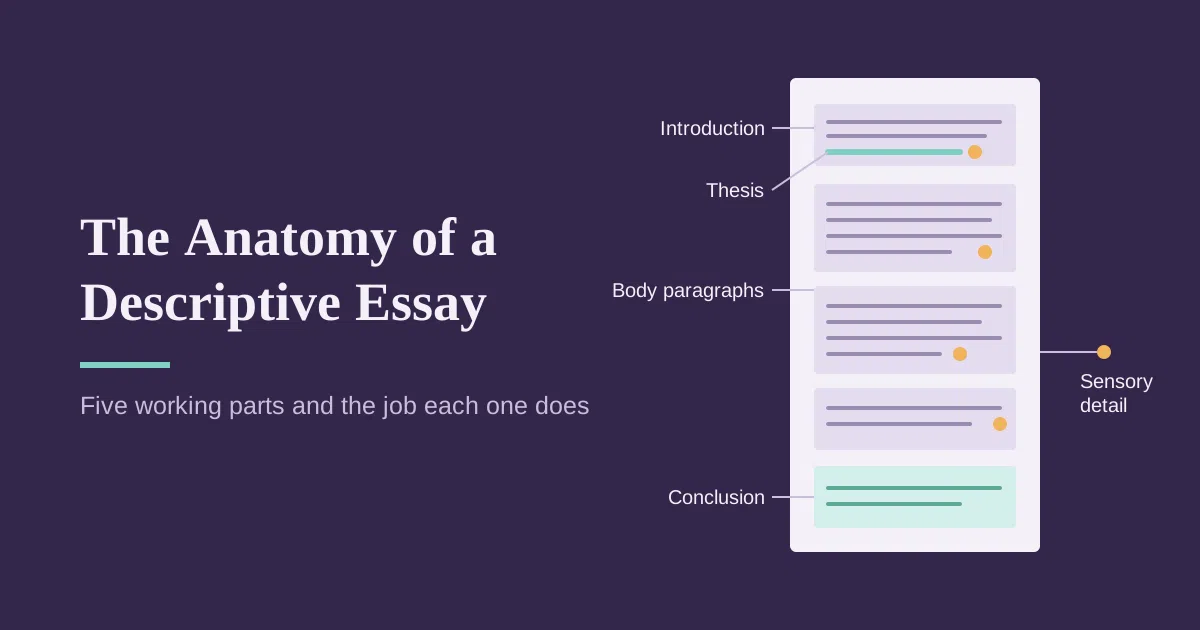
Students who compare a descriptive essay writing service sample with their own drafts usually notice the same thing: the strong version is built from a few clear parts, each with a job to do. A descriptive essay has an introduction, a thesis that names one dominant impression, body paragraphs organized around details, a layer of sensory language and a conclusion that brings the picture into focus.
Knowing those parts changes how you plan. Instead of writing every detail you can remember and hoping it adds up, you decide what each section must accomplish and choose details to serve it. The sections below break the essay into its working pieces, define the format, cover the common types you may be assigned and show how the parts fit together on the page.
What Are the Five Parts of a Descriptive Essay?
The five parts are the introduction, the thesis statement, the body paragraphs, the sensory details woven through them and the conclusion.
Instructors, writing centers and any legit essay writing service tend to describe this same frame, even when they label the pieces a little differently. The frame matters because description can easily drift. Without a structure, an essay about a farmhouse becomes a list of rooms rather than a picture with a point.
Introduction: places the reader in front of the subject and sets the mood.
Thesis statement: names the dominant impression the essay will build.
Body paragraphs: each one develops a single area, angle or moment of the subject.
Sensory details: supply the sights, sounds, smells, tastes and textures that make the essay vivid.
Conclusion: returns to the impression and leaves the reader with a final image.
Sensory detail is the part students forget to count, because it does not sit in one place. It runs through every paragraph. Yet graders often treat it as its own criterion, since an essay can have a tidy introduction and conclusion and still fail to make the reader see anything.
Body paragraphs are where most of the word count goes. Each one should cover a single area, angle or moment of the subject and open with a sentence that tells the reader where they are. Ending each body paragraph on a detail that echoes the thesis keeps the impression building instead of resetting.
The introduction deserves more care than its size suggests. A single concrete image, such as the hiss of a radiator in an empty classroom, does more than a general sentence about how special a place is. The thesis then follows, often in the last sentence of the opening, naming the feeling the details will prove.
What Does a Descriptive Essay Actually Ask You to Do?
It asks you to recreate a person, place, object or moment so clearly that the reader experiences it, and to shape that experience around one controlling impression.
The standard descriptive essay definition sounds simple: describe something. The difficulty is in the second half of the task. A description without a controlling impression reads like an inventory, while a description with one reads like an argument made through detail. "The market was busy" reports; "The market felt like a festival nobody had planned" interprets.
This is why the thesis in a descriptive essay looks different from one in an argumentative paper. It does not take a side on a debate. It commits to a mood, a meaning or a way of seeing the subject, and every body paragraph has to earn that commitment through specific observation.
Description also shows up inside other assignments. Narrative essays, personal statements and even lab reports use descriptive passages, so the skills you practice here carry into work that is not labeled descriptive at all. College application essays in particular rely on short descriptive scenes to show a reader who the applicant is.
Which Types of Descriptive Essay Might You Be Assigned?
Most assignments fall into a handful of types defined by the subject: a person, a place, an object, an event or an emotion.
Person: a relative, coach or stranger, described through appearance, habits, voice and the effect they have on others
Place: a room, street or landscape, usually organized by moving through the space
Object: a single item, often one with personal history, examined closely from several angles
Event or moment: a short stretch of time, such as the minute before a race, described rather than narrated
Emotion or abstract idea: a feeling like homesickness made concrete through images and situations
Instructors also distinguish between objective and subjective description. Objective description, common in science and technical writing, records what is there with as little coloring as possible. Subjective description, the usual choice for composition classes, filters the subject through the writer's perspective and lets mood guide which details appear.
The type you receive shapes the body paragraphs more than any other part. A place essay often moves spatially, from the doorway inward. A person essay might move from outward appearance to behavior to what the person reveals under pressure.
If the prompt lets you pick the subject, choose one you can observe closely or remember in detail. A small, specific subject, such as a single bench in a park, usually produces a richer essay than a large one, such as an entire city, because there is room to slow down.
How Is a Descriptive Essay Usually Formatted?
Most follow the five-paragraph shape or a longer version of it, with standard academic formatting and an organizing pattern chosen to suit the subject.
The descriptive essay format in most composition courses follows MLA style: a heading with your name, instructor, course and date, a centered title, double spacing and one inch margins. Some instructors prefer APA or their own template, so the assignment sheet is the final word on page setup.
Inside the essay, organization does more work than page setup. Three patterns cover most descriptive writing:
Spatial: moves near to far, left to right or outside to inside, and suits places and objects.
Chronological: moves from early to late within a short span of time, and suits events and moments.
Order of importance: moves from the least striking detail to the most striking, and suits people and emotions.
Transitions should follow whichever pattern you choose. Spatial essays lean on phrases like "beyond the counter" or "above the doorway," while chronological ones use "by the time" or "a moment later." Matching transitions to the pattern helps the reader track movement without noticing the structure.
Length varies more than the structure does. A short assignment may compress the body into two paragraphs, while a longer one gives each area of the subject its own section. The five parts stay the same either way; only the amount of room inside them changes.
Plenty of students start searching how to get my descriptive essay written once they see a strict rubric and a deadline at the same time. Even then, knowing these parts makes it easier to judge whether a finished paper actually follows the format the class expects.
How Do the Parts Work Together on the Page?
Each part hands something to the next: the introduction sets a scene, the thesis names its meaning, the body proves it and the conclusion settles it.
Take a subject like a laundromat at midnight. The introduction might open on the buzz of a fluorescent tube and the smell of warm cotton. The thesis could claim that the place feels less like a chore and more like a refuge for people who cannot sleep.
The body then tests that claim. One paragraph might cover the room itself, the humming machines and the cracked plastic chairs. Another might focus on the few people there, each absorbed in a quiet routine. A third could slow down on a single moment, such as a dryer door opening and releasing a wave of heat.
Sensory language holds these paragraphs together. Similes and metaphors help, but only when they sharpen the impression. A comparison that is clever but off mood pulls the reader away from the feeling the thesis promised, so every figure of speech should point the same way.
The conclusion returns to the fluorescent buzz, now heard differently because of everything the reader has seen. A descriptive essay writing guide with worked examples of openings and endings can show more ways to make that final echo land without simply repeating the first line.
This anatomy also makes revision easier. Read the draft one part at a time and ask whether each is doing its job: does the introduction place the reader, does the thesis commit to a mood, does every body paragraph prove it and does the conclusion close the loop? A part that fails that question is the part to rewrite.
Seeing a complete essay built this way often makes the anatomy click faster than any diagram. A model paper from CollegeEssay.org written to your own prompt shows each of these parts working on your actual subject, which you can then study as a pattern for your own draft.
Coverage on Yahoo Finance describes studying a model paper for how the thesis is framed and how each paragraph supports it, the same part by part reading that helps you check whether your own draft holds together.
Other Questions About the Structure of a Descriptive Essay
Can a descriptive essay run longer than five paragraphs?
Yes. Five paragraphs is a common minimum, not a limit. Longer assignments simply add body paragraphs, each focused on one area or moment, while the introduction and conclusion keep the same roles.
Should a descriptive essay be written in present or past tense?
Either works if you stay consistent. Present tense creates immediacy, which suits places and scenes, while past tense fits memories. Switching tenses midway is one of the most common errors graders mark.
Is dialogue allowed in a descriptive essay?
A line or two can work when a voice is part of the scene, such as a vendor calling out prices. Long exchanges shift the essay toward narrative, so keep dialogue brief and descriptive in purpose.
How many similes and metaphors should a descriptive essay include?
There is no set number. A few precise comparisons usually beat many loose ones. If a figure of speech does not strengthen the dominant impression, a plain, exact detail will often do more.
Can the conclusion introduce a new detail?
A small final image is fine if it confirms the impression the essay built. Avoid opening a new area of the subject, since the conclusion should settle the picture rather than extend it.
TL;DR
Five working parts carry every descriptive essay, and sensory detail is the one that runs through all the others rather than sitting in a single paragraph. Pick a type, match it to an organizing pattern and let one impression decide what stays. CollegeEssay.org delivers model papers that show this anatomy on a real subject, giving you a clear example to learn the structure from.