A compare and contrast essay writing service, a textbook and a classmate's old paper can all supply an example, but the example only helps if it is read with a purpose. Skimming a sample for its topic teaches very little. Reading it for its thesis, its structure and the words that signal each comparison shows how the format actually works, and those are the parts that carry into your own essay.
Most students look at examples too late, after a draft is already stuck, and then read them the same way they would read any article. A better approach treats each example as a set of choices to notice and question. The sections below start with the signal words that hold a comparison together, then move through what a finished essay looks like and how to study one without leaning on it too heavily.
What Are 10 Examples of Compare and Contrast Words?
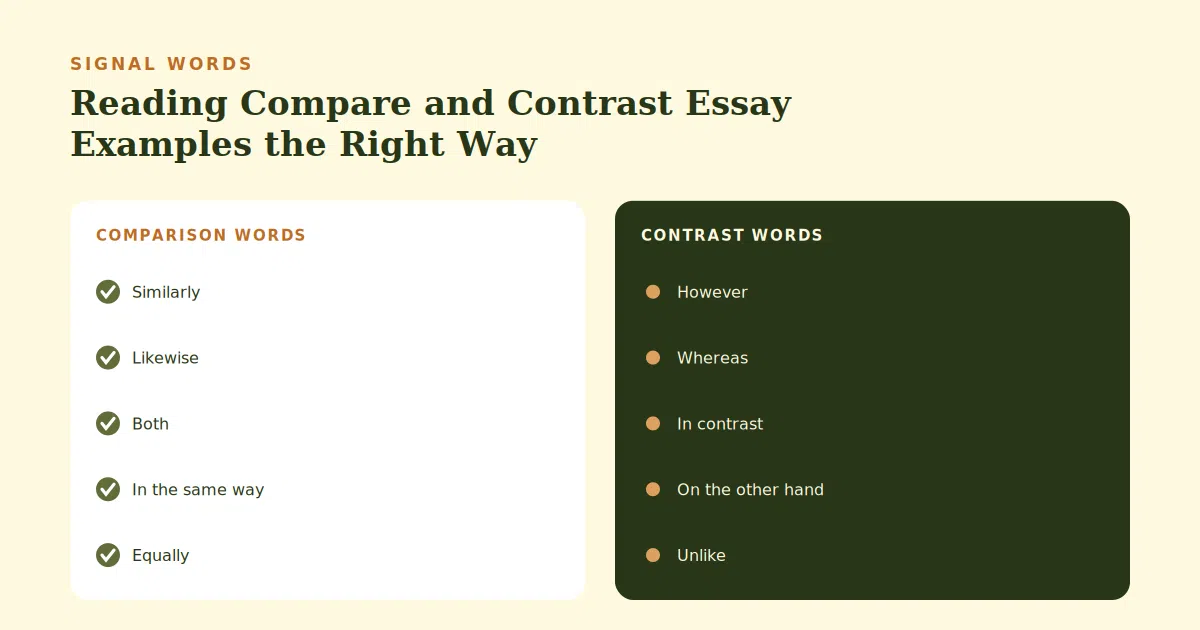
Common comparison words include similarly, likewise and both, while common contrast words include however, whereas and in contrast.
These words are the joints of a comparison essay. They tell the reader whether the next point shows a shared feature or a difference, which keeps a two subject argument easy to follow. Students reviewing samples from an online essay writing service or a textbook often notice that strong examples use these words deliberately rather than at random.
Similarly: signals a shared feature, as in “Similarly, both authors open with a childhood memory.”
Likewise: signals a parallel point, as in “Likewise, the second policy targets urban voters.”
Both: signals common ground, as in “Both paintings use a muted palette.”
In the same way: signals a matching method, as in “In the same way, each study relies on surveys.”
Equally: signals equal weight, as in “Equally, each leader faced economic pressure.”
However: signals a turn to difference, as in “However, only one novel resolves the conflict.”
Whereas: signals a direct contrast, as in “The first poem is formal, whereas the second is loose.”
In contrast: signals a clear opposite, as in “In contrast, the later model ignores cost.”
On the other hand: signals an alternative view, as in “On the other hand, critics praised the sequel.”
Unlike: signals a specific difference, as in “Unlike Hamlet, Laertes acts without hesitation.”
Knowing the words is only half the skill. The other half is placing them where the logic changes. A paragraph that strings "however" and "in contrast" together without a real difference behind them reads as mechanical, so each signal word should introduce a point that actually earns it.
Variety matters too. Repeating "similarly" at the start of every comparison sentence makes an essay sound like a checklist. Rotating between a few options, and sometimes building the comparison into the sentence itself, keeps the writing natural while still guiding the reader.
What Does a Compare and Contrast Essay Look Like?
It has an introduction with a comparative thesis, body paragraphs organized by subject or by criterion, and a conclusion that explains what the comparison shows.
The thesis is the first thing to look for in any example. A strong one names both subjects and says something about how they relate, such as which is more effective or why their similarities matter. If an example's thesis only says that two things are alike and different, it is showing a weak version of the format.
The body comes next. Examples usually follow one of two structures. In a block structure, the first half covers one subject and the second half covers the other. In a point by point structure, each paragraph compares both subjects on a single criterion. Identifying which one an example uses is the first step in learning from it.
The conclusion is often the most overlooked part of a sample. A good one does not simply repeat the thesis. It explains what the reader understands now that they did not before, which is the real payoff of putting two subjects side by side.
Length also shapes what an example looks like. A short essay may compare only two criteria, while a longer research based comparison might cover four or five with subheadings. Matching an example to the length of your own assignment gives a more realistic picture of how much ground each paragraph should cover.
How Should You Read a Compare and Contrast Essay Sample?
Read it twice, first for the overall argument and then paragraph by paragraph for the choices behind it.
The first read should be quick. The goal is to see the argument as a whole and decide whether the comparison feels balanced. Notice which subject seems to get more attention and whether the conclusion feels earned. These impressions help guide the slower second read.
The second read is where the learning happens. A few questions make it more productive:
What criterion does each body paragraph compare?
Where do signal words appear, and what change do they mark?
How is evidence for each subject introduced and cited?
Does every paragraph link back to the thesis?
Writing short notes in the margin turns a passive read into an active one. A note such as "criterion: setting" or "shift to difference here" makes the structure visible. Once the structure is mapped, it becomes much easier to see how a similar structure could carry a completely different pair of subjects.
It also helps to read more than one example. Two samples on different topics show which choices belong to the format and which belong to a particular writer. Where both examples do the same thing, that is likely a convention worth following.
How Is a Template Different From an Example?
A template shows the empty structure, while an example shows that structure filled in with a real argument.
Templates are useful for planning. They lay out where the thesis goes, how many body paragraphs to expect and what each one should do. What a template cannot show is how the sentences sound, how evidence is woven in or how transitions carry a reader from one subject to the next.
The risk with templates is that every essay built from one starts to sound alike. A fill in the blank thesis such as "X and Y are similar in some ways but different in others" fits any topic, which is exactly why it says nothing about this one.
Examples fill that gap. Seeing a full essay on a real topic shows the decisions a template leaves blank. Many students find it useful to start with a template to plan and then check their plan against an example to see how the finished version should read.
A model paper written to the student's own brief goes one step further. A model paper from CollegeEssay.org is an example written to the specific prompt, so the subjects, criteria and citation style already match the assignment. That makes it easier to see how the general structure applies to the exact comparison the instructor set.
Students who want that level of match sometimes put the request simply, "get my comparison essay written to this prompt," and then study the delivered paper using the same two read method described above. Reading a model paper on your own subjects makes the margin notes more useful, because every structural choice applies directly to the essay you still need to write.
How Can You Use an Example Without Copying It?
Learn the structure and techniques from the example, then build your own argument with your own words and sources.
The line between learning from an example and copying it is about what moves into your work. Structure, the type of signal words and the way evidence is introduced are techniques that can be learned. Specific sentences, phrasing and unique arguments belong to the original and should stay there unless quoted and cited properly.
Institutions draw this line in slightly different places, so the syllabus and honor code are the final word. A clear explanation of model papers versus plagiarism shows how a reference differs from work presented as a student's own, which helps when deciding how to use any sample responsibly.
One practical method is to close the example before drafting. Keep your notes on its structure open, but write each paragraph without looking at the original text. This keeps the wording your own while still letting the example guide the shape of the essay.
Waiting a day between studying an example and drafting can help as well. The structure stays in memory, but the specific wording fades, which makes it easier to write sentences that sound like you rather than like the sample.
Frequently Asked Questions
Where can I find reliable compare and contrast essay samples?
Textbooks, university writing center websites and instructors' handouts are good starting points. They usually show the format as your course expects it.
Should my essay follow the same structure as a sample?
Only if that structure suits your subjects and prompt. Choose block or point by point based on your own comparison.
Can I quote from an example essay?
Only with a proper citation, and only if the example is a legitimate source for your topic. Most samples are better used for structure.
How many signal words should one paragraph use?
Usually one or two. Enough to mark the shift between subjects, without making every sentence start with a transition.
Are older sample essays still useful?
Yes, for structure. Check citation formatting against the current edition of your style guide, since rules change between editions.
TL;DR
Compare and contrast essay examples teach the most when they are read for their thesis, structure and signal words rather than their topic. Reading twice, taking notes and closing the example before drafting keeps the learning yours. CollegeEssay.org writes each model paper to the student's own brief, which makes it a closely matched example to study.