A critical essay writing service plans every order around its assigned length, and the 10 percent rule is the margin most students work within. It treats a count landing about one tenth above or below the target as acceptable when the prompt allows it. How much that margin is worth, though, changes with the kind of critique, the length of the assignment and what your course counts as a word.
A 400 word film response and a 3,000 word critique of a research article both carry a word count, yet they use it very differently. The margin on one is a few sentences, while on the other it is several paragraphs. The sections below look at the rule from that angle: actual ranges for common lengths, how different critique formats handle it, what gets counted and how to plan the evaluation to fit.
What Is the 10% Rule in Essay Writing?
It is an informal tolerance that lets an essay land within about 10 percent of the assigned count, unless the prompt sets a firmer limit.
No style guide sets the rule. It grew out of classroom practice, and you will see it described by instructors, writing centers and an essay writing service alike as a reasonable allowance rather than a right. Its purpose is to stop students from padding or cutting good material just to hit an exact figure.
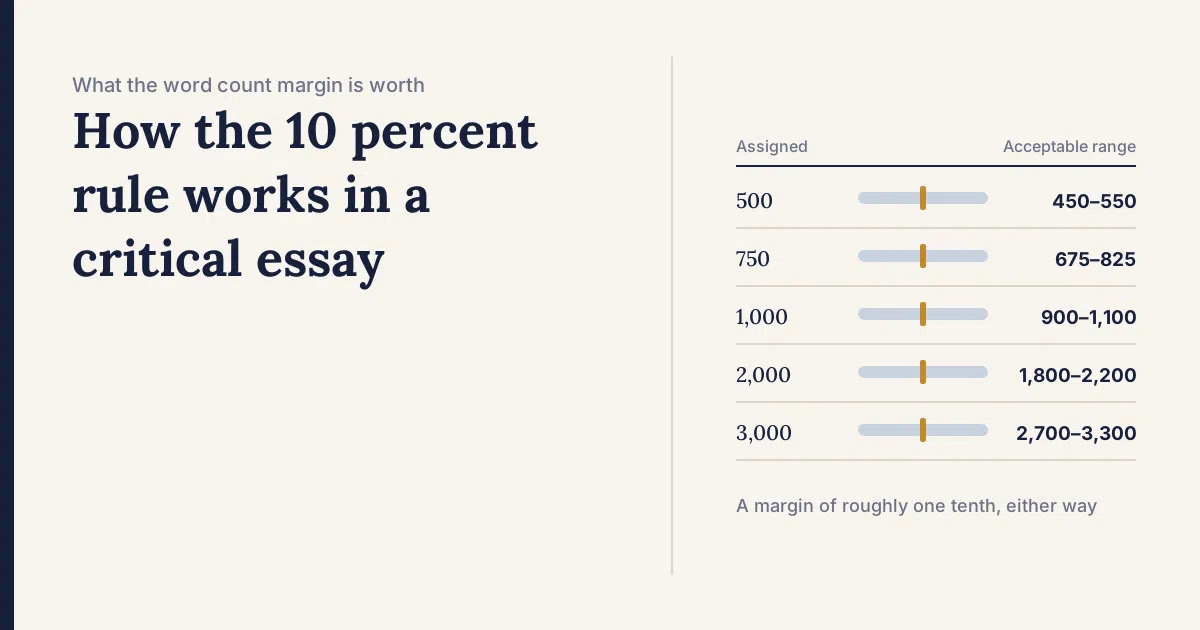
Turning the percentage into real numbers makes it easier to plan. The ranges below apply the margin to lengths that critical essays are often assigned:
Assigned lengthRange under the ruleMargin in practice500 words450 to 550About two or three sentences750 words675 to 825About one short paragraph1,000 words900 to 1,100About one to two paragraphs2,000 words1,800 to 2,200About three to four paragraphs3,000 words2,700 to 3,300About a full section
The third column is the useful one. On a short critique the margin barely covers a single extra example, so it cannot rescue a draft that is badly over. On a long one it can absorb a whole section, which makes planning the structure more important than watching individual sentences.
The margin also runs in both directions, and the lower edge deserves as much attention as the upper one. A critique that falls short of the range usually signals an evaluation that stopped early, which instructors tend to notice faster than a few extra words. Treat the bottom of the range as a floor for argument, not just for length.
How Does the Rule Apply to Different Kinds of Critical Essays?
The margin stays the same in percentage terms, but each format spends it differently and some leave almost no room for it.
Book reviews written for a class often imitate published reviews, which work to tight editorial limits. Instructors who assign them may expect the count to be treated as close to fixed. Film critiques are similar, and both tend to reward compact judgment over extended analysis of every scene.
Article critiques, common in psychology, nursing and the social sciences, usually follow a set structure covering the research question, method, results and limitations. Because each part is expected, the margin is best used to strengthen the weakest section of the evaluation rather than to extend the summary of the study.
Response papers and art or exhibition critiques are often the shortest assignments in a course. With little room to move, the margin works best as protection against a few unavoidable words of context. Students who want to see how a format of this kind is paced within its count sometimes pay for a critical essay on the same prompt and study how the space is divided.
Longer literary or philosophical critiques sit at the other end. A 3,000 word evaluation of a novel or an argument can use its margin to add a further criterion or respond to a counterargument, which often lifts the essay more than any extra context would.
Rhetorical analysis critiques, common in first year composition, fall somewhere in between. They judge how a speech, essay or advertisement persuades its audience, and the margin is best spent on one more close look at a specific appeal or technique. Extra words on the speaker's background rarely add to the grade.
What Counts Toward a Critical Essay's Word Count?
Usually the body text, including quotations, while titles, reference lists and appendices are often left out, though courses differ.
The question matters more than it seems, because the answer can move a draft in or out of range. A critique heavy with quoted lines from a poem, or with in-text citations in APA style, can carry dozens of words that some instructors count and others do not.
Common conventions to check against your syllabus include:
The works cited or reference list is rarely counted.
Titles, headers and cover page details are usually excluded.
Footnotes in Chicago style are sometimes counted and sometimes not, depending on the department.
Block quotations are generally counted, since they sit inside the body.
Abstracts, where required, are often given their own separate limit.
Counting tools add another variable. Word processors and learning platforms can treat hyphenated terms, numbers and citations differently, so the same file may show slightly different totals. If the course submits through a portal that displays a count, that figure is the one worth checking before the deadline.
When the syllabus says nothing about what counts, a sensible default is to count the body text, including quotations, and exclude the title and reference list. Mentioning that assumption in a short question to the instructor, or following the approach used in earlier graded work, keeps the count defensible if it is ever questioned.
How Many Evaluation Points Fit Into a Given Length?
As a rough guide, each well developed criterion needs a few hundred words, so the length sets how many judgments the essay can support.
A critique is built on criteria, such as the strength of an argument, the use of evidence or the effectiveness of a film's pacing. Each criterion needs a claim, evidence from the work and an explanation of why the evidence supports the judgment. That pattern takes space, and trying to fit too many criteria into a short count leaves each one thin.
Working out how many criteria the count can hold is a large part of length planning. CollegeEssay.org starts each order from the brief, so the assigned count and academic level decide how many evaluation points the model paper develops and how deeply each one is argued.
For your own draft, a quick estimate helps. Subtract the space for the introduction and conclusion, then divide what remains by the space a solid criterion needs. If the answer is two, a plan with five points will either break the limit or skim every point, and narrowing the list early saves a painful cut later.
Take a 1,000 word critique as an example. If the introduction and conclusion together use around 200 words, about 800 remain for the body. At roughly 250 words per developed criterion, that leaves room for three points, with the margin available for a short response to an opposing reading.
Choosing which criteria survive is part of the critique itself. A critical essay guide that explains how evaluative claims are framed can help you rank the points by how much they reveal about the work, keeping the strongest ones and letting the minor observations go.
How Does the Rule Work for Very Short and Very Long Critiques?
Short critiques leave almost no room for error, while long ones need the margin managed section by section.
On a 300 or 400 word critique, the margin is only a few dozen words. One example too many or a long opening sentence can push the draft past it. These pieces usually work best with a single focused judgment, one or two pieces of evidence and almost no summary.
Short critiques of long works are the hardest case. Evaluating a full novel or a lengthy report in a few hundred words means choosing one aspect, such as the ending, the method or a central argument, and judging it well. Trying to cover the whole work in that space turns the critique into a compressed summary.
Long critiques bring the opposite problem. With a margin of several hundred words, it is easy to drift past the target without noticing, because no single paragraph seems too long. Setting a rough count for each section before drafting, and checking it as each section is finished, keeps the overall length from creeping.
Long pieces also benefit from signposting. When a critique runs to several thousand words, short transitions that tell the reader which criterion comes next help the length feel purposeful. A reader who knows where the argument is heading is far less likely to notice whether the essay sits a little above or below its target.
Frequently Asked Questions
Does the 10 percent rule apply to discussion board critiques?
Often it does, though many boards set a minimum rather than a target. Meeting the minimum with substance matters more than landing near a figure, and replies to classmates may carry their own separate limit.
Can I use the full extra 10 percent on purpose?
Only when the extra words add evaluation. Planning to run over from the start tends to produce padding rather than stronger critique. Aim for the target and let the margin absorb what the argument genuinely needs.
What if the prompt already gives a range?
Then the range replaces the rule. A prompt asking for 1,000 to 1,200 words has set its own margin, and the extra 10 percent does not apply on top of it. Stay inside the stated figures.
Does the rule apply to drafts submitted for peer review?
Usually less strictly. Draft stages focus on argument, though a draft far from the target will need major changes before the final version. Check whether the course grades drafts on length at all.
How is length judged in a timed, handwritten critique?
Mostly by completeness rather than an exact count. Instructors look for a clear judgment, supporting evidence and a conclusion within the time allowed.
TL;DR
The 10 percent rule is an informal margin around a critical essay's word count, and its real value depends on the format, the length and what your course counts. Short critiques leave little room, while long ones need section level planning. CollegeEssay.org plans each model paper from the assigned length, matching the number of evaluation points to the count.