Introduction
Machine learning becomes easier to understand when learners build complete projects instead of studying algorithms only in notebooks. Practical projects force learners to make decisions about data preparation, feature selection, validation, model choice, evaluation, and error handling. Neural network projects add further decisions involving architecture, training, regularization, and computational resources.
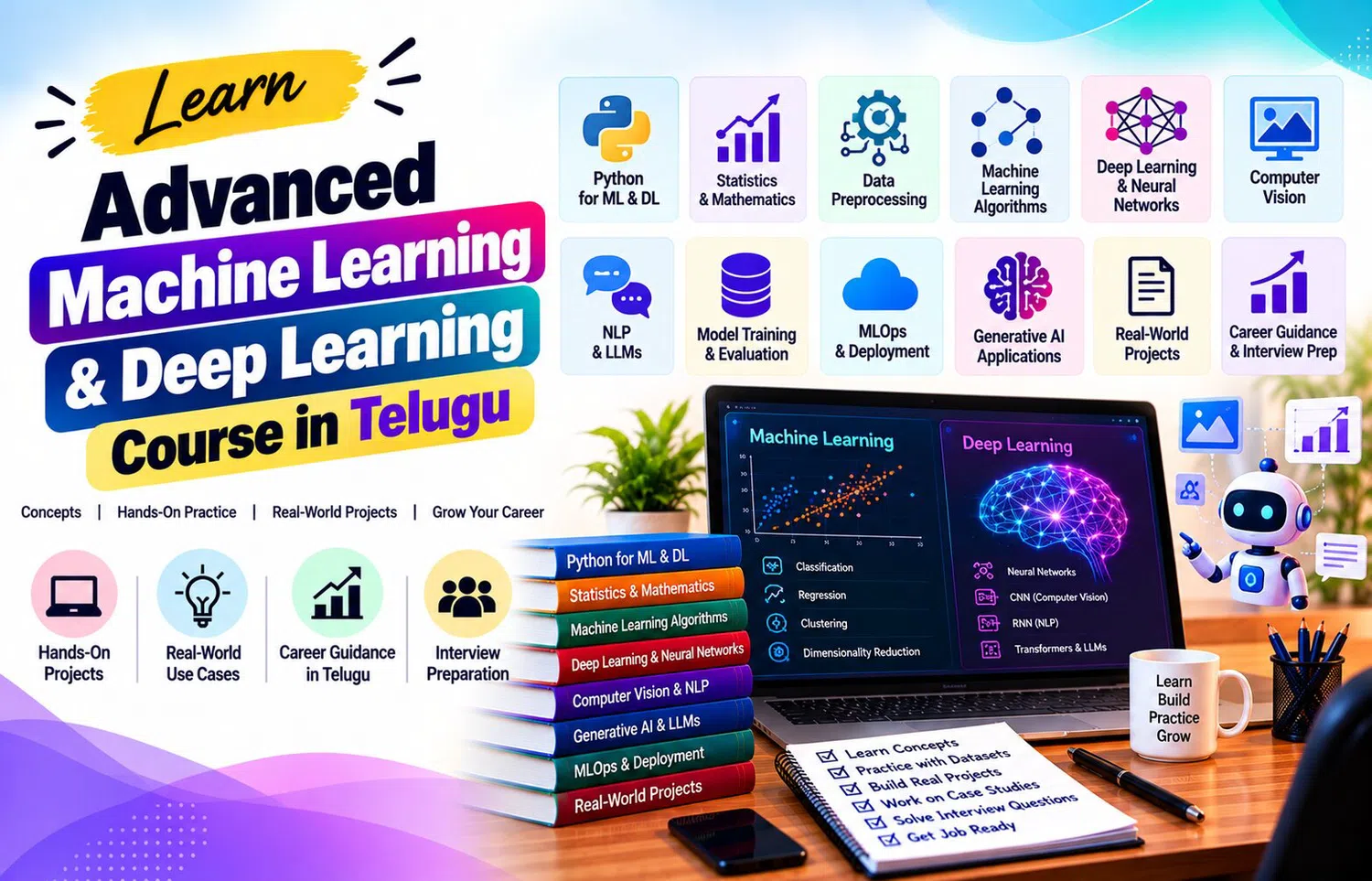
An Advanced Machine Learning Course & Deep Learning in Telugu can help learners build project-based skills across structured data, images, text, and sequence data.
The goal is not to create many unfinished projects. A few well-designed projects that demonstrate complete problem-solving provide stronger learning than a large collection of copied models.
What Makes a Good AI Project?
A strong project has:
Clear problem statement.
Reliable dataset.
Defined target.
Baseline model.
Evaluation metric.
Advanced model.
Error analysis.
Documented conclusion.
For example:
Weak project:
“Used Random Forest on data.”
Strong project:
“Predicted customer churn, compared Logistic Regression, Random Forest, and boosting, optimized F1 Score, and analyzed false negatives.”
The second project demonstrates actual machine learning thinking.
Project 1: Customer Churn Prediction
Goal:
Predict customers likely to leave.
Possible features:
Tenure.
Monthly Charges.
Contract.
Usage.
Support Calls.
Payment History.
Workflow:
Clean data.
Engineer features.
Handle class imbalance.
Train Logistic Regression.
Train Random Forest.
Train boosting model.
Compare F1 and ROC-AUC.
This is a strong structured-data project.
What Can Learners Explore in Churn Prediction?
Advanced topics may include:
Threshold tuning.
Feature importance.
SHAP-style explanations.
Class weights.
Cross-validation.
Customer segment analysis.
For example, learners can investigate whether false negatives are concentrated among:
New customers.
High-value customers.
Specific plans.
This turns the project into meaningful error analysis.
Project 2: Credit Risk Classification
Goal:
Estimate risk category for loan applicants.
Possible features:
Income.
Loan Amount.
Employment Length.
Credit History.
Existing Debt.
Important considerations include:
Imbalanced classes.
False-negative cost.
Explainability.
Fair evaluation.
Learners should treat financial prediction as a high-impact example and focus on responsible modeling rather than using the model as an unsupervised decision maker.
Project 3: Retail Sales Forecasting
Goal:
Predict future product sales.
Features may include:
Past Sales.
Day of Week.
Month.
Promotions.
Holiday Flag.
Price.
Lag Features.
Rolling Averages.
This project teaches time-series splitting.
Do not randomly shuffle future and past records.
Evaluation should mirror real forecasting.
Project 4: Product Recommendation Prototype
Goal:
Recommend items based on user activity.
Possible inputs include:
Product Views.
Purchases.
Ratings.
Categories.
A beginner version can explore:
Popularity baseline.
Content similarity.
Collaborative filtering concepts.
Advanced learners can investigate neural recommendation models.
Always compare with a simple baseline.
Project 5: Fraud Detection
Goal:
Identify unusual transactions.
This project is useful for studying:
Extreme class imbalance.
Precision.
Recall.
PR-AUC.
Threshold selection.
Cost-sensitive evaluation.
Accuracy should not be the main metric.
Learners can investigate whether the system catches important rare cases without producing an unusable number of false alerts.
Project 6: Plant Disease Classification
Goal:
Classify leaf images.
Workflow:
Inspect images.
Create clean splits.
Apply augmentation.
Train CNN.
Use transfer learning.
Evaluate confusion matrix.
Review incorrect predictions.
This project introduces computer vision.
Learners can compare:
CNN from scratch.
Pretrained network.
This demonstrates the practical value of transfer learning.
Project 7: Manufacturing Defect Detection
Goal:
Identify defective products from images.
Possible classes include:
Normal.
Scratch.
Crack.
Shape Defect.
This project can emphasize:
Class imbalance.
False-negative cost.
Image quality.
Lighting variation.
Robustness testing.
A practical deployment may care more about missing defects than overall accuracy.
Project 8: Handwritten Character Recognition
Goal:
Recognize handwritten characters or digits.
This is a useful first CNN project because:
Data is structured.
Image size is manageable.
Classes are clear.
Learners can experiment with:
Convolution layers.
Pooling.
Dropout.
Confusion matrix.
The focus should be architecture understanding rather than achieving a record score.
Project 9: Sentiment Analysis
Goal:
Classify reviews as:
Positive.
Negative.
Possibly Neutral.
Compare:
TF-IDF + Logistic Regression.
LSTM.
Pretrained Transformer.
This project helps learners understand how NLP approaches evolved.
A transformer should not automatically be declared best.
Compare:
F1.
Training time.
Inference speed.
Data requirement.
Project 10: Support Ticket Classification
Goal:
Automatically categorize customer-support messages.
Classes may include:
Billing.
Technical.
Account.
General.
This project is practical because the output can help route tickets.
Challenges include:
Short text.
Overlapping categories.
Class imbalance.
Changing vocabulary.
Error analysis is especially important.
Project 11: Named Entity Recognition
Goal:
Identify entities such as:
Person.
Organization.
Location.
Product.
Learners can use pretrained NLP models and fine-tuning.
This project teaches token-level prediction.
Evaluation may use:
Precision.
Recall.
F1 at entity level.
Annotation quality becomes very important.
Project 12: Energy Consumption Forecasting
Goal:
Predict future electricity usage.
Possible input:
Previous hourly or daily values.
Weather.
Calendar variables.
Usage patterns.
Models to compare:
Simple average baseline.
Gradient Boosting.
LSTM.
This is an excellent example where learners should verify whether the deep model actually outperforms simpler methods.
Project 13: Activity Recognition from Sensor Data
Goal:
Classify activities such as:
Walking.
Sitting.
Running.
Standing.
Input:
Sensor sequences.
Models may include:
Traditional feature-based classifier.
1D CNN.
LSTM.
This introduces sequence modeling outside text.
Data splitting should avoid putting highly similar samples from the same session into both training and test sets.
Project 14: Image Similarity Search
Goal:
Find visually similar images.
A pretrained vision model can extract embeddings.
Then compare images using vector similarity.
Possible use cases include:
Product search.
Duplicate detection.
Visual catalog browsing.
This project introduces the idea of learned representations beyond direct classification.
Project 15: Text Similarity Project
Goal:
Measure whether two sentences have similar meaning.
Applications include:
FAQ matching.
Duplicate question detection.
Search.
Support knowledge retrieval.
Pretrained sentence embeddings can be used.
Evaluation should use realistic positive and negative pairs.
This teaches representation learning.
How Should Projects Be Structured?
A reusable project structure is:
Problem Statement.
Dataset Description.
Data Cleaning.
EDA.
Baseline.
Feature Engineering.
Advanced Model.
Tuning.
Evaluation.
Error Analysis.
Conclusion.
Limitations.
This structure helps learners explain their work clearly.
It also prevents the notebook from becoming a random sequence of experiments.
Why Is a Baseline Important in Projects?
Without a baseline, a complex model has no reference.
For forecasting:
Use previous value.
For classification:
Use majority class or simple Logistic Regression.
For image tasks:
Use a small CNN.
For NLP:
Use TF-IDF baseline.
The advanced model should demonstrate meaningful improvement.
Otherwise, extra complexity may not be justified.
Why Should Projects Include Error Analysis?
A score alone does not show why the model fails.
Review examples.
For churn:
Which customers were missed?
For vision:
Which images were confused?
For NLP:
Which sentences were misclassified?
This can reveal:
Data quality issues.
Missing features.
Ambiguous labels.
Insufficient examples.
Error analysis turns a model project into a learning project.
Why Should Projects Include Limitations?
Every model has limitations.
Examples:
Small dataset.
Limited geographic diversity.
Class imbalance.
Weak labels.
High inference cost.
No production monitoring.
Documenting these limitations demonstrates maturity.
A good AI project should not pretend the model is perfect.
How Should Learners Present Projects?
A good project explanation should cover:
Problem.
Why it matters.
Data.
Models compared.
Metric.
Best result.
Important errors.
What was learned.
Avoid describing only library calls.
Interviewers and reviewers often care more about reasoning than code volume.
How Can Telugu Learners Choose Projects?
Learners from Telangana, Andhra Pradesh, and other Telugu-speaking regions can select projects based on their learning goal.
For Advanced ML:
Churn.
Fraud.
Forecasting.
Credit Risk.
For Computer Vision:
Plant Disease.
Defect Detection.
For NLP:
Sentiment.
Ticket Classification.
For Sequence Modeling:
Energy Forecasting.
Activity Recognition.
Build one strong project from each relevant category instead of many shallow projects.
A Practical Project Portfolio
A balanced learning portfolio might contain:
Project 1:
Customer Churn with boosting.
Project 2:
Plant Disease with transfer learning.
Project 3:
Support Ticket Classification with transformer.
Project 4:
Energy Forecasting with LSTM comparison.
For each:
Include baseline.
Advanced model.
Evaluation.
Error analysis.
This demonstrates broad AI understanding.
Frequently Asked Questions
How many AI projects should a learner build?
A few complete, well-explained projects are usually more valuable than many incomplete projects.
Should every project use deep learning?
No. Deep learning should be used when the data type and problem justify it.
What should every project include?
A baseline, fair validation, suitable metrics, error analysis, and clear limitations.
Are Kaggle-style datasets useful?
Yes, especially for learning, but learners should still simulate realistic data splitting and deployment thinking.
Conclusion
An Advanced Machine Learning Course & Deep Learning in Telugu can help learners turn advanced concepts into practical skills through complete projects.
A strong portfolio can include structured-data models, computer vision, NLP, and sequence learning.
The strongest learners do not measure a project by how complex the architecture looks.
They demonstrate:
Clear problem definition.
Reliable evaluation.
Model comparison.
Error analysis.
Practical reasoning.
When projects are built this way, they become useful not only for practice but also for explaining advanced AI skills in interviews and real development discussions.