Introduction
Coding interviews often require more than remembering Java syntax. A candidate may be asked to analyze a problem they have not seen in exactly the same form, explain possible approaches, write a solution, discuss its efficiency, and handle follow-up conditions.
That is one reason Data Structures and Algorithms receive significant attention during programming interview preparation.
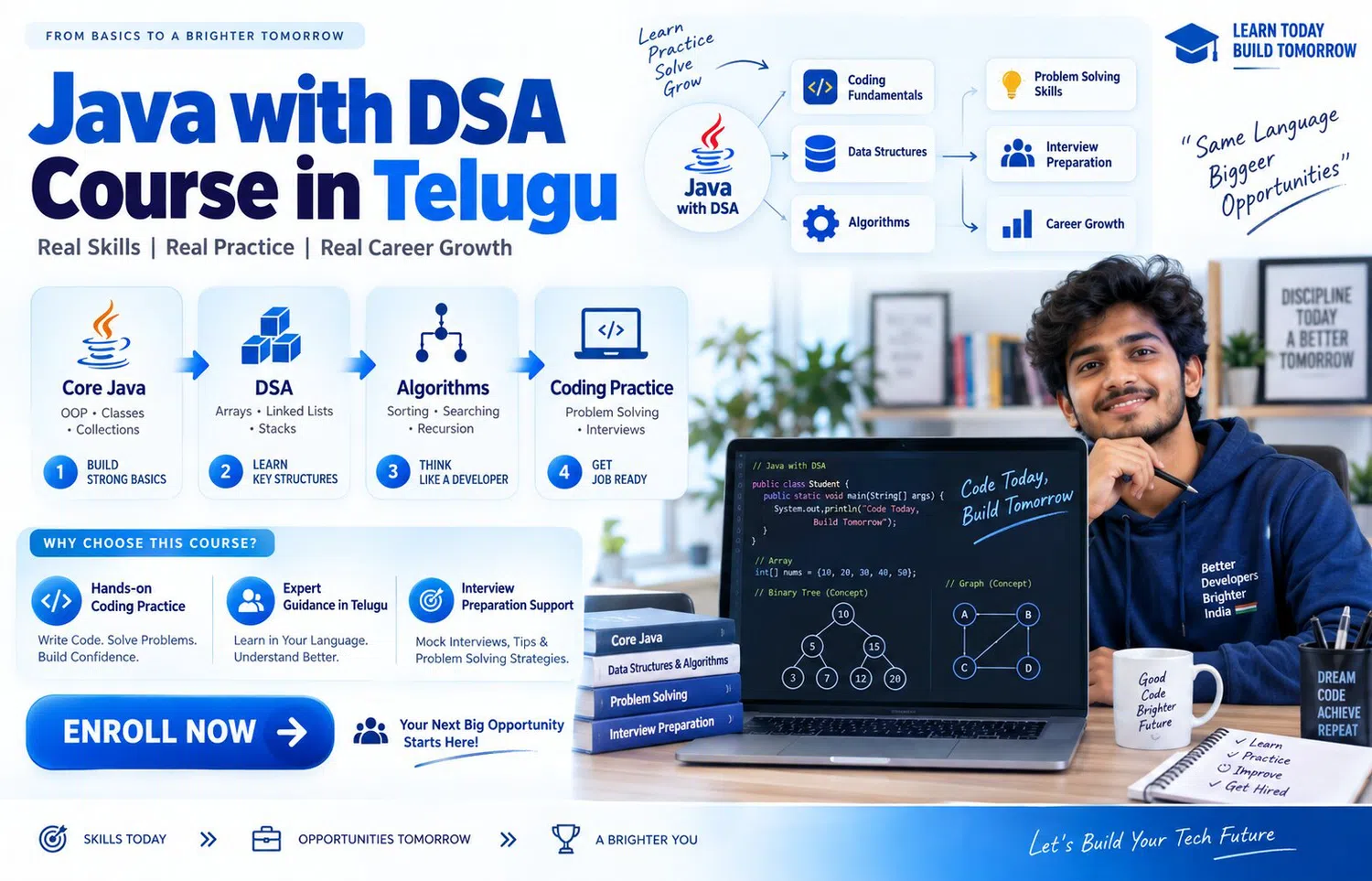
A Java with DSA Course in Telugu can help learners prepare by connecting Java implementation with arrays, strings, linked structures, stacks, queues, hashing, trees, graphs, searching, sorting, recursion, and common problem-solving techniques.
The useful goal is not to memorize hundreds of interview answers. It is to learn how to reason when the question changes.
Interviews Can Test Your Approach
Imagine you receive this problem:
“Given an array, determine whether any value appears more than once.”
You may know how to write Java loops.
But the interviewer can ask:
What is your first approach?
How many comparisons does it perform?
Can you reduce repeated work?
What additional memory would another approach require?
What happens with an empty array?
These follow-up questions examine reasoning around the solution.
DSA gives you concepts for discussing those decisions.
Arrays Build Basic Interview Thinking
Arrays appear in many beginner and intermediate coding problems because they provide a simple structure for testing algorithmic reasoning.
Practice questions involving:
Maximum and minimum values.
Duplicates.
Missing values.
Subarrays.
Pair-based conditions.
Reversal.
Frequency counting.
Two-pointer techniques.
Searching.
The objective is not to memorize an answer for every variation.
Learn to inspect the properties of the input and derive an approach.
Strings Require Careful Reasoning
String problems can appear simple but contain many details.
Consider checking whether two strings contain the same character frequencies.
You need to think about:
Case sensitivity.
Spaces.
Special characters.
Length.
Frequency storage.
Input assumptions.
A candidate who asks useful clarification questions demonstrates careful problem interpretation before implementation.
Hashing Can Change an Approach
Suppose you repeatedly search whether an element has already appeared.
One approach may compare it against many previous values.
Another may store previously seen values in a suitable hash-based structure.
Now you have a useful interview discussion.
You can explain why the second approach changes repeated lookup behavior and what extra memory it uses.
This is more valuable than simply saying, “Use a HashSet.”
Stacks Help with Specific Patterns
Stack-based thinking can appear in problems involving nested structures, bracket validation, expression processing, or previous-state behavior.
For example, balanced brackets require you to consider the order in which opening symbols should be matched.
A stack naturally represents the idea that the most recent unmatched opening bracket should be considered first.
Understanding the behavior allows you to derive the solution instead of memorizing code.
Queues Support Ordered Processing
Queues are useful when processing order matters.
Interview problems may involve level-wise processing, task scheduling concepts, or breadth-first traversal.
The important question is:
Why does first-in, first-out behavior match this problem?
If you can explain that relationship, your use of the structure becomes meaningful rather than mechanical.
Linked Lists Test Reference Understanding
Linked-list questions can reveal whether you understand references and pointer-like movement.
Typical practice areas include:
Traversal.
Reversal.
Finding a middle node.
Detecting certain patterns.
Insertion and deletion.
Merging ordered lists.
Do not memorize linked-list code line by line.
Draw nodes and arrows.
Track how references change after every operation.
A small diagram can prevent many implementation mistakes.
Trees Combine Structure and Recursion
Tree problems can test recursive reasoning and hierarchical data processing.
Begin with traversal.
Understand what happens when you visit:
The current node.
The left side.
The right side.
Then practice questions involving height, depth, search, and structural properties.
During an interview, explaining the recursive relationship clearly can be as important as producing syntactically correct Java code.
Graphs Expand the Problem Space
Graphs can represent networks, routes, dependencies, and connections.
Learn fundamental traversal approaches and understand when breadth-first or depth-first exploration is useful.
Before coding, clarify:
How is the graph represented?
Is it directed?
Can cycles exist?
Do you need a visited structure?
What exactly are you searching for?
These questions demonstrate structured thinking.
Complexity Helps You Discuss Trade-Offs
An interviewer may accept your initial solution and then ask whether it can be improved.
This is where time and space complexity become useful.
Suppose one solution repeatedly scans the same data.
Another stores additional information to avoid repeated scanning.
You can discuss the trade-off between execution work and additional memory.
Do not use complexity notation as decorative vocabulary.
Connect it directly to what your code does.
Interview Preparation Should Include Communication
Silent coding practice is not enough.
During a mock interview, practice saying:
“First, I want to clarify the input.”
“My straightforward approach would be…”
“This approach performs repeated comparisons because…”
“I can improve that by storing…”
“The additional structure uses extra memory.”
“I would test these edge cases…”
This turns internal reasoning into understandable technical communication.
Avoid Memorizing Problem Titles
If you memorize that a particular named problem requires a particular technique, a small change in the question can confuse you.
Instead, study why the technique works.
What property allows two pointers?
Why is binary search possible?
Why does a stack preserve the required order?
Why does hashing avoid repeated searching?
Understanding these conditions helps you handle unfamiliar variations.
Build Interview Practice Around Patterns
After foundational problems, organize practice by reasoning patterns.
For example:
Traversal.
Frequency counting.
Two pointers.
Sliding windows.
Binary search.
Stack behavior.
Tree recursion.
Graph traversal.
Backtracking.
Dynamic programming fundamentals.
Do not treat patterns as formulas.
They are possible tools to consider after understanding the problem.
Review Every Mock Interview
After practice, classify your difficulty.
Was the problem misunderstood?
Did Java syntax slow you down?
Did you choose an unsuitable structure?
Did you miss an edge case?
Was complexity analysis unclear?
Could you solve it but not explain it?
Each weakness requires a different type of practice.
This makes preparation more targeted.
Telugu Can Help Build Initial Confidence
You may first understand an interview concept as:
“Question chusina ventane code start cheyyakunda, requirement clarify chesi, simple approach explain chesi, tarvata optimize cheyyali.”
Then practice expressing the same reasoning using terms such as Brute-Force Approach, Optimization, Time Complexity, Space Complexity, Edge Case, and Trade-Off.
This helps bridge conceptual understanding and interview communication.
Frequently Asked Questions
Is DSA required for every Java interview?
Interview formats vary by company and role. However, DSA practice can strengthen algorithmic reasoning useful for many coding assessments and technical interviews.
Should I memorize common coding interview solutions?
Understand the reasoning and practice deriving solutions. Pure memorization becomes unreliable when a problem is modified.
Is time complexity important in interviews?
It can be important because interviewers may ask candidates to compare approaches and explain efficiency.
Should beginners practice mock interviews?
Yes. Mock interviews can reveal difficulties in communication, problem interpretation, coding, testing, and complexity analysis.
Conclusion
DSA matters for coding interviews because it gives you a structured way to reason about data, operations, efficiency, and alternative solutions.
A Java with DSA Course in Telugu can support this preparation by connecting Java coding with arrays, strings, hashing, linked lists, stacks, queues, trees, graphs, searching, sorting, recursion, and algorithmic patterns.
Do not make your preparation a collection of memorized answers.
Practice reading unfamiliar questions, clarifying requirements, developing a simple approach, improving it when possible, writing clean Java code, testing edge cases, and explaining your decisions.
That process prepares you for the reasoning component of coding interviews rather than only for questions you have already seen.