Introduction
A modern full stack application often separates the user interface from the backend. The frontend may be built with JavaScript or a frontend framework, while ASP.NET Core provides REST APIs for data, authentication, and business logic. Connecting these two layers correctly is one of the most important full stack skills.
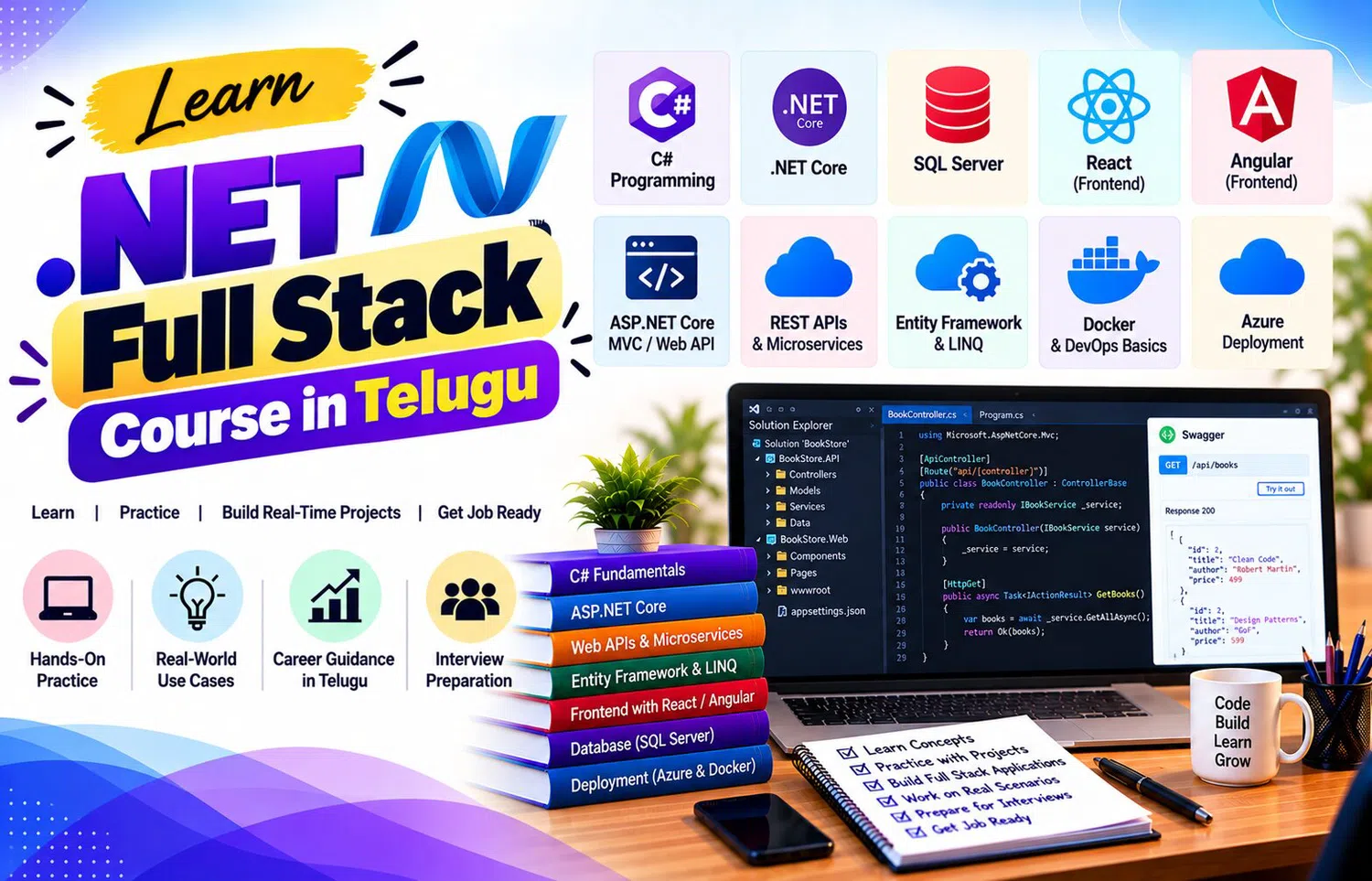
A.NET Full Stack Course in Telugu can help learners understand how frontend applications send HTTP requests, receive JSON, display data, handle errors, and securely communicate with ASP.NET Core APIs.
The key is to think of frontend-backend integration as a contract. Both sides must agree on routes, request formats, response formats, authentication, and error handling.
What Does Frontend-Backend Integration Mean?
The frontend handles:
User interface.
Forms.
Buttons.
Data display.
The backend handles:
Validation.
Business rules.
Authentication.
Database access.
The two communicate through API requests.
Example:
User opens products page.
Frontend sends GET request.
ASP.NET Core retrieves products.
API returns JSON.
Frontend displays product cards.
What Is an API Contract?
An API contract defines:
Endpoint.
HTTP method.
Request fields.
Response fields.
Status codes.
Authentication requirements.
For example:
POST /api/orders.
Request:
ProductId.
Quantity.
Response:
OrderId.
Status.
Total.
If the contract changes unexpectedly, the frontend may break.
How Does the Frontend Send a GET Request?
JavaScript can use Fetch or another HTTP client.
Conceptually:
Call GET /api/products.
Wait for response.
Check status.
Convert JSON.
Render results.
The frontend should also handle:
Loading.
No data.
Error.
A successful API call is only one possible state.
How Does a POST Request Work?
Suppose a user submits a registration form.
Frontend collects:
Name.
Email.
Password.
It sends JSON to:
POST /api/register.
Backend:
Validates input.
Creates user.
Returns result.
Frontend then displays:
Success.
Or validation errors.
This is a common full stack workflow.
What Is JSON Serialization?
Frontend sends data as JSON.
ASP.NET Core converts JSON into a C# request model.
The backend processes it.
ASP.NET Core converts response objects back into JSON.
This automatic serialization reduces manual data parsing.
Both frontend and backend still need compatible field structures.
Why Use DTOs?
DTOs define exactly what the frontend should send or receive.
Example CreateOrderRequest:
ProductId.
Quantity.
OrderResponse:
OrderId.
Total.
Status.
DTOs avoid exposing database entities directly.
They also make frontend integration clearer because the contract is explicit.
How Should Validation Errors Be Returned?
Suppose quantity is zero.
The backend should return a structured validation response.
The frontend can display:
“Quantity must be greater than zero.”
This is better than a generic:
“Something went wrong.”
Clear field-level errors improve user experience.
What Are Loading States?
API calls may take time.
The frontend should show feedback such as:
Loading...
Spinner.
Disabled submit button.
Skeleton content.
Without loading states, users may think the application is frozen and click repeatedly.
Good integration includes these user-interface states.
What Are Empty States?
An API may return an empty result.
Example:
No orders.
No search matches.
The frontend should not show a broken blank screen.
Instead, display a message such as:
“No orders found.”
Empty states are part of good frontend behavior.
What Are Error States?
Requests can fail because of:
Network issues.
Invalid input.
Expired authentication.
Permission problems.
Missing data.
Server errors.
The frontend should interpret responses and display useful messages.
The backend should avoid exposing internal stack traces.
What Is CORS?
When frontend and backend use different origins, browser security rules apply.
Example:
Frontend:
app.example.com.
API:
api.example.com.
ASP.NET Core must allow approved origins through CORS configuration.
CORS should permit trusted frontend origins rather than being opened unnecessarily.
Does CORS Provide Authentication?
No.
CORS controls browser cross-origin access.
Authentication identifies users.
Authorization controls permissions.
Even when a frontend origin is allowed, protected API endpoints should still verify:
User.
Role.
Ownership.
These are separate security layers.
How Does Authentication Integrate with Frontend Apps?
The frontend may present a login form.
Backend verifies credentials.
After login, the system may use:
Cookie authentication.
Token-based authentication.
Future requests include the required authentication information.
The backend checks it before returning protected data.
How Should Tokens Be Handled?
Token security depends on architecture.
Important considerations include:
Expiration.
Refresh.
Storage.
Revocation.
HTTPS.
Exposure risk.
Developers should follow established framework and security guidance.
Do not place sensitive data in tokens simply because the token is signed.
What Happens When Authentication Expires?
The API may return:
401 Unauthorized.
The frontend can then:
Redirect to login.
Attempt a permitted refresh flow.
Show session-expired message.
The exact behavior depends on authentication design.
It should be consistent across the application.
How Does Authorization Affect the Frontend?
The frontend may hide options the user cannot access.
Example:
Admin panel hidden for normal user.
But the backend must still verify permissions.
A malicious user can manually call an endpoint even if the button is hidden.
Frontend visibility improves UX.
Backend authorization provides real protection.
What Is Pagination Integration?
Suppose the API returns 20 products per page.
The response may contain:
Current page.
Items.
Total count.
Next-page information.
The frontend can render controls such as:
Previous.
Next.
Page numbers.
Pagination prevents huge responses.
What Is Filtering Integration?
Frontend may send filters such as:
Category.
Price range.
Status.
Search text.
Example:
GET /api/products?category=laptop.
Backend applies filters in the database query.
Frontend displays only matching data.
Server-side filtering is usually more efficient for large datasets.
What Is Sorting Integration?
Frontend may allow:
Price low to high.
Newest first.
Name A-Z.
The selected sort option is sent to the API.
The backend applies controlled ordering.
Do not allow arbitrary database field input without validation.
Supported sorting options should be clearly defined.
How Does a Frontend Upload Files?
Some applications upload:
Profile pictures.
Documents.
Product images.
The frontend sends file data using the appropriate request format.
The backend should validate:
File size.
Allowed type.
Ownership.
Storage destination.
File uploads require stricter security than ordinary text input.
What Is Optimistic UI?
An optimistic interface updates immediately before backend confirmation.
Example:
User marks task completed.
UI changes instantly.
API request runs.
If request fails, UI restores previous state.
This can improve perceived speed.
Use it only where failed operations can be safely reversed.
What Is Centralized API Handling?
As frontend applications grow, repeated API logic can become messy.
A centralized API layer can manage:
Base URL.
Authentication headers.
Common errors.
JSON parsing.
This reduces duplication.
It also makes future API changes easier.
Why Is API Documentation Important?
Frontend developers need to know:
Routes.
Methods.
Payloads.
Responses.
Validation errors.
Authentication.
ASP.NET Core APIs can use OpenAPI documentation.
Even when one person builds both frontend and backend, documentation prevents confusion later.
How Should Integration Be Debugged?
If data does not appear, check step by step:
Did frontend send the request?
What URL was used?
What status returned?
What JSON came back?
Did backend receive the expected model?
Did the database query succeed?
Browser developer tools and server logs are extremely useful.
A Practical Integration Exercise
Build a Product Catalog.
Frontend:
Product cards.
Search.
Category filter.
Add Product form for admins.
Backend:
ASP.NET Core REST API.
EF Core.
SQL Server.
Authentication.
Flow:
Frontend sends GET.
API returns products.
User filters category.
Frontend sends query parameter.
Admin creates product with POST.
Validation errors display beside the form.
This demonstrates full integration.
Frequently Asked Questions
How do frontend applications communicate with ASP.NET Core?
Usually through HTTP requests to REST API endpoints that return JSON.
What is the role of CORS?
It controls browser requests between different origins.
Should the frontend be trusted for authorization?
No. Backend endpoints must enforce every important access rule.
Why are loading and error states important?
They help users understand what is happening when API requests take time or fail.
Conclusion
A .NET Full Stack Course in Telugu can help learners understand frontend-backend integration as the final connection between the user interface and ASP.NET Core services.
The frontend sends requests.
The API validates and processes them.
The database stores or retrieves information.
The backend returns JSON.
The frontend updates the interface.
The strongest developers also handle authentication, CORS, validation, errors, loading states, filtering, and pagination.
That complete integration mindset is essential for building practical modern .NET full stack applications.