Introduction
Data science is not one single skill. It combines programming, databases, statistics, visualization, analytical thinking, machine learning, communication, and problem solving. Beginners sometimes focus only on Python or machine-learning algorithms, but practical data work requires a broader set of abilities.
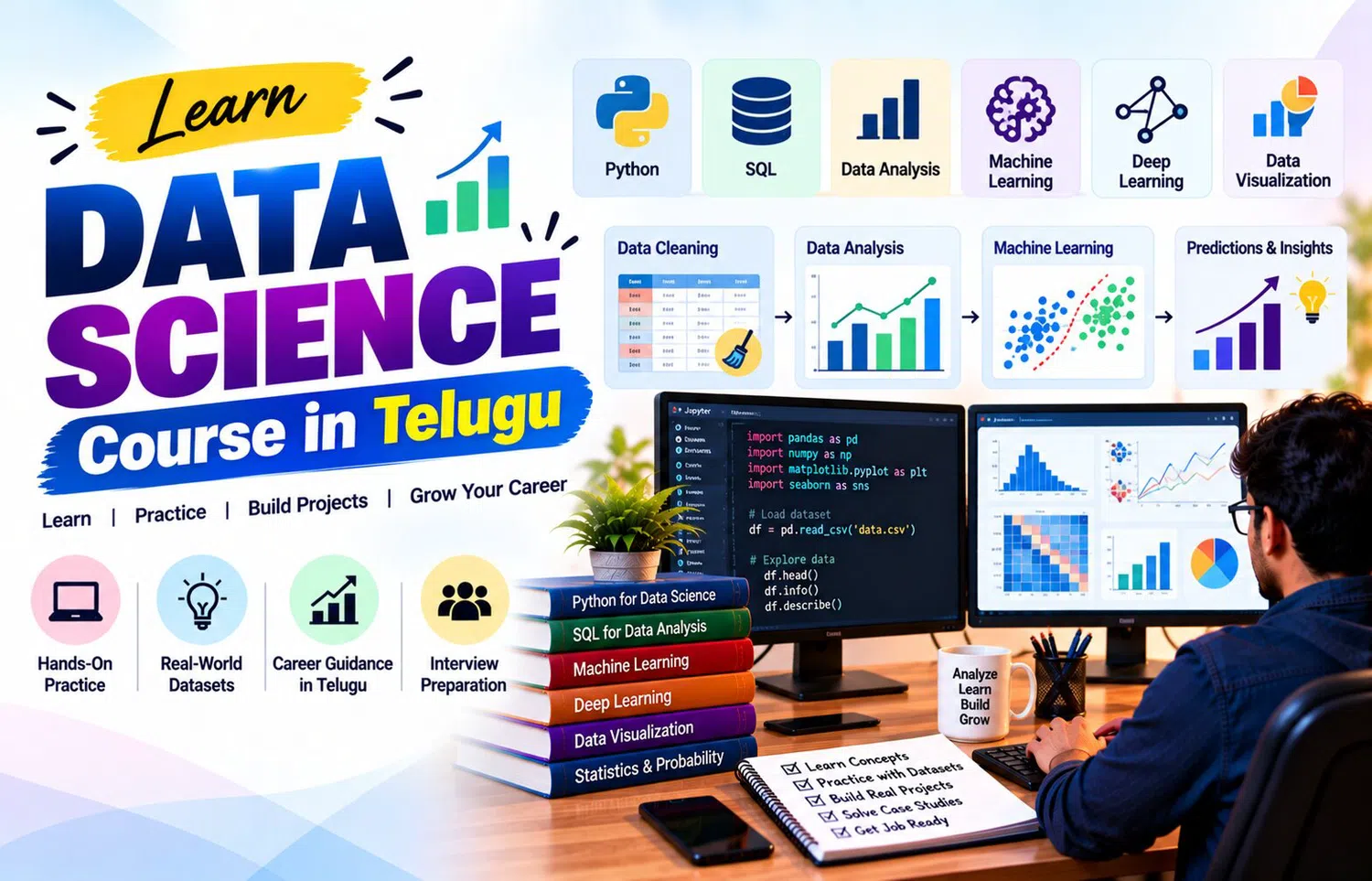
A Data Science Course In Telugu can help learners build these skills gradually through datasets and projects. The strongest learning outcome is not simply knowing how to use a tool. It is being able to understand a problem, prepare the data, choose a suitable method, evaluate the result, and explain what the evidence means. These skills are useful across many industries because organizations increasingly rely on data to understand performance and make decisions.
Data Literacy
The first skill is understanding data itself.
Learners should become comfortable with:
Rows.
Columns.
Numbers.
Categories.
Dates.
Missing values.
Structured data.
Unstructured data.
Python Programming
Python is one of the most useful technical skills in data science.
Learners can develop confidence in:
Variables.
Lists.
Dictionaries.
Conditions.
Loops.
Functions.
File handling.
Libraries.
The goal is not to become an advanced software engineer immediately.
Python is used as a practical tool for cleaning, analysis, visualization, automation, and machine learning.
Data Manipulation
Working with data requires more than loading a file.
Learners can develop skills such as:
Selecting columns.
Filtering rows.
Sorting values.
Grouping records.
Combining datasets.
Creating new columns.
Aggregating values.
Libraries such as pandas make these tasks easier.
SQL Skills
SQL helps learners work with data stored in relational databases.
Useful skills include:
SELECT.
WHERE.
GROUP BY.
ORDER BY.
JOIN.
Subqueries.
Aggregations.
SQL teaches learners how to translate business questions into structured queries.
For example:
Which products generated the highest revenue?
Which customers have not purchased recently?
How many orders were created each month?
Data Cleaning
Data cleaning is one of the most important real-world skills.
Learners can practice handling:
Missing values.
Duplicates.
Incorrect data types.
Inconsistent categories.
Invalid dates.
Outliers.
The important part is not only knowing a command.
Learners should understand why a cleaning decision is appropriate.
Removing data without a reason can damage the analysis.
Statistical Thinking
Statistics helps learners summarize and interpret information.
Core skills include:
Mean.
Median.
Percentages.
Distribution.
Variance.
Standard deviation.
Correlation.
Probability.
Sampling.
These concepts help learners avoid making conclusions based only on a few observations.
Exploratory Data Analysis
EDA combines several skills.
Learners inspect a dataset, calculate summaries, create charts, and ask questions about patterns.
Useful EDA skills include:
Identifying trends.
Finding unusual values.
Comparing categories.
Studying distributions.
Exploring relationships.
Checking class balance.
A good analyst learns to ask meaningful questions rather than creating charts randomly.
Data Visualization
Visualization is both a technical and communication skill.
Learners can practice:
Bar charts.
Line charts.
Histograms.
Scatter plots.
Dashboards.
They should also learn how to avoid misleading scales, confusing labels, and unnecessary decoration.
A chart should answer a clear question.
Machine Learning
Machine learning introduces predictive and pattern-recognition skills.
Beginners can learn:
Features.
Labels.
Training data.
Test data.
Classification.
Regression.
Clustering.
Model evaluation.
Overfitting.
The important skill is understanding the workflow.
A learner should know why a model is being used and how performance will be measured.
Problem Definition
A technically correct analysis can still be useless if it answers the wrong question.
Data-science learners should develop the ability to define problems clearly.
Ask:
What decision are we trying to support?
What data is available?
What output is needed?
What would count as success?
What limitations exist?
This problem-definition skill helps learners avoid applying machine learning when a simple report would solve the need.
Business Understanding
Domain knowledge improves analytical work.
A marketing analyst should understand campaign metrics.
A finance analyst should understand revenue, cost, and risk.
An operations analyst should understand process time and capacity.
Data science becomes more useful when technical methods are connected to real business context.
Model Evaluation
Building a model is only part of the task.
Learners should also understand:
Accuracy.
Precision.
Recall.
F1 score.
Prediction error.
Validation.
Class imbalance.
For example, a model may show high accuracy but still fail to identify the cases that matter most.
Evaluation teaches learners not to accept one metric blindly.
Communication Skills
Data scientists need to explain results clearly.
A learner should be able to:
Write concise summaries.
Explain charts.
Present assumptions.
Describe limitations.
Avoid technical jargon when unnecessary.
Separate observations from opinions.
For example, saying “Sales fell by 12% in June” is an observation.
Saying “Sales fell because customers switched to a competitor” requires additional evidence.
This distinction is important.
Documentation
Documentation makes analytical work easier to reproduce.
Learners can document:
Dataset source.
Cleaning steps.
Code decisions.
Feature choices.
Model settings.
Evaluation results.
Limitations.
Version Control and Project Organization
As projects grow, learners can use Git to track code and notebooks.
They should also learn to organize:
Data folders.
Scripts.
Notebooks.
Reports.
Documentation.
A clean project structure makes the work easier to understand.
Sensitive information should not be stored in public repositories.
A Practical Skill-Building Project
Use a customer dataset.
The learner can:
Retrieve data with SQL.
Clean it using Python.
Perform EDA.
Create charts.
Build a simple churn model.
Evaluate the model.
Write a stakeholder summary.
Document limitations.
This single project develops multiple technical and analytical skills together.
Frequently Asked Questions
Is coding the most important data-science skill?
Coding is important, but data understanding, problem definition, statistics, evaluation, and communication are equally important.
Can beginners develop these skills without a technical degree?
Yes. The skills can be learned gradually through structured practice and projects.
Why is communication important in data science?
Insights only become useful when stakeholders can understand what the data shows and what the limitations are.
Should beginners focus on tools or concepts?
Learn core concepts first and use tools to apply them. Tools can change, while analytical reasoning remains valuable.
Conclusion
A Data Science Course In Telugu can help learners develop a balanced set of skills across data literacy, Python, SQL, cleaning, statistics, visualization, EDA, machine learning, evaluation, and communication.
The most valuable data-science skill is the ability to move from a real problem to a reliable, understandable result.
That requires more than code.
Learners need to understand the data, question assumptions, select suitable methods, check results, document decisions, and explain findings clearly.
When these skills are developed together through hands-on projects, beginners become better prepared for practical analytical work and for learning more advanced data-science topics later.