Introduction
Generative AI tools can answer questions, create drafts, summarize information, suggest ideas, and assist with many digital tasks. However, the quality of the output often depends on the quality of the instruction. A vague prompt can produce a broad or generic answer, while a clear prompt can guide the model toward a more useful result.
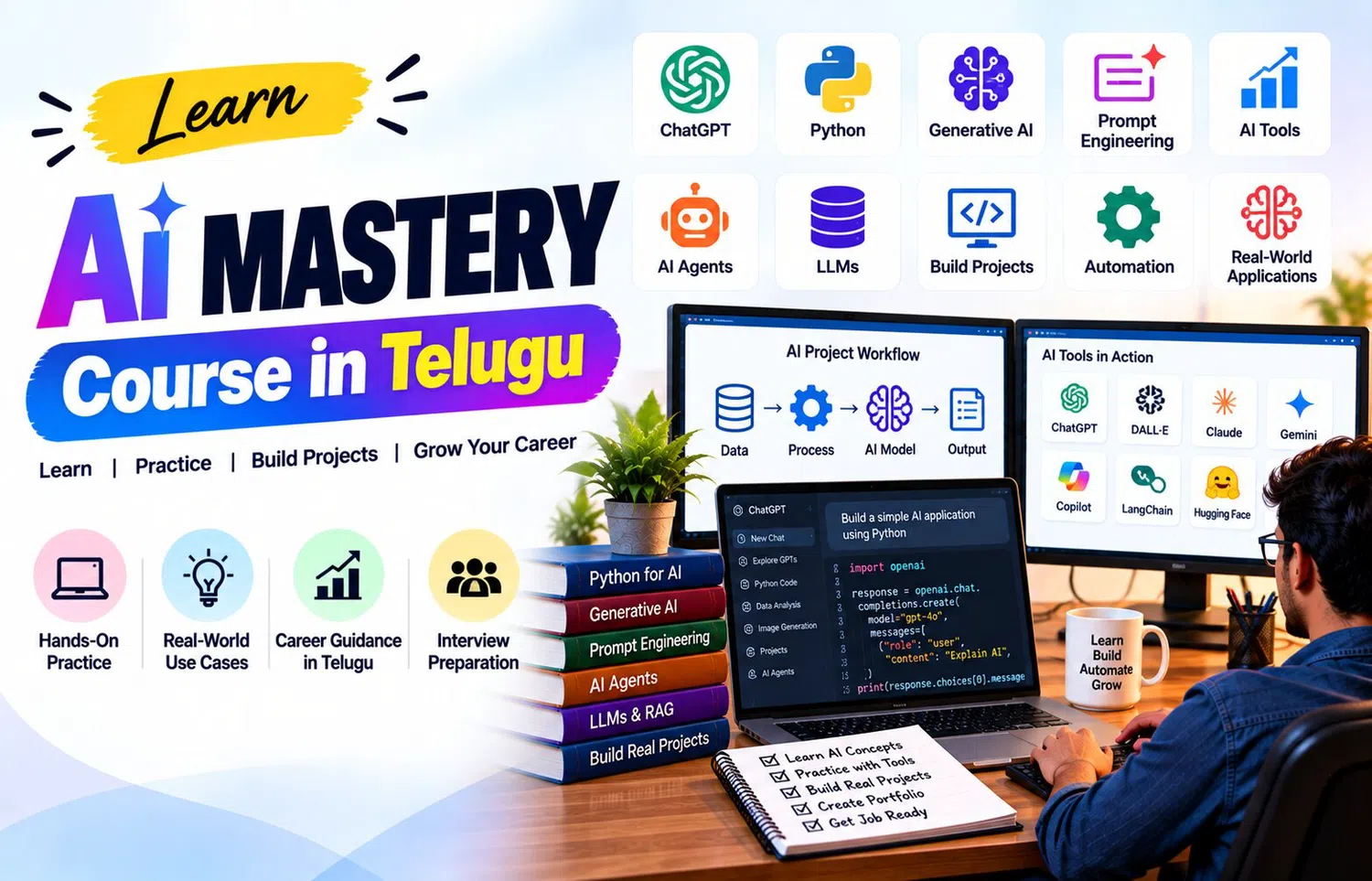
An AI Mastery Course in Telugu can help beginners understand prompt engineering as the skill of giving AI systems clear, structured, and purposeful instructions. Prompt engineering is not about finding one magical sentence that always works. It is about understanding the task, providing useful context, setting constraints, checking the output, and improving the prompt when necessary.
What Is Prompt Engineering?
Prompt engineering is the process of designing instructions that help an AI system produce a useful response.
A prompt can include:
The task.
Background information.
Audience.
Required format.
Tone.
Length.
Examples.
Restrictions.
For example, compare these two prompts:
“Write about interviews.”
“Write a 150-word guide for final-year students explaining three ways to prepare for a technical interview. Use simple English and include one practical example.”
The second prompt gives the model much clearer direction.
Why Does Context Matter?
AI cannot automatically know every detail that the user has in mind.
Suppose someone asks:
“Create a study plan.”
The model does not know the learner’s subject, available time, exam date, or current skill level.
A better prompt might say:
“I am a beginner learning Python. I can study one hour each evening for four weeks. Create a weekly plan covering syntax, functions, lists, dictionaries, and one small project.”
Context reduces ambiguity and helps the AI produce an answer that fits the real need.
How Should a Good Prompt Be Structured?
There is no single prompt formula for every situation, but beginners can use a simple structure.
Start with the goal.
Add relevant context.
Describe the audience.
Specify the output format.
Add constraints.
For example:
Goal: Explain cloud computing.
Audience: First-year engineering students.
Format: Five short points and one analogy.
Constraint: Avoid advanced technical terms.
This structure makes the instruction easier for both the user and the AI to follow.
How Are Examples Used in Prompts?
Examples can show the model what kind of output is expected.
Suppose a learner wants AI to classify customer feedback.
They can provide examples:
“Delivery was fast” → Positive.
“The package arrived damaged” → Negative.
“Product is okay” → Neutral.
Then they can ask the model to classify new comments using the same categories.
Examples are useful when the required pattern is difficult to describe in one sentence.
What Is Iterative Prompting?
Good AI use often requires more than one attempt.
The first response may be too long, too technical, or missing important information.
Instead of starting over completely, the learner can refine the prompt.
For example:
“Make the explanation shorter.”
“Add one real-world example.”
“Rewrite it for a beginner.”
“Put the comparison into a table.”
This process is called iteration.
Prompt engineering is therefore partly about evaluating output and improving the next instruction.
How Can Prompts Improve Research Tasks?
AI can help organize research questions, summarize provided information, compare concepts, and suggest areas that need more investigation.
For example:
“Summarize these notes into five themes and list two unanswered questions under each theme.”
However, AI-generated facts and references should be checked against reliable sources.
Prompt engineering can improve organization, but it does not remove the need for verification.
How Is Prompt Engineering Used for Writing?
A writing prompt can define:
Purpose.
Audience.
Tone.
Length.
Structure.
Important points.
Words to avoid.
For example:
“Draft a professional email asking a recruiter for an interview update. Keep it under 120 words, polite, and direct.”
This is more useful than simply asking, “Write an email.”
The learner can then edit the draft to match their own voice.
Why Are Constraints Useful?
Constraints tell the model what not to do or what boundaries to follow.
Examples include:
Use fewer than 200 words.
Do not use technical jargon.
Return only five points.
Use a professional tone.
Do not invent statistics.
Constraints help keep the response aligned with the intended use.
What Are Common Prompting Mistakes?
Beginners often make mistakes such as:
Giving too little context.
Combining many unrelated tasks.
Assuming the first answer is correct.
Using vague words such as “better” without explaining what better means.
Sharing sensitive information unnecessarily.
Copying output without editing.
Prompt engineering improves when learners become specific about what success looks like.
A Practical Prompt Engineering Exercise
Choose one task, such as creating a study plan.
Write three versions:
Version 1: Very broad prompt.
Version 2: Add learner background and goal.
Version 3: Add timeline, format, constraints, and examples.
Compare the outputs.
Ask:
Which version was most useful?
What information changed the result?
What still needed correction?
This teaches prompt quality through observation rather than memorization.
Frequently Asked Questions
Is prompt engineering only for technical users?
No. Students, marketers, writers, analysts, managers, and other users can benefit from clearer prompting.
Does a longer prompt always produce a better result?
No. A prompt should include useful context, not unnecessary information. Clear and relevant instructions matter more than length.
Can prompt engineering prevent all AI mistakes?
No. Better prompts can improve relevance, but AI can still produce incorrect or unsupported information.
Should the same prompt be used for every AI tool?
Not always. Different tools may respond differently, so prompts may need adjustment based on the model and task.
Conclusion
Prompt engineering is used in an AI Mastery Course in Telugu to help learners communicate more clearly with generative AI systems.
A strong prompt defines the goal, context, audience, format, and constraints. Examples can guide complex tasks, while iteration helps improve weak first responses.
The most important skill is not memorizing prompt templates. It is learning how to describe a problem clearly, evaluate the AI response, identify what is missing, and improve the next instruction.
When beginners combine clear prompting with verification, editing, and responsible data handling, AI tools become far more useful for study, writing, research, coding, analysis, and productivity.