Cloud infrastructure performance relies heavily on how effectively hypervisors process storage I/O operations. When running high-throughput web applications, database clusters, or microservices architectures inside virtualized environments, storage latency frequently becomes the primary bottleneck hindering total system performance. While upgrading physical compute hardware provides incremental speed gains, true operational efficiency requires a complete understanding of how storage virtual adapters, hypervisor disk scheduling, and host-level storage protocols interact.
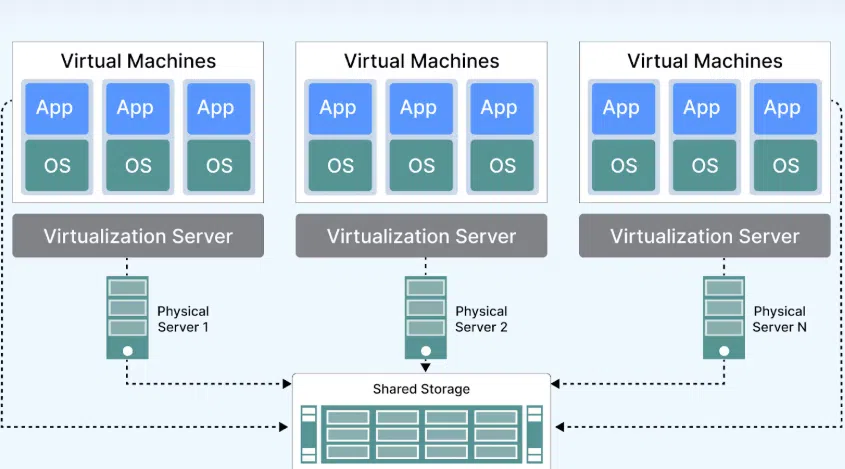
In legacy cloud deployments, hypervisors frequently relied on virtualized SATA or IDE controllers to present storage blocks to guest operating systems. These legacy virtual interfaces introduce significant kernel overhead because every read or write request requires CPU-level software emulation. Modern cloud infrastructure bypasses this bottleneck using paravirtualized storage drivers, such as virtio-blk or virtio-scsi in KVM-based hypervisors. Paravirtualization allows the guest operating system to communicate directly with the host hypervisor using shared memory ring buffers, drastically reducing latency and reducing CPU consumption per I/O operation.
┌─────────────────────────────────────────────────────────────┐
│                 Paravirtualized Storage Path                │
│                                                             │
│  Guest OS ──► Virtio-SCSI Driver ──► Ring Buffer (RAM)      │
│                                              │              │
│                                              ▼              │
│  Host Kernel ◄── Host Block Layer ◄── Hypervisor Driver     │
└─────────────────────────────────────────────────────────────┘
When provisioning enterprise cloud instances, select hypervisors configured with paravirtualized block drivers to maintain optimal throughput. Exploring high performance hosting allows infrastructure engineers to leverage hardware setups optimized for intensive storage requirements.

The Role of NVMe Passthrough and SR-IOV in Virtual Storage
For database-heavy workloads processing thousands of concurrent queries per second, software-based storage abstractions often struggle to deliver sub-millisecond latency. To overcome hypervisor abstraction overhead, enterprise hosting environments utilize PCI Express (PCIe) passthrough and Single Root I/O Virtualization (SR-IOV).
PCIe passthrough maps a physical NVMe drive directly to a single guest virtual machine, completely bypassing the host kernel block layer and hypervisor virtualization stacks. This configuration enables the guest OS to utilize native hardware drivers, unlocking raw NVMe IOPS capabilities and achieving bare-metal performance inside a virtualized container.
Storage Architecture Performance Comparison
Emulated IDE/SATA Controllers: High CPU utilization, restricted command queues (32 commands), processing latency exceeding 5ms.
Paravirtualized Drivers (virtio-scsi): Low CPU utilization, parallel command processing (up to 64k queues), latency between 0.5ms and 1.5ms.
Direct PCIe Passthrough (NVMe): Near-zero CPU virtualization overhead, direct memory access (DMA), sub-0.2ms storage latency.
+-----------------------------------------------------------------------+
|                    Virtual Storage Queue Capabilities                 |
+-----------------------------------------------------------------------+
| Adapter Type            | Max Command Queues | Max Queue Depth        |
+-------------------------+--------------------+------------------------+
| Emulated SATA (AHCI)    | 1                  | 32                     |
| Paravirtualized SCSI    | 32                 | 256                    |
| Native NVMe Passthrough | 64,000             | 64,000                 |
+-------------------------+--------------------+------------------------+
Integrating hardware-level storage access into your deployment strategy keeps enterprise applications responsive during heavy traffic spikes. Choosing reliable managed VPS hosting guarantees that your virtual server receives dedicated CPU pin assignments and isolated block storage access.
Hypervisor Disk Scheduling and Block Size Alignment
Achieving consistent storage performance requires aligning file system block sizes across every layer of the storage stack. A common misconfiguration occurs when the guest file system (e.g., ext4 or XFS configured with 4KB blocks) does not align with the underlying host storage array or physical NVMe sector size (such as 4096-byte native sectors).
When misaligned block writes occur, the host storage controller must perform two distinct physical write operations for a single guest write request—a phenomenon known as write amplification. Over time, write amplification degrades total storage throughput, increases read/write latency, and accelerates flash memory wear on solid-state drives.
Best Practices for Guest File System Optimization:
Format Guest Partitions with 4KB Alignment: Ensure partition boundary offsets start precisely on 2048-sector (1MB) boundaries using modern partitioning tools like
partedorfdisk.Match Allocation Unit Sizes: Match database block sizes (e.g., PostgreSQL 8KB pages or InnoDB 16KB pages) to underlying RAID stripe sizes.
Use Asynchronous I/O Engines: Configure database applications to use native asynchronous I/O (
libaioin Linux) to maximize parallel queue utilization.
Bash
# Verify partition block alignment on a virtual block device (/dev/vda)
sudo parted /dev/vda align-check optimal 1
Implementing Host-Level Storage Caching Policies
Hypervisors offer several write-caching modes that dictate how storage writes pass from guest memory to physical host disks:
Writeback Caching: The hypervisor acknowledges write completion as soon as data reaches the host RAM page cache. This mode delivers maximum write speed but risks data loss during sudden host power failures unless backed by Uninterruptible Power Supplies (UPS).
Writethrough Caching: The hypervisor acknowledges writes only after data successfully flushes to the physical storage media. While safer for non-redundant hardware, writethrough caching increases overall write latency.
Direct Sync (No Cache): Bypasses host caching completely, opening a direct pipeline between guest memory and host physical storage. Ideal for enterprise database clusters managing their own internal memory flush routines.
By evaluating workload requirements, system administrators can select the appropriate caching policy to balance data integrity with high-speed execution. Deploying web applications on optimized cloud infrastructure solutions ensures your storage configuration delivers dependable uptime and high-speed data processing.
Storage Monitoring and Latency Diagnostics
Continuous monitoring of disk latency metrics is essential for maintaining production health. Key metrics to track include:
Read/Write IOPS: The total number of read and write operations processed per second.
Throughput (MB/s): The volume of data transferred to and from storage media every second.
Await Time (ms): The average time required for a storage request to be serviced by the underlying host hardware.
Bash
# Monitor storage device performance metrics in real time
iostat -xz 1 10
Systematic performance testing allows system engineers to identify underlying hardware bottlenecks before they impact end-user experience. Implementing paravirtualized controllers, aligning block boundaries, and configuring proper hypervisor caching ensures that virtualized cloud servers perform with exceptional stability and speed.