The Stationery Industry's Plastic Dilemma
Writing instruments, pen bodies, cosmetic packaging components, and other stationery-adjacent plastic parts have long relied on conventional fossil-based plastics. These materials are valued for their processability and cost efficiency, but they come with well-documented drawbacks: dependence on fossil resources, long-term environmental persistence, and complicated end-of-life waste management. At the same time, many emerging bio-based and biodegradable material systems still struggle with trade-offs among performance, processability, cost, and large-scale commercialization. For brand owners, OEM/ODM manufacturers, and material buyers asking what can realistically replace fossil-based plastics in stationery applications, the answer depends on finding a material platform that solves both sides of this equation—environmental benefit without sacrificing manufacturability.
A Materials Technology Company Built to Bridge the Gap
SYNLIFE, operated by Shanghai Sipeng Technology Ltd., is a bio-based materials technology company founded in May 2022 and headquartered in Shanghai, China, with business coverage extending globally through ongoing market development and commercial cooperation. Built on synthetic biology and materials engineering, SYNLIFE develops high-performance bio-based materials, finished applications, and cross-industry material solutions, with a long-term goal of advancing lower-carbon and carbon-negative biomanufacturing technologies.
What distinguishes SYNLIFE's approach is that the company does not focus on material synthesis alone. Instead, it develops materials around actual processing conditions and end-use requirements—an application-oriented development model that combines capabilities across biological manufacturing, material development, formulation optimization, process scale-up, manufacturing, and application development. This full-chain integration is directly relevant to stationery applications, where pen bodies, caps, and components must meet specific injection molding, transparency, and durability requirements before any bio-based alternative can be considered viable.
The YOGTIC® Resin Platform for Stationery Components
At the center of SYNLIFE's stationery-relevant offering is the YOGTIC® bio-based resin series, a family of materials engineered for different performance and processing needs.
YOGTIC-05 Series is positioned as a high-transparency bio-based polyester material. Its key features include high transparency, good toughness, and high bio-based content depending on product grade, making it suitable for applications requiring transparent plastic components. In stationery terms, this is directly applicable to transparent pen barrels, caps, and other visible components where clarity and bio-based content both matter. The application value of this series lies in its potential to serve as a bio-based alternative to conventional transparent plastics in selected applications where performance and processing requirements are met.
YOGTIC-15 Series is a high-performance, natural-color bio-based polyester material with improved thermal resistance compared with conventional PLA grades, along with balanced toughness and rigidity. This series is suitable for selected injection-molded and rigid applications, providing an option for replacing conventional fossil-based plastics after appropriate application validation—relevant for structural pen components and other rigid stationery parts.
YOGTIC-08/18 Thermoforming Series, while more commonly associated with trays and packaging, reflects the same underlying platform logic: materials designed around commercial thermoforming processes, with good sheet flatness and balanced rigidity and toughness.
Commercial Proof Points in Writing Instruments
Beyond material specifications, SYNLIFE's stationery-related work has moved into commercial and exhibition settings, offering concrete evidence of feasibility rather than theoretical claims.
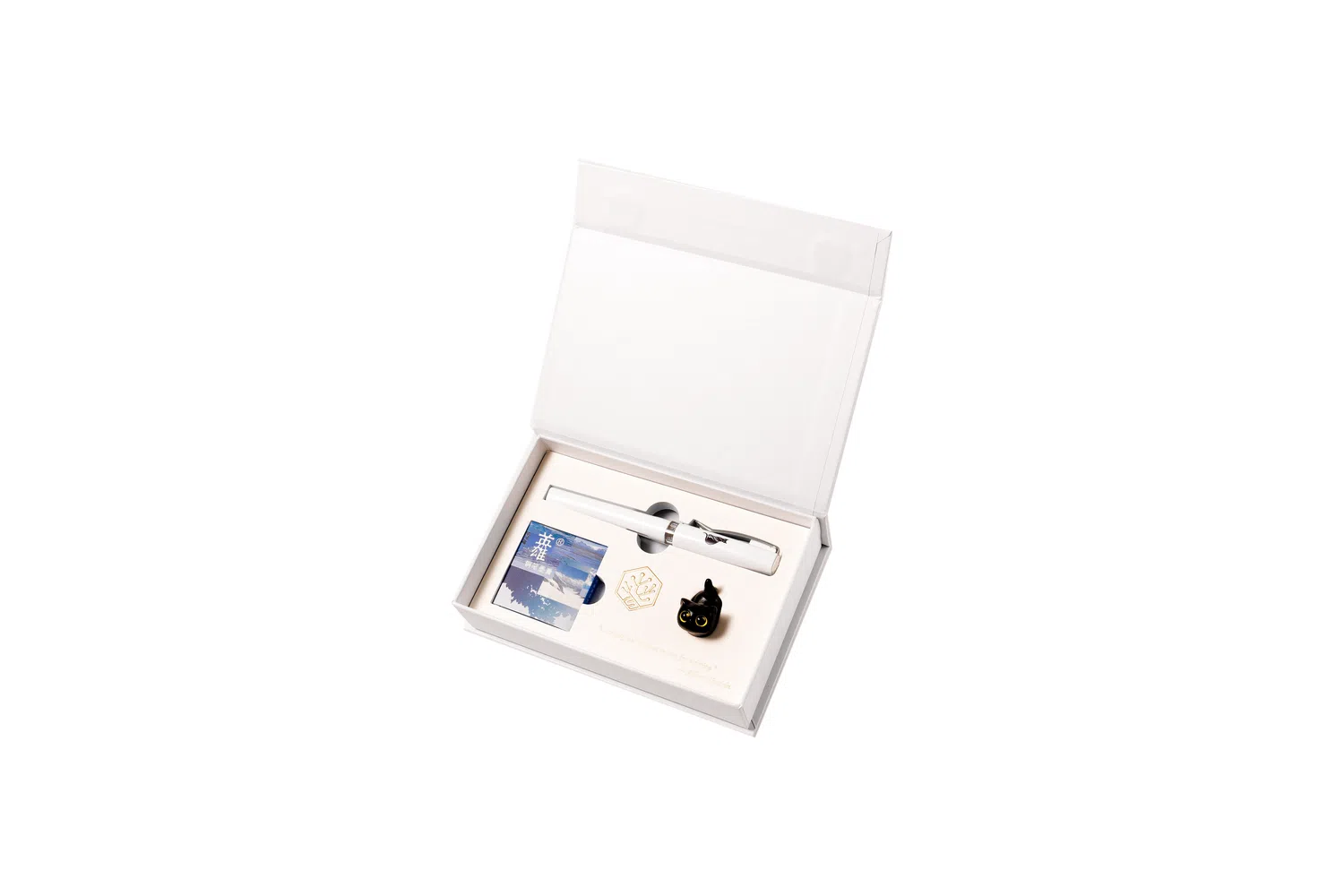
The Hero Bio-based Fountain Pen represents one documented case: SYNLIFE's bio-based resin was applied to plastic components of the fountain pen, with selected conventional plastic components replaced by SYNLIFE bio-based materials. This resulted in a commercialized bio-based fountain pen application, which was commercially launched in June 2025 and has participated in regional cultural-product and souvenir selection activities.
The Platinum GK-50 Eco Pen Application is a second case in which high-transparency YOGTIC® resin was used for selected transparent pen components. This case demonstrates the feasibility of applying high-transparency bio-based materials to commercial writing instruments. The Platinum Eco series itself debuted at the China International Industry Fair in September 2024, marking an early milestone in bringing SYNLIFE's bio-based resin technology into a visible commercial and exhibition context.
It is worth noting, in the interest of balanced reporting, that performance comparisons between these bio-based materials and conventional plastics such as PC should only be stated when supported by corresponding test or product data—an important caveat for any brand evaluating material switch decisions.
Recognition Beyond the Pen Barrel
SYNLIFE's bio-based writing-instrument work has also received external recognition. The "Wildflowers in the Fields" bio-based writing-instrument series was nominated as a recommended souvenir gift by Minhang District in June 2025 and was subsequently selected for the 2025 Shanghai Souvenir Award in September 2025. The company also received a CIIF Bio-Manufacturing Special Award in 2025. More broadly, SYNLIFE was selected as one of 16 winners from approximately 660 global applications across 54 countries and regions in Tencent's CarbonX Program 2.0 in 2026, following a selection process that narrowed to 50 finalists—an indicator of how the company's broader carbon-reduction and biomanufacturing direction is viewed within a competitive international field.
Why This Matters for Material Decision-Makers
For companies asking what can replace fossil-based plastics in stationery, three factors from SYNLIFE's model stand out as directly relevant:
Application-first development. YOGTIC-05 and YOGTIC-15 are positioned for selected injection-molded applications, while the YOGTIC-08/18 Series is developed around sheet extrusion and thermoforming. This grade-specific approach aligns material development with actual processing conditions rather than focusing purely on material synthesis.
Documented finished-product applications. The Hero bio-based fountain pen was commercially launched in June 2025, while the Platinum GK-50 Eco Pen application demonstrates the use of high-transparency YOGTIC® resin in selected transparent components, with the Platinum Eco series debuting at the China International Industry Fair in September 2024. Together, these cases demonstrate SYNLIFE's progress in translating bio-based material development into finished writing-instrument applications at different stages of commercialization.
Full-chain support. SYNLIFE's service model spans raw material supply, material customization, joint product development, application development, finished-product OEM/ODM, process and technical support, and pilot and scale-up support—meaning a stationery brand can engage the company at virtually any stage, from early formulation through to finished-product manufacturing.
A Note on Responsible Claims
Any organization evaluating bio-based alternatives for stationery should request the specific product grade, applicable certification, and test conditions relevant to their intended use, since compostability, bio-based content, and performance characteristics vary by grade and are not universal across an entire product family. SYNLIFE's own materials indicate that certification claims should always be paired with the certifying body, standard, certificate number, and applicable product grade—a discipline that reflects well on the broader credibility of the bio-based materials sector as it works to replace conventional fossil-based plastics across stationery and adjacent consumer categories.
As demand grows for stationery and consumer-goods materials that reduce fossil-resource dependence without compromising manufacturability, platforms like YOGTIC®, backed by SYNLIFE's synthetic biology and materials engineering capabilities, illustrate one documented pathway for brands pursuing this transition—grounded in named commercial cases such as the Hero fountain pen and the Platinum GK-50 Eco Pen rather than abstract promises.