Tesla shareholders are accustomed to volatility, but few things trigger anxiety quite like a notification that a top executive has just sold millions of dollars in stock. In early 2026, as Tesla navigates a complex transition from EV manufacturer to AI robotics firm, we have seen a steady stream of Form 4 filings reporting sales. Bearish commentators love to cite these numbers as proof that management is "bailing out" before the competition catches up.
However, a deeper dive into the mechanics of these transactions reveals a completely different picture. In Silicon Valley, and specifically at Tesla, stock options are the primary currency of compensation. When executives exercise these options to claim their shares, they trigger a massive, immediate tax bill—often taxed as ordinary income. To pay the IRS, they are functionally forced to sell a portion of the shares they just acquired.
1. The "Sell-to-Cover" Mechanism Explained
When you see a Form 4, the most important column is not "Securities Disposed," but the transaction code. A code "M" followed by an "F" or "S" usually indicates a "Sell-to-Cover" transaction. For example, if CFO Vaibhav Taneja exercises options for 10,000 shares and sells 4,000, he hasn't reduced his faith in Tesla; he has simply paid his taxes. In fact, his net long position increased by 6,000 shares. This is technically a "buy," yet the headlines will always scream "CFO Sells Shares."
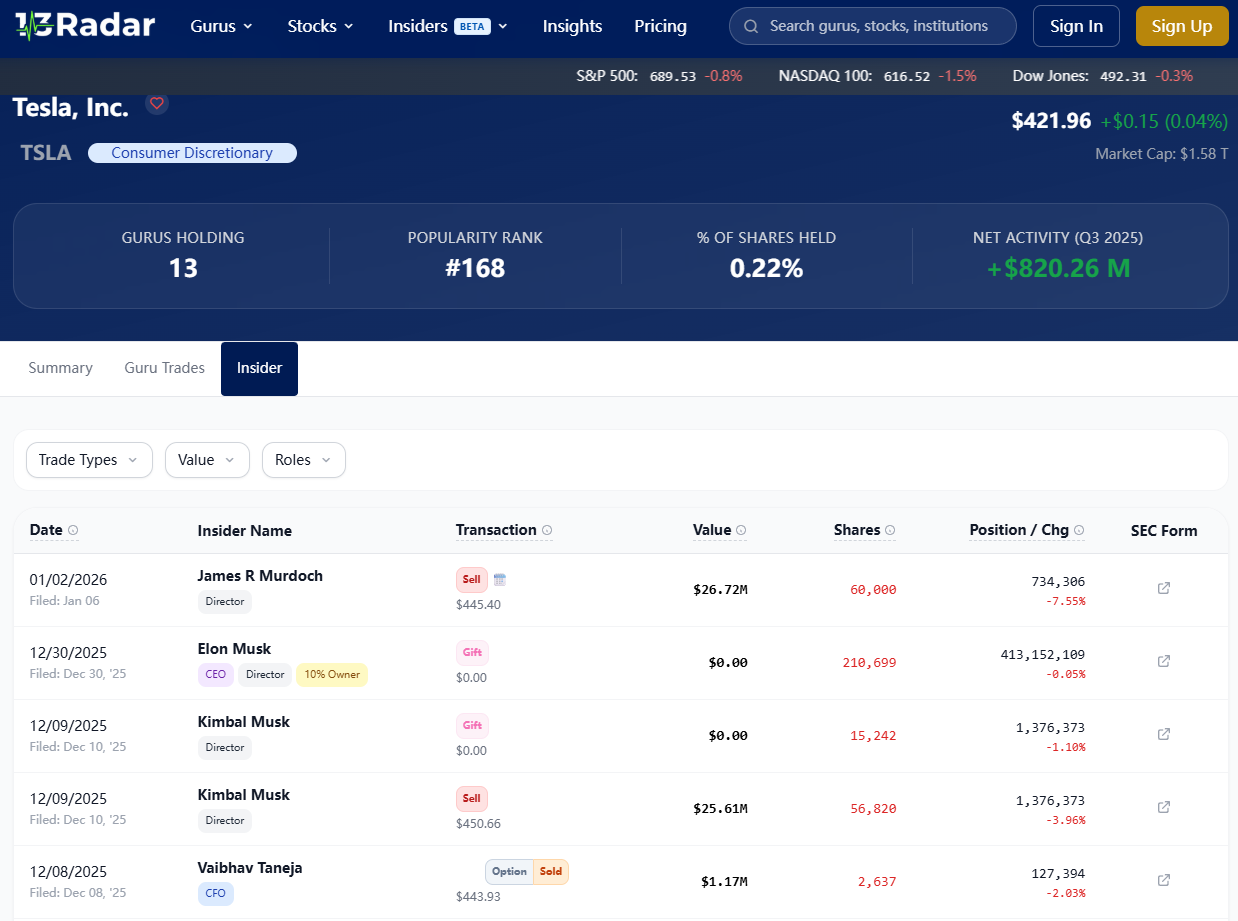
📊 2. NET OWNERSHIP: THE REAL METRIC TO WATCH
To truly understand insider sentiment, you must ignore the raw sales figures and track the Net Delta of beneficial ownership. By utilizing tools that aggregate TSLA Form 4 data, savvy investors can see that despite the frequent sell notifications, the total share count held by Tesla's inner circle often remains stable or growing. If the "smart money" were truly fleeing, we would see a rapid depletion of their total holdings, not just the mechanical churning of options.
3. Contextualizing the European Sales Slump
Recent reports of a sales dip in Europe have weighed on the stock. If insiders were genuinely panicked about this fundamental weakness, we would expect to see discretionary selling outside of 10b5-1 plans. The absence of panic-selling during this bad news cycle is, paradoxically, a bullish indicator. It suggests that leadership views the European softness as a temporary blip or a necessary cost of the pivot to the robotaxi model, rather than an existential threat warranting a cash-out.